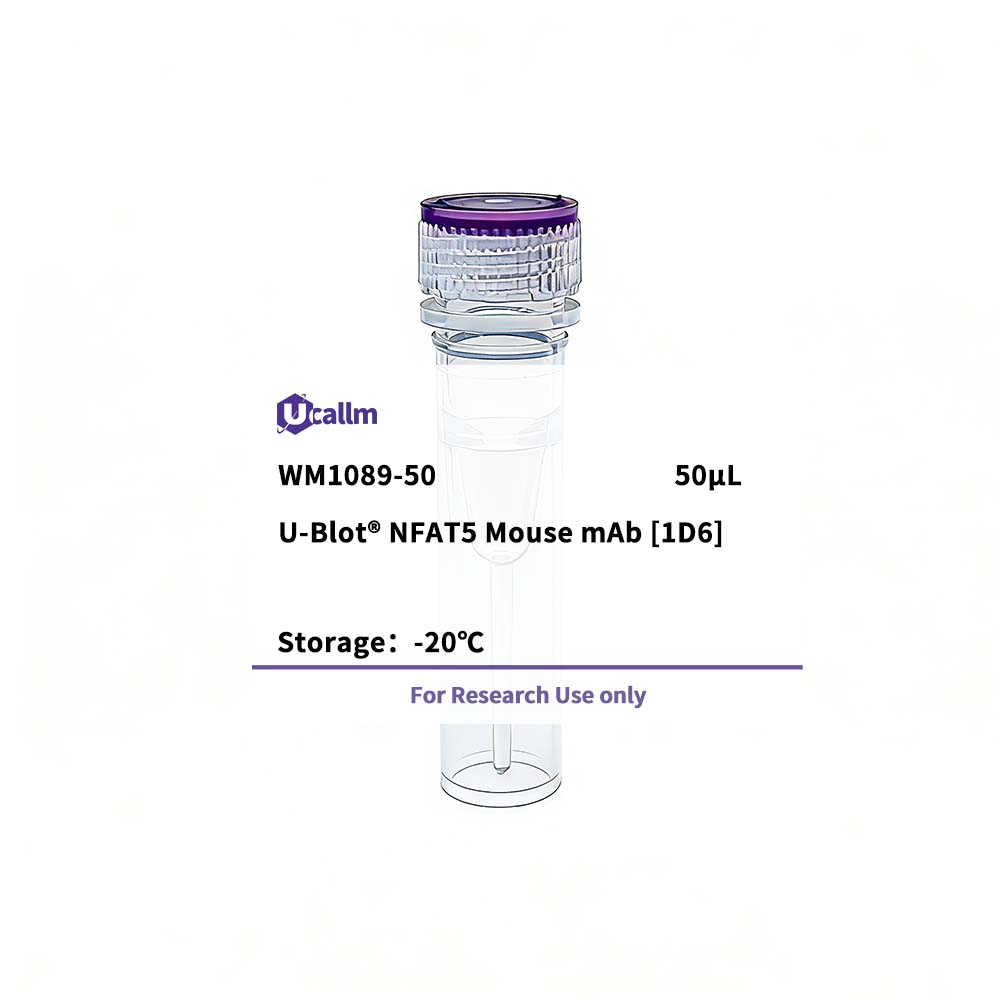
SKU: WM1089 Categories: ,

NFAT5 Mouse mAb [1D6]

Price range: $268.00 through $328.00

SKU: WM1089-50
Enter the quantity you would like, or drag the panel to find the quantity and price that best for you
Bulk QuoteAuthorize OEM & ODM

Product details

Background:
The product of this gene is a member of the nuclear factors of activated T cells family of transcription factors. Proteins belonging to this family play a central role in inducible gene transcription during the immune response. This protein regulates gene expression induced by osmotic stress in mammalian cells. Unlike monomeric members of this protein family, this protein exists as a homodimer and forms stable dimers with DNA elements. Multiple transcript variants encoding different isoforms have been found for this gene. [provided by RefSeq, Jul 2008],


Specifications

Size50μL/100μL
TargetNFAT5
ReactivityHuman, Mouse, Rat
ApplicationsIHC, WB
MW(Calculated)
MW(Observed)200kD
Host SpeciesMouse
Isotype
Conjugate/ModificationUnmodified
Recommended Dilution RatioIHC1:50-200; WB 1:1000-2000 / Note: For IHC, we suggest antigen retrieval with TE buffer pH 9.0 (Cat#WT1004)
FormulationLiquid in PBS containing 50% glycerol, 0.5% BSA and 0.02% sodium azide.
PurificationThe antibody was affinity-purified from mouse ascites by affinity-chromatography using specific immunogen.
Storage-15°C to -25°C/1 year(Do not lower than -25°C)
Concentration1 mg/ml
ClonalityMonoclonal
Clone Number1D6
ImmunogenSynthesized peptide derived from human NFAT5
SpecificityThis antibody detects endogenous levels of NFAT5 at Human, Mouse,Rat
Gene NameNFAT5 KIAA0827 TONEBP
Protein NameNFAT5
Other NameNuclear factor of activated T-cells 5; / NF-AT5; / T-cell transcription factor NFAT5; / Tonicity-responsive enhancer-binding protein; / TonE-binding protein; / TonEBP
SpeciesHuman
Gene ID10725
UniprotO94916,
Species.1Mouse
Gene ID.1
Uniprot.1Q9WV30
Species.2
Gene ID.2
Uniprot.2
Cellular LocalizationNucleus . Cytoplasm . Nuclear distribution increases under hypertonic conditions. .
Tissue ExpressionWidely expressed, with highest levels in skeletal muscle, brain, heart and peripheral blood leukocytes.
Signaling_pathway
Research Areas
FunctionAlternative products:Experimental confirmation may be lacking for some isoforms,Function:Plays a role in the inducible expression of genes. Regulates hypertonicity-induced cellular accumulation of osmolytes.,similarity:Contains 1 RHD (Rel-like) domain.,subunit:Does not bind with Fos and Jun transcription factors. But might be capable of forming stable dimers with DNA elements.,tissue specificity:Highest levels in skeletal muscle, brain, heart and peripheral blood leukocytes. Also expressed in placenta, lung, liver, kidney, pancreas, spleen, thymus, prostate, testis, ovary, small intestine and colon.,
Please login to post questions
Back to Top
Product has been added to your cart
