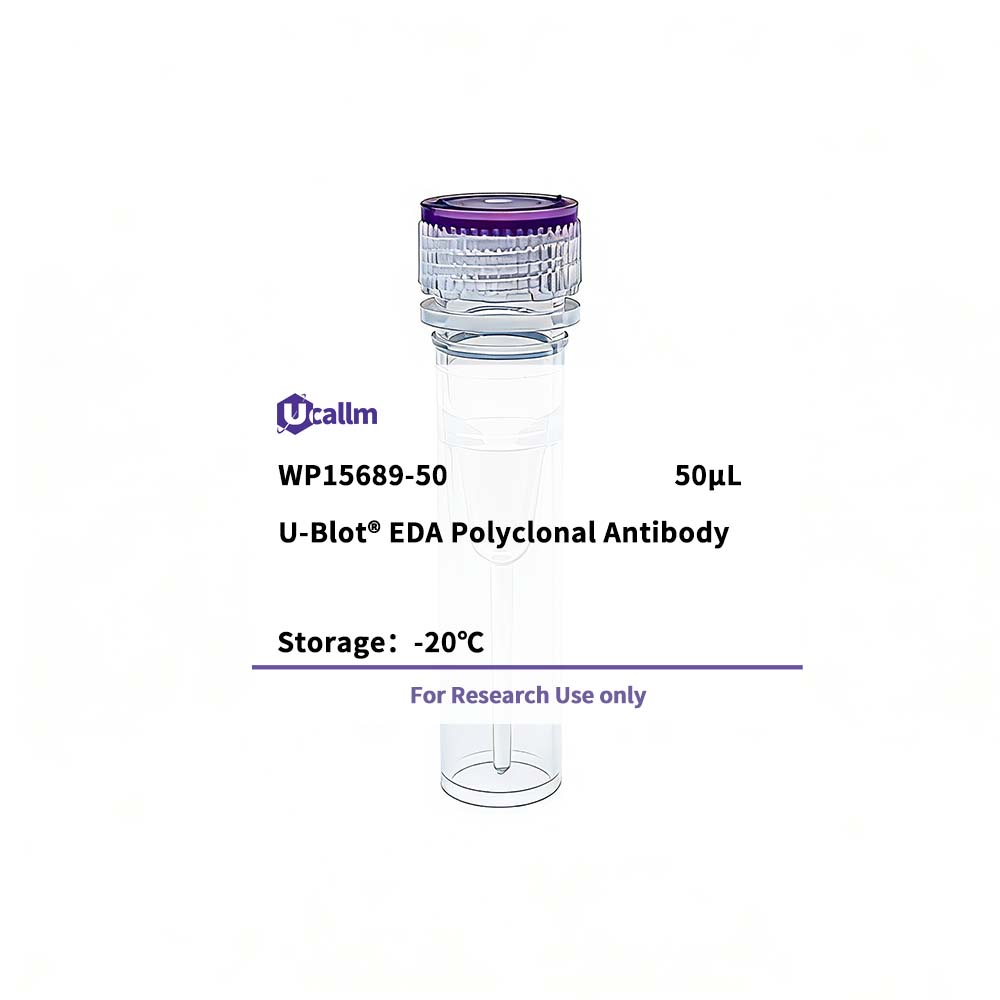
SKU: WP15689 Categories: ,

EDA Polyclonal Antibody

Price range: $268.00 through $328.00

SKU: WP15689-100
Enter the quantity you would like, or drag the panel to find the quantity and price that best for you
Bulk QuoteAuthorize OEM & ODM

Product details

Background:

The protein encoded by this gene is a type II membrane protein that can be cleaved by furin to produce a secreted form. The encoded protein, which belongs to the tumor necrosis factor family, acts as a homotrimer and may be involved in cell-cell signaling during the development of ectodermal organs. Defects in this gene are a cause of ectodermal dysplasia, anhidrotic, which is also known as X-linked hypohidrotic ectodermal dysplasia. Several transcript variants encoding many different isoforms have been found for this gene. [provided by RefSeq, Jul 2008],

Specifications

Size50μL/100μL
TargetEDA
ReactivityHuman, Mouse
ApplicationsWB, IHC, IF, ELISA
MW(Calculated)
MW(Observed)42kD
Host SpeciesRabbit
IsotypeIgG
Conjugate/ModificationUnmodified
Recommended Dilution RatioWB 1:500-1:2000; IHC: 1:100-1:300; ELISA 1:10000; IF 1:50-200 / Note: For IHC, we suggest antigen retrieval with TE buffer pH 9.0 (Cat#WT1004)
FormulationLiquid in PBS containing 50% glycerol, 0.5% BSA and 0.02% sodium azide.
PurificationThe antibody was affinity-purified from rabbit antiserum by affinity-chromatography using epitope-specific immunogen.
Storage-15°C to -25°C/1 year(Do not lower than -25°C)
Concentration1 mg/ml
ClonalityPolyclonal
Clone Number
ImmunogenThe antiserum was produced against synthesized peptide derived from the Internal region of human EDA. AA range:120-170
SpecificityEDA Polyclonal Antibody detects endogenous levels of EDA protein.
Gene NameEDA
Protein NameEctodysplasin-A
Other NameEDA; / ED1; / EDA2; / Ectodysplasin-A; / Ectodermal dysplasia protein; / EDA protein
SpeciesHuman
Gene ID1896
UniprotQ92838,
Species.1Mouse
Gene ID.113607
Uniprot.1O54693
Species.2
Gene ID.2
Uniprot.2
Cellular LocalizationCell membrane; Single-pass type II membrane protein .; [Ectodysplasin-A, secreted form]: Secreted .
Tissue ExpressionNot abundant; expressed in specific cell types of ectodermal (but not mesodermal) origin of keratinocytes, hair follicles, sweat glands. Also in adult heart, liver, muscle, pancreas, prostate, fetal liver, uterus, small intestine and umbilical chord.
Signaling_pathwayEnvironmental Information Processing >> Signal transduction >> NF-kappa B signaling pathway;Environmental Information Processing >> Signaling molecules and interaction >> Cytokine-cytokine receptor interaction
Research Areas>>Cytokine-cytokine receptor interaction; / >>NF-kappa B signaling pathway
FunctionAlternative products:Additional isoforms seem to exist,Disease:Defects in EDA are a cause of hypodontia [MIM:300606]. Hypodontia is agenesis of two or more permanent teeth without associated systemic disorders. Hypodontia due to EDA defects is an X-linked recessive disorder. Affected individuals have normal hair, skin, and nails, but lack primary and permanent teeth.,Disease:Defects in EDA are the cause of ectodermal dysplasia, type 1 (ED1) [MIM:305100]; also known as Christ-Siemens-Touraine syndrome or X-linked hypohidrotic ectodermal dysplasia (XLHED). Ectodermal dysplasia defines a heterogeneous group of disorders due to abnormal development of two or more ectodermal structures. ED1 is a disease characterized by sparse hair (atrichosis or hypotrichosis), abnormal or missing teeth and the inability to sweat due to the absence of sweat glands. ED1 is the most common form of over 150 clinically distinct ectodermal dysplasias.,Function:Seems to be involved in epithelial-mesenchymal signaling during morphogenesis of ectodermal organs. Isoform A1 binds only to the receptor EDAR, while isoform A2 binds exclusively to the receptor XEDAR.,PTM:N-glycosylated.,PTM:Processing by furin produces a secreted form.,similarity:Belongs to the tumor necrosis factor family.,similarity:Contains 1 collagen-like domain.,subunit:Homotrimer. The homotrimers may then dimerize and form higher order oligomers.,tissue specificity:Not abundant; expressed in specific cell types of ectodermal (but not mesodermal) origin of keratinocytes, hair follicles, sweat glands. Also in adult heart, liver, muscle, pancreas, prostate, fetal liver, uterus, small intestine and umbilical chord.,
Please login to post questions
Back to Top
Product has been added to your cart

