

Product details
Background:
This gene encodes a protein that may be involved in kinetochore-microtubule interaction and spindle checkpoint activity. [provided by RefSeq, Jul 2008],
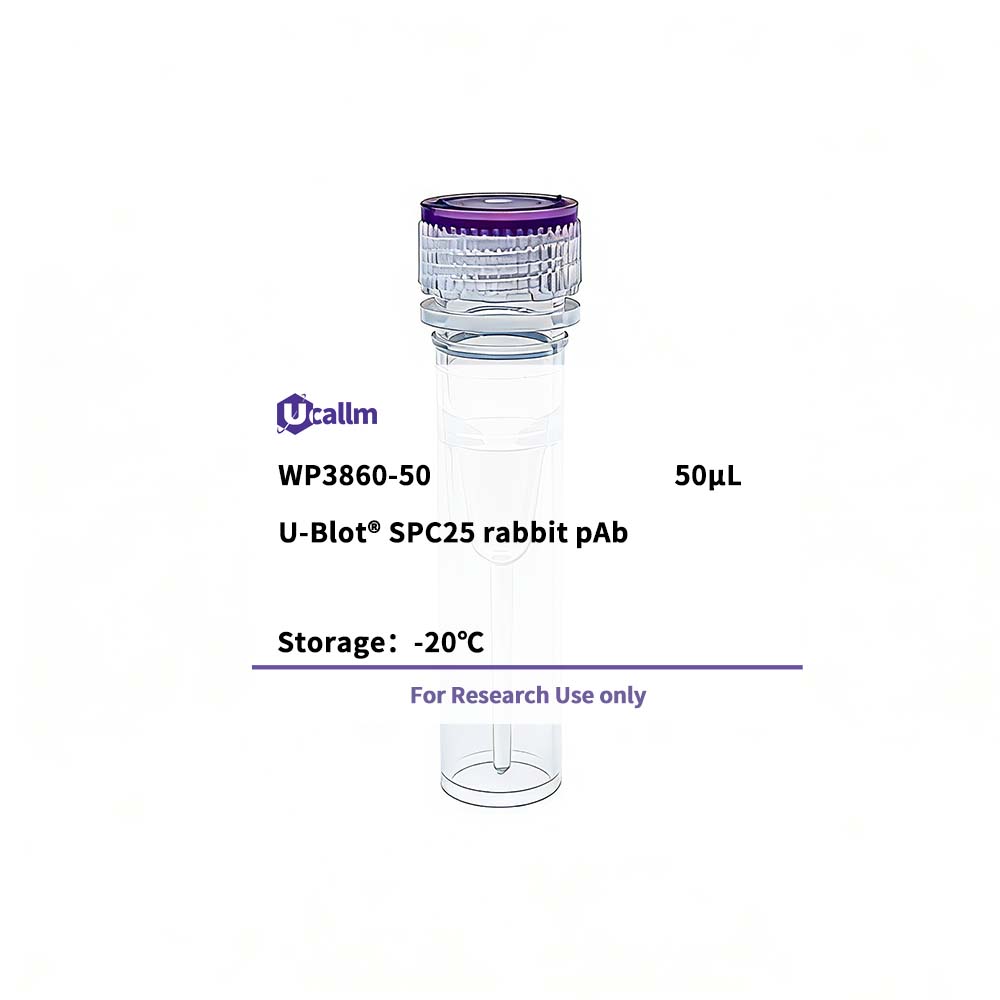
Price range: $268.00 through $328.00
Background:
This gene encodes a protein that may be involved in kinetochore-microtubule interaction and spindle checkpoint activity. [provided by RefSeq, Jul 2008],
| Size | 50μL/100μL |
| Target | SPC25 |
| Reactivity | Human, Mouse, Rat |
| Applications | WB |
| MW(Calculated) | 25kD |
| MW(Observed) | |
| Host Species | Rabbit |
| Isotype | IgG |
| Conjugate/Modification | Unmodified |
| Recommended Dilution Ratio | WB 1:500-2000 |
| Formulation | Liquid in PBS containing 50% glycerol, 0.5% BSA and 0.02% sodium azide. |
| Purification | The antibody was affinity-purified from rabbit antiserum by affinity-chromatography using epitope-specific immunogen. |
| Storage | -15°C to -25°C/1 year(Do not lower than -25°C) |
| Concentration | 1 mg/ml |
| Clonality | Polyclonal |
| Clone Number | |
| Immunogen | Synthesized peptide derived from human SPC25 AA range: 17-67 |
| Specificity | This antibody detects endogenous levels of SPC25 at Human/Mouse/Rat |
| Gene Name | SPC25 SPBC25 AD024 |
| Protein Name | SPC25 |
| Other Name | |
| Species | Human |
| Gene ID | 57405 |
| Uniprot | Q9HBM1, |
| Species.1 | Mouse |
| Gene ID.1 | 66442 |
| Uniprot.1 | Q3UA16, |
| Species.2 | Rat |
| Gene ID.2 | 295661 |
| Uniprot.2 | Q5M856 |
| Cellular Localization | Nucleus. Chromosome, centromere, kinetochore . Localizes to kinetochores from late prophase to anaphase (PubMed:14738735). Localizes specifically to the outer plate of the kinetochore (PubMed:14738735, PubMed:14699129). . |
| Tissue Expression | |
| Signaling_pathway | |
| Research Areas | |
| Function | Function:Acts as a component of the essential kinetochore-associated NDC80 complex, which is required for chromosome segregation and spindle checkpoint activity. Required for kinetochore integrity and the organization of stable microtubule binding sites in the outer plate of the kinetochore.,similarity:Belongs to the SPC25 family.,subcellular location:Localizes to kinetochores from late prophase to anaphase. Localizes specifically to the outer plate of the kinetochore.,subunit:Component of the NDC80 complex, which consists of NDC80/HEC1, CDCA1, SPBC24 and SPBC25. The NDC80 complex is formed by two subcomplexes composed of NDC80/HEC1-CDCA1 and SPBC24-SPBC25. Each subcomplex is formed by parallel interactions through the coiled-coil domains of individual subunits. Formation of a tetrameric complex is mediated by interactions between the C-terminal regions of both subunits of the NDC80/HEC1-CDCA1 subcomplex and the N-terminal regions of both subunits of the SPBC24-SPBC25 complex. The tetrameric NDC80 complex has an elongated rod-like structure with globular domains at either end., |





