

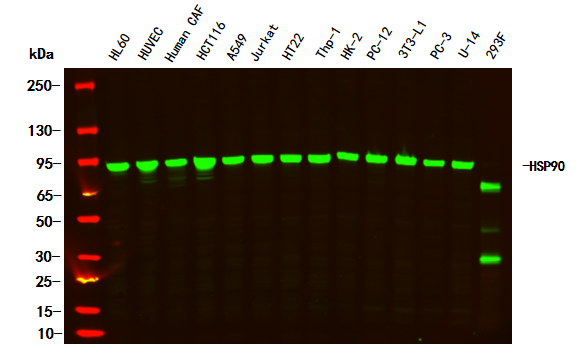
Background:HSP90 encodes a member of the heat shock protein 90 family; these proteins are involved in signal transduction, protein folding and degradation and morphological evolution. This gene encodes the constitutive form of the cytosolic 90 kDa heat-shock protein and is thought to play a role in gastric apoptosis and inflammation. Alternative splicing results in multiple transcript variants. Pseudogenes have been identified on multiple chromosomes.
| Reagents Information | ||
|---|---|---|
| Category | Name/Description | Details |
| Antibody | HSP90 Rabbit mAb | WR4008 |
| Membrane | 0.22 Nitrocellulose Membrane | W3N21 |
| Protein Marker | pre-staining standard protein Marker(10-250kDa) | W2101 |
| Lane Cell Types | ||
| Lane | Cell Type | Description |
| Lane1 | HL60 | Human promyelocytic leukemia cell |
| Lane2 | HUVEC | Human umbilical vein endothelial cell |
| Lane3 | Human CAF | Human cancer-associated fibroblast |
| Lane4 | HCT116 | Human colorectal carcinoma |
| Lane5 | A549 | Human lung carcinoma |
| Lane6 | Jurkat | Human T lymphocyte leukemia |
| Lane7 | HT22 | Mouse hippocampal neuronal |
| Lane8 | Thp-1 | Human monocytic leukemia |
| Lane9 | HK-2 | Human proximal tubular epithelial |
| Lane10 | PC-12 | Rat adrenal pheochromocytoma |
| Lane11 | 3T3-L1 | Mouse embryonic fibroblast cells |
| Lane12 | PC-3 | Human prostate adenocarcinoma |
| Lane13 | U-14 | Mouse cervical carcinoma |
| Lane14 | 293F | HEK293 derivative, adapted for suspension culture |
| Experimental Conditions | ||
| Category | Parameter | Details |
| Electrophoresis | SDS-PAGE | 4-20% |
| Primary Antibody Incubation | Temperature, Time, Dilution | 4°C, over night, 1:2500 |
| Secondary Antibody | Dylight 800-conjugated Goat anti-Rabbit antibody | Cat:WS0446 |
| Band Sizes | |
| Type | Size |
| Predicted | 85 kDa |
| Observed | 85 kDa |
Elevate your heat shock protein research with the HSP90 Rabbit Monoclonal Antibody (Cat. WR4008). This high-specificity reagent is validated across 14 diverse cell lines (human, mouse, rat, including HL60, A549, HCT116, and more) via 4-20% SDS-PAGE, delivering consistent results with a 1:2500 dilution and overnight incubation at 4°C. Targeting HSP90—a key player in signal transduction, protein folding, and gastric apoptosis/inflammation—this antibody ensures a predicted and observed band size of 85 kDa, making it ideal for Western Blot applications in cell biology, oncology, and inflammation research. Optimize your experiments with a tool trusted for its reliability: choose the HSP90 Rabbit Monoclonal Antibody for precise detection and breakthrough insights into heat shock protein pathways.
Leave a Comment
Your email address will not be published. Required fields are marked *