SKU: WP11179 Categories: ,

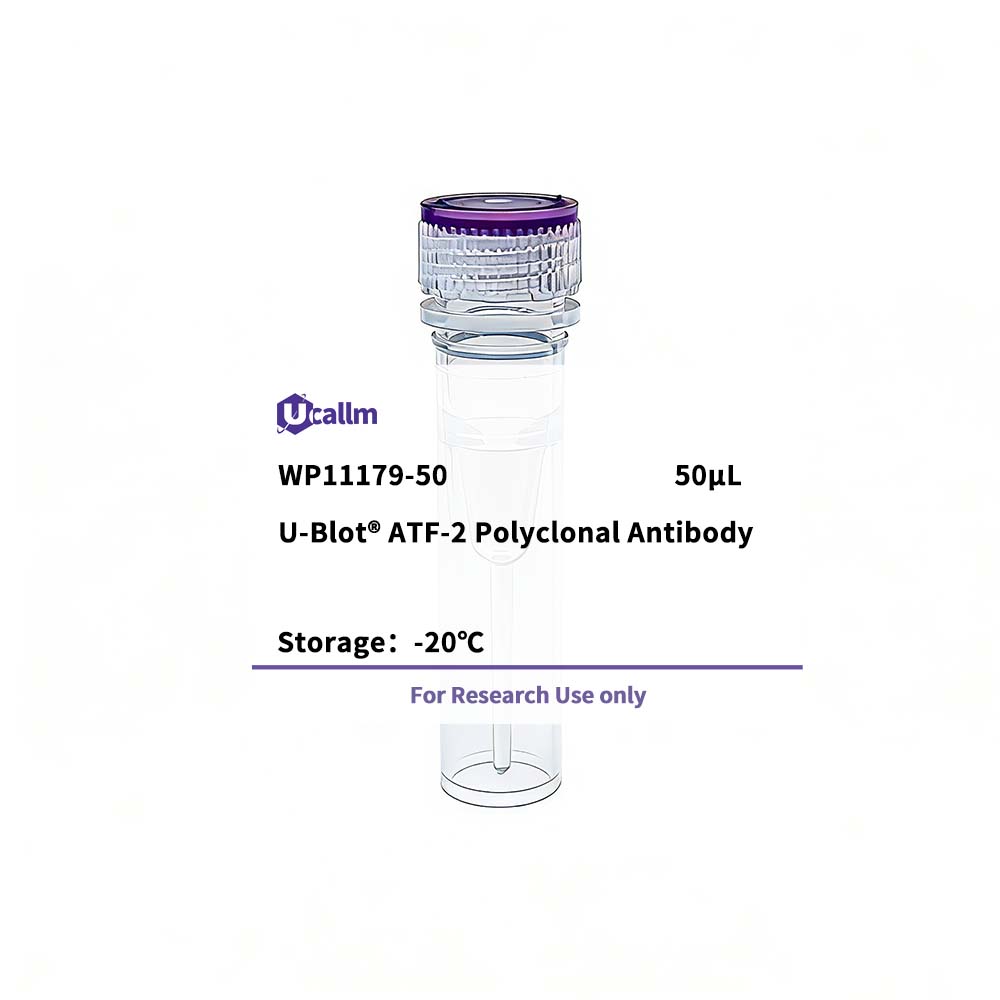
ATF-2 Polyclonal Antibody

Price range: $268.00 through $328.00

SKU: WP11179-100
Enter the quantity you would like, or drag the panel to find the quantity and price that best for you
Bulk QuoteAuthorize OEM & ODM

Product details

Background:

activating transcription factor 2(ATF2) Homo sapiens This gene encodes a transcription factor that is a member of the leucine zipper family of DNA binding proteins. The encoded protein has been identified as a moonlighting protein based on its ability to perform mechanistically distinct functions This protein binds to the cAMP-responsive element (CRE), an octameric palindrome. It forms a homodimer or a heterodimer with c-Jun and stimulates CRE-dependent transcription. This protein is also a histone acetyltransferase (HAT) that specifically acetylates histones H2B and H4 in vitro; thus it may represent a class of sequence-specific factors that activate transcription by direct effects on chromatin components. The encoded protein may also be involved in cell's DNA damage response independent of its role in transcriptional regulation. Several alternatively spliced transcript variants have been found for this gene [provided by RefSeq, Jan 2014
Specifications

TargetATF-2
ReactivityHuman, Mouse, Rat
ApplicationsWB, IHC, IF, IP, ELISA
MW(Calculated)
MW(Observed)52kD
Host SpeciesRabbit
IsotypeIgG
Conjugate/ModificationUnmodified
Modification
Recommended Dilution RatioWB 1:500-1:2000; IHC 1:100-1:300; IP 2-5 ug/mg lysate; ELISA 1:10000; IF 1:50-200 / Note: For IHC, we suggest antigen retrieval with TE buffer pH 9.0 (Cat#YS0004)
FormulationLiquid in PBS containing 50% glycerol, 0.5% BSA and 0.02% sodium azide.
Source
PurificationThe antibody was affinity-purified from rabbit antiserum by affinity-chromatography using epitope-specific immunogen.
Purity
Storage-15°C to -25°C/1 year(Do not lower than -25°C)
Concentration1 mg/ml
ClonalityPolyclonal
Clone Number
ImmunogenThe antiserum was produced against synthesized peptide derived from human ATF2. AA range:29-78
Sequence
SpecificityATF-2 Polyclonal Antibody detects endogenous levels of ATF-2 protein.
Gene NameATF2
Protein NameCyclic AMP-dependent transcription factor ATF-2
Other NameATF2; / CREB2; / CREBP1; / Cyclic AMP-dependent transcription factor ATF-2; / cAMP-dependent transcription factor ATF-2; / Activating transcription factor 2; / Cyclic AMP-responsive element-binding protein 2; / CREB-2; / cAMP-responsive element-binding pro
SpeciesHuman
Gene ID-11386
UniprotP15336,
Species.1Mouse
Gene ID-211909
Uniprot.1P16951,
Species.2Rat
Gene ID-381647
Uniprot.2Q00969
Organism-4
Gene ID-4
SwissProt-4
Backgroundactivating transcription factor 2(ATF2) Homo sapiens This gene encodes a transcription factor that is a member of the leucine zipper family of DNA binding proteins. The encoded protein has been identified as a moonlighting protein based on its ability to perform mechanistically distinct functions This protein binds to the cAMP-responsive element (CRE), an octameric palindrome. It forms a homodimer or a heterodimer with c-Jun and stimulates CRE-dependent transcription. This protein is also a histone acetyltransferase (HAT) that specifically acetylates histones H2B and H4 in vitro; thus it may represent a class of sequence-specific factors that activate transcription by direct effects on chromatin components. The encoded protein may also be involved in cell' s DNA damage response independent of its role in transcriptional regulation. Several alternatively spliced transcript variants have been found for this gene [provided by RefSeq, Jan 2014
Cellular LocalizationNucleus. Cytoplasm. Mitochondrion outer membrane. Shuttles between the cytoplasm and the nucleus and heterodimerization with JUN is essential for the nuclear localization. Localization to the cytoplasm is observed under conditions of cellular stress and in disease states. Localizes at the mitochondrial outer membrane in response to genotoxic stress. Phosphorylation at Thr-52 is required for its nuclear localization and negatively regulates its mitochondrial localization. Co-localizes with the MRN complex in the IR-induced foci (IRIF).
Tissue ExpressionUbiquitously expressed, with more abundant expression in the brain.
Signaling_pathwayOrganismal Systems >> Endocrine system >> Insulin secretion;Organismal Systems >> Endocrine system >> Glucagon signaling pathway;Organismal Systems >> Endocrine system >> Estrogen signaling pathway;Organismal Systems >> Endocrine system >> Relaxin signaling pathway;Organismal Systems >> Endocrine system >> Growth hormone synthesis, secretion and action;Organismal Systems >> Endocrine system >> Aldosterone synthesis and secretion;Organismal Systems >> Circulatory system >> Adrenergic signaling in cardiomyocytes;Organismal Systems >> Nervous system >> Dopaminergic synapse;Organismal Systems >> Aging >> Longevity regulating pathway;Human Diseases >> Neurodegenerative disease >> Prion disease;Environmental Information Processing >> Signal transduction >> MAPK signaling pathway;Environmental Information Processing >> Signal transduction >> TNF signaling pathway;Environmental Information Processing >> Signal transduction >> cGMP-PKG signaling pathway;Environmental Information Processing >> Signal transduction >> PI3K-Akt signaling pathway
Research Areas>>MAPK signaling pathway; / >>cGMP-PKG signaling pathway; / >>PI3K-Akt signaling pathway; / >>Longevity regulating pathway; / >>Adrenergic signaling in cardiomyocytes; / >>TNF signaling pathway; / >>Thermogenesis; / >>Dopaminergic synapse; / >>Insulin secretion; / >>Estrogen signaling pathway; / >>Thyroid hormone synthesis; / >>Glucagon signaling pathway; / >>Aldosterone synthesis and secretion; / >>Relaxin signaling pathway; / >>Cortisol synthesis and secretion; / >>Parathyroid hormone synthesis, secretion and action; / >>Cushing syndrome; / >>Growth hormone synthesis, secretion and action; / >>Prion disease; / >>Cocaine addiction; / >>Amphetamine addiction; / >>Alcoholism; / >>Hepatitis B; / >>Human cytomegalovirus infection; / >>Human T-cell leukemia virus 1 infection; / >>Viral carcinogenesis; / >>Chemical carcinogenesis - receptor activation
FunctionCaution:It is uncertain whether Met-1 or Met-19 is the initiator.,Function:Transcriptional activator, probably constitutive, which binds to the cAMP-responsive element (CRE) (consensus: 5'-GTGACGT[AC][AG]-3'), a sequence present in many viral and cellular promoters. Interaction with JUN redirects JUN to bind to CRES preferentially over the 12-O-tetradecanoylphorbol-13-acetate response elements (TRES) as part of an ATF2-c-Jun complex.,PTM:Phosphorylation of Thr-69 and Thr-71 by MAPK14 causes increased transcriptional activity. Also phosphorylated and activated by JNK.,similarity:Belongs to the bZIP family.,similarity:Belongs to the bZIP family. ATF subfamily.,similarity:Contains 1 bZIP domain.,similarity:Contains 1 C2H2-type zinc finger.,subunit:Binds DNA as a dimer and can form a homodimer in the absence of DNA. Can form a heterodimer with JUN. Interacts with SMAD3 and SMAD4. Binds through its N-terminal region to UTF1 which acts as a coactivator of ATF2 transcriptional activity.,tissue specificity:Abundant expression seen in the brain.,
RRID
Please login to post questions
Back to Top
Product has been added to your cart