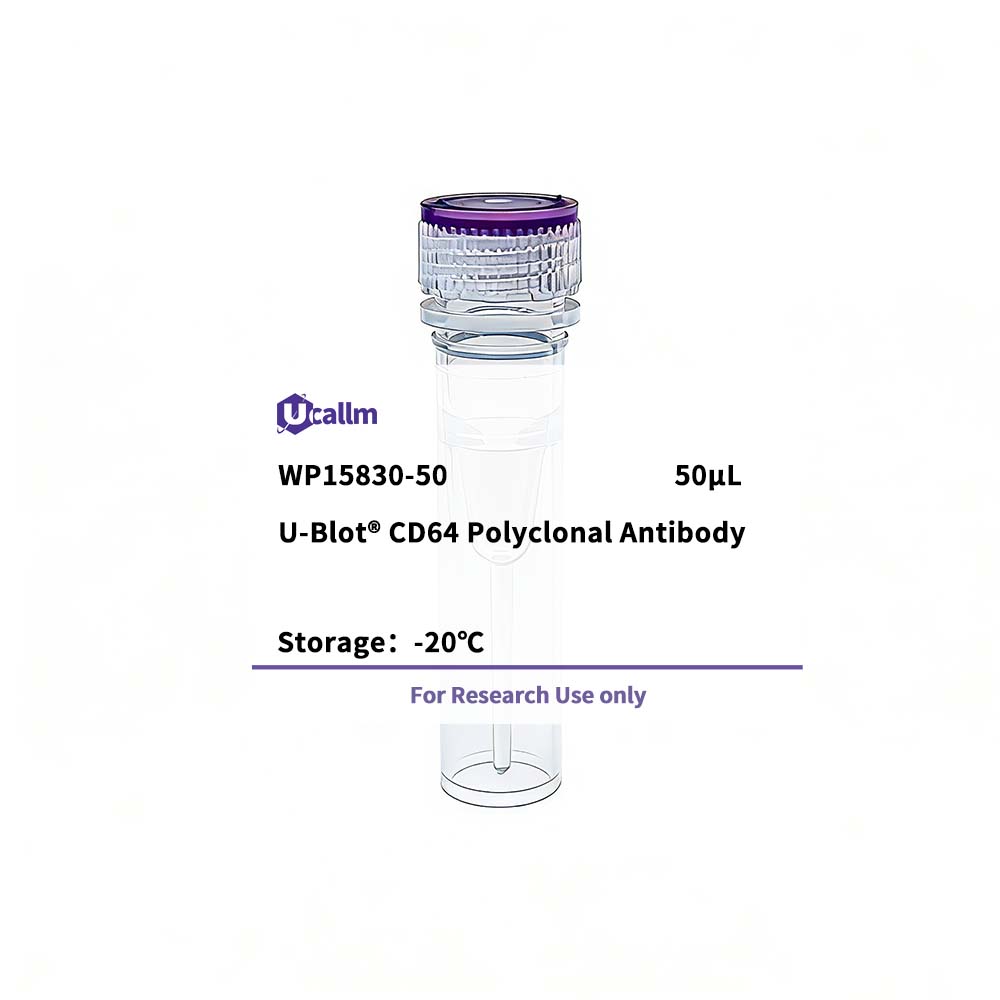
SKU: WP15830 Categories: ,

CD64 Polyclonal Antibody

Price range: $268.00 through $328.00

SKU: WP15830-100
Enter the quantity you would like, or drag the panel to find the quantity and price that best for you
Bulk QuoteAuthorize OEM & ODM

Product details

Background:

This gene encodes a protein that plays an important role in the immune response. This protein is a high-affinity Fc-gamma receptor. The gene is one of three related gene family members located on chromosome 1. [provided by RefSeq, Jul 2008],

Specifications

Size50μL/100μL
TargetCD64
ReactivityHuman
ApplicationsWB, IHC, IF, ELISA
MW(Calculated)
MW(Observed)45kD
Host SpeciesRabbit
IsotypeIgG
Conjugate/ModificationUnmodified
Recommended Dilution RatioWB 1:500-2000; IHC 1:50-200; ELISA 1:10000-20000; IF 1:50-200 / Note: For IHC, we suggest antigen retrieval with TE buffer pH 9.0 (Cat#WT1004)
FormulationLiquid in PBS containing 50% glycerol, 0.5% BSA and 0.02% sodium azide.
PurificationThe antibody was affinity-purified from rabbit antiserum by affinity-chromatography using epitope-specific immunogen.
Storage-15°C to -25°C/1 year(Do not lower than -25°C)
Concentration1 mg/ml
ClonalityPolyclonal
Clone Number
ImmunogenSynthetic peptide from human protein at AA range: 230-280
SpecificityThe antibody detects endogenous CD64
Gene NameFCGR1A FCG1 FCGR1 IGFR1
Protein NameHigh affinity immunoglobulin gamma Fc receptor I (IgG Fc receptor I) (Fc-gamma RI) (FcRI) (Fc-gamma RIA) (FcgammaRIa) (CD antigen CD64)
Other NameHigh affinity immunoglobulin gamma Fc receptor I; / IgG Fc receptor I; / Fc-gamma RI; / FcRI; / Fc-gamma RIA; / FcgammaRIa; / CD antigen CD64
SpeciesHuman
Gene ID2209
UniprotP12314,
Species.1Mouse
Gene ID.114129
Uniprot.1P26151
Species.2
Gene ID.2
Uniprot.2
Cellular LocalizationCell membrane; Single-pass type I membrane protein . Stabilized at the cell membrane through interaction with FCER1G.
Tissue ExpressionMonocyte/macrophage specific.
Signaling_pathwayCellular Processes >> Transport and catabolism >> Phagosome;Organismal Systems >> Immune system >> Hematopoietic cell lineage;Organismal Systems >> Immune system >> Neutrophil extracellular trap formation;Organismal Systems >> Immune system >> Fc gamma R-mediated phagocytosis;Organismal Systems >> Development and regeneration >> Osteoclast differentiation;Human Diseases >> Cancer: overview >> Transcriptional misregulation in cancer;Human Diseases >> Cancer: specific types >> Acute myeloid leukemia;Human Diseases >> Immune disease >> Systemic lupus erythematosus
Research Areas>>Phagosome; / >>Osteoclast differentiation; / >>Neutrophil extracellular trap formation; / >>Hematopoietic cell lineage; / >>Fc gamma R-mediated phagocytosis; / >>Leishmaniasis; / >>Staphylococcus aureus infection; / >>Tuberculosis; / >>Transcriptional misregulation in cancer; / >>Acute myeloid leukemia; / >>Systemic lupus erythematosus
FunctionFunction:High affinity receptor for the Fc region of immunoglobulins gamma. Functions in both innate and adaptive immune responses.,online information:FCGR1A mutation db,PTM:N-glycosylated.,PTM:Phosphorylated on serine residues.,similarity:Belongs to the immunoglobulin superfamily. FCGR1 family.,similarity:Contains 3 Ig-like C2-type (immunoglobulin-like) domains.,subcellular location:Stabilized at the cell membrane through interaction with FCER1G.,subunit:Interacts with FCERG1; forms a functional signaling complex. Interacts with FLNA; prevents FCGR1A degradation. Interacts with EPB41L2, LAT and PPL.,tissue specificity:Monocyte/macrophage specific.,
Please login to post questions
Back to Top
Product has been added to your cart