SKU: WR4542 Categories: ,

U-Blot® Collagen I Rabbit mAb

Price range: $268.00 through $328.00

SKU: WR4542-50
Enter the quantity you would like, or drag the panel to find the quantity and price that best for you
Bulk QuoteAuthorize OEM & ODM

Product details

Background:Type I collagen is an important component of extracellular matrix, which is mainly distributed in cornea, skin, bone, tendon and other tissues. It is mainly used to study the distribution of connective tissue proteins, epithelial / mesothelial interaction and basement membrane.

Specifications

Size50μL/100μL
TargetCollagen I
ReactivityHuman, Mouse, Rat
ApplicationsWB, IHC, IF, ELISA
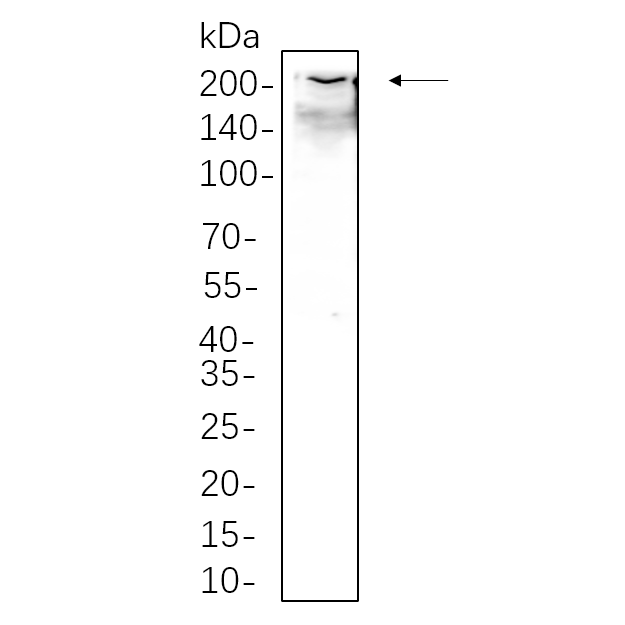
MW(Calculated)139kD
MW(Observed)220kD
Host SpeciesRabbit
IsotypeIgG,Kappa
Conjugate/ModificationUnmodified
Recommended Dilution RatioIHC 1:200-1:1000; WB 1:2000-1:10000; IF 1:200-1:1000; ELISA 1:5000-1:20000; / Note: For IHC, we suggest antigen retrieval with TE buffer pH 9.0 (Cat#WT1004)
Formulation
PurificationRecombinant Antibody expressed in animal component-free (ACF) media, purified via Protein A affinity chromatography.
Storage-15°C to -25°C/1 year(Do not lower than -25°C)
Concentration
ClonalityMonoclonal
Clone NumberRM0817R
ImmunogenThe specific immunogen used to produce this antibody is proprietary information.
SpecificityEndogenous
Gene NameCOL1A1
Protein NameCollagen I α1 (Cleaved-Ala1218)
Other NameAlpha 1 collagen type I; / Alpha 1 type I collagen; / Alpha 1 type I procollagen; / Alpha 1; / I; / collagen; / Alpha 1; / I; / procollagen; / Alpha-1 type I collagen; / CO1A1_HUMAN; / COL1A1; / Collagen alpha 1; / I; / chain; / Collagen alpha-1; / I; / chain; / Collagen I alpha 1 polypeptide; / Collagen of skin tendon and bone alpha 1 chain; / Collagen type I alpha 1
SpeciesHuman
Gene ID1277
UniprotP02452,
Species.1Mouse
Gene ID.112842
Uniprot.1P11087,
Species.2Rat
Gene ID.229393
Uniprot.2P02454
Cellular LocalizationSecreted, extracellular space, extracellular matrix .
Tissue ExpressionForms the fibrils of tendon, ligaments and bones. In bones the fibrils are mineralized with calcium hydroxyapatite.
Signaling_pathwayCellular Processes >> Cellular community - eukaryotes >> Focal adhesion;Organismal Systems >> Immune system >> Platelet activation;Organismal Systems >> Endocrine system >> Relaxin signaling pathway;Environmental Information Processing >> Signal transduction >> PI3K-Akt signaling pathway;Environmental Information Processing >> Signaling molecules and interaction >> ECM-receptor interaction
Research Areas>>PI3K-Akt signaling pathway; / >>Focal adhesion; / >>ECM-receptor interaction; / >>Platelet activation; / >>Relaxin signaling pathway; / >>AGE-RAGE signaling pathway in diabetic complications; / >>Protein digestion and absorption; / >>Amoebiasis; / >>Human papillomavirus infection; / >>Proteoglycans in cancer; / >>Diabetic cardiomyopathy
FunctionDisease:A chromosomal aberration involving COL1A1 is a cause of dermatofibrosarcoma protuberans (DFSP) [MIM:607907]. Translocation t(17; 22)(q22; q13) with PDGF. DFSP is an uncommon, locally aggressive, but rarely metastasizing tumor of the deep dermis and subcutaneous tissue. It typically occurs during early or middle adult life and is most frequently located on the trunk and proximal extremities.,Disease:Defects in COL1A1 are a cause of Ehlers-Danlos syndrome type 1 (EDS1) [MIM:130000]; also known as Ehlers-Danlos syndrome gravis. EDS is a connective tissue disorder characterized by hyperextensible skin, atrophic cutaneous scars due to tissue fragility and joint hyperlaxity. EDS1 is the severe form of classic Ehlers-Danlos syndrome.,Disease:Defects in COL1A1 are a cause of osteogenesis imperfecta type I (OI-I) [MIM:166200]. OI-I is a dominantly inherited serious newborn disease characterized by bone fragility, normal stature, little or no deformity, blue sclerae and hearing loss in 50% of families. Dentinogenesis imperfecta is rare and may distinguish a subset of OI type I (formation of dentine).,Disease:Defects in COL1A1 are a cause of osteogenesis imperfecta type II (OI-II) [MIM:166210]; also known as osteogenesis imperfecta congenita. OI-II is lethal in the perinatal period and is charaterized by calvarial mineralization, beaded ribs, compressed femurs, marked long bone deformity and platyspondyly (congenital flattening of the vertebral bodies).,Disease:Defects in COL1A1 are a cause of osteogenesis imperfecta type III (OI-III) [MIM:259420]; also called progressively deforming osteogenesis imperfecta with normal sclerae. OI-III is characterized by progressively deforming bones, usually with moderate deformity at birth, sclerae is variable in color, dentinogenesis imperfecta and hearing loss are common. The stature is very short.,Disease:Defects in COL1A1 are a cause of osteogenesis imperfecta type IV (OI-IV) [MIM:166220]. OI-IV is charaterized by normal sclerae, moderate to mild deformity and variable short stature. Dentinogenesis imperfecta is common and hearing loss occurs in some patients.,Disease:Defects in COL1A1 are the cause of Caffey disease [MIM:114000]; also known as infantile cortical hyperostosis. Caffey disease is characterized by an infantile episode of massive subperiosteal new bone formation that typically involves the diaphyses of the long bones, mandible, and clavicles. The involved bones may also appear inflamed, with painful swelling and systemic fever often accompanying the illness. The bone changes usually begin before 5 months of age and resolve before 2 years of age.,Disease:Defects in COL1A1 are the cause of Ehlers-Danlos syndrome type 7A (EDS7A) [MIM:130060]; also known as autosomal dominant Ehlers-Danlos syndrome type VII. EDS is a connective tissue disorder characterized by hyperextensible skin, atrophic cutaneous scars due to tissue fragility and joint hyperlaxity. EDS7A is marked by bilateral congenital hip dislocation, hyperlaxity of the joints, and recurrent partial dislocations.,Disease:Genetic variations in COL1A1 are associated with susceptibility to involutional osteoporosis [MIM:166710]; also known as senile osteoporosis or postmenopausal osteoporosis. Osteoporosis is characterized by reduced bone mineral density, disrutption of bone microarchitecture, and the alteration of the amount and variety of non-collagenous proteins in bone. Osteoporotic bones are more at risk of fracture.,Function:Type I collagen is a member of group I collagen (fibrillar forming collagen).,online information:Collagen type I alpha-1 chain mutations,online information:Type-I collagen entry,PTM:O-linked glycan consists of a Glc-Gal disaccharide bound to the oxygen atom of a post-translationally added hydroxyl group.,PTM:Proline residues at the third position of the tripeptide repeating unit (G-X-Y) are hydroxylated in some or all of the chains.,similarity:Belongs to the fibrillar collagen family.,similarity:Contains 1 VWFC domain.,subunit:Trimers of one alpha 2(I) and two alpha 1(I) chains. Interacts with MRC2.,tissue specificity:Forms the fibrils of tendon, ligaments and bones. In bones the fibrils are mineralized with calcium hydroxyapatite.,
Please login to post questions

Back to Top
Product has been added to your cart