

- Please choose product options by visiting U-Blot® mitF/aspF1 Antibody.
- Please choose product options by visiting U-Blot® MIF Reference Antibody (imalumab).
- Please choose product options by visiting U-Blot® Mesothelin Reference Antibody (BMS-986148).
- Please choose product options by visiting U-Blot® Mesothelin Reference Antibody (anetumab).
- Please choose product options by visiting U-Blot® MMP9 Reference Antibody (andecaliximab).
- Please choose product options by visiting U-Blot® MICA Reference Antibody (CLN-619).
- Please choose product options by visiting U-Blot® Monkeypox virus/MPXV A29L Antibody (A96).
- Please choose product options by visiting U-Blot® Monkeypox virus/MPXV A29L Mouse Antibody (B147).
- Please choose product options by visiting U-Blot® Monkeypox virus/MPXV A29L nanobody (A229).
- Please choose product options by visiting U-Blot® Monkeypox virus/MPXV A29L Mouse Antibody (B057).
- Please choose product options by visiting U-Blot® Monkeypox virus/MPXV A30L Mouse Antibody (A015).
- Please choose product options by visiting U-Blot® MICB Reference Antibody (U.Washington patent anti-MICB).
CYCS Polyclonal Antibody
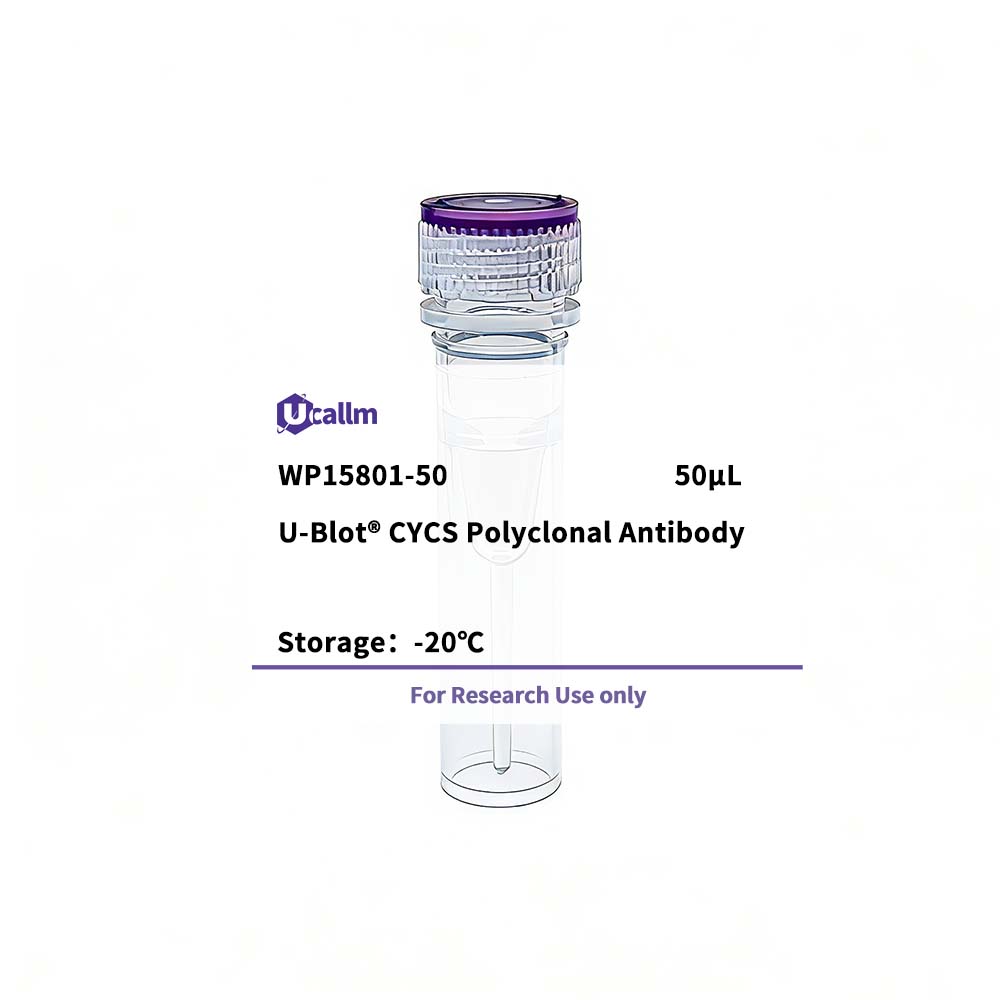
Ucallm_WP15801-50
Price range: $268.00 through $328.00
Product details
Background:
This gene encodes a small heme protein that functions as a central component of the electron transport chain in mitochondria. The encoded protein associates with the inner membrane of the mitochondrion where it accepts electrons from cytochrome b and transfers them to the cytochrome oxidase complex. This protein is also involved in initiation of apoptosis. Mutations in this gene are associated with autosomal dominant nonsyndromic thrombocytopenia. Numerous processed pseudogenes of this gene are found throughout the human genome.[provided by RefSeq, Jul 2010],
Specifications
| Size | 50μL/100μL |
| Target | Cytochrome C |
| Reactivity | Human, Mouse, Rat |
| Applications | IF, WB, IHC, ELISA |
| MW(Calculated) | |
| MW(Observed) | 15kD |
| Host Species | Rabbit |
| Isotype | IgG |
| Conjugate/Modification | Unmodified |
| Recommended Dilution Ratio | IF 1:50-200; WB 1:500-2000; IHC 1:50-200; ELISA 1:10000-20000 / Note: For IHC, we suggest antigen retrieval with TE buffer pH 9.0 (Cat#WT1004) |
| Formulation | Liquid in PBS containing 50% glycerol, 0.5% BSA and 0.02% sodium azide. |
| Purification | The antibody was affinity-purified from rabbit antiserum by affinity-chromatography using epitope-specific immunogen. |
| Storage | -15°C to -25°C/1 year(Do not lower than -25°C) |
| Concentration | 1 mg/ml |
| Clonality | Polyclonal |
| Clone Number | |
| Immunogen | Synthetic peptide from human protein at AA range: 1-69 |
| Specificity | The antibody detects endogenous CYCS |
| Gene Name | CYCS CYC |
| Protein Name | Cytochrome c |
| Other Name | CYCS; / CYC; / Cytochrome c |
| Species | Human |
| Gene ID | 54205 |
| Uniprot | P99999, |
| Species.1 | Mouse |
| Gene ID.1 | 13063 |
| Uniprot.1 | P62897, |
| Species.2 | Rat |
| Gene ID.2 | |
| Uniprot.2 | P62898 |
| Cellular Localization | Mitochondrion intermembrane space. Loosely associated with the inner membrane. |
| Tissue Expression | Amygdala,Bone marrow,Brain,Embryo,Heart,Kidney,Lung,Skeletal muscle,Skin,Testis,Uri |
| Signaling_pathway | Cellular Processes >> Cell growth and death >> Apoptosis;Cellular Processes >> Cell growth and death >> Apoptosis - multiple species;Cellular Processes >> Cell growth and death >> p53 signaling pathway;Human Diseases >> Cancer: overview >> Pathways in cancer;Human Diseases >> Cancer: specific types >> Colorectal cancer;Human Diseases >> Cancer: specific types >> Small cell lung cancer;Human Diseases >> Neurodegenerative disease >> Alzheimer disease;Human Diseases >> Neurodegenerative disease >> Parkinson disease;Human Diseases >> Neurodegenerative disease >> Amyotrophic lateral sclerosis;Human Diseases >> Neurodegenerative disease >> Huntington disease;Human Diseases >> Neurodegenerative disease >> Spinocerebellar ataxia;Human Diseases >> Neurodegenerative disease >> Prion disease;Human Diseases >> Neurodegenerative disease >> Pathways of neurodegeneration - multiple diseases |
| Research Areas | >>Oxidative phosphorylation; / >>Metabolic pathways; / >>Platinum drug resistance; / >>p53 signaling pathway; / >>Apoptosis; / >>Apoptosis - multiple species; / >>Non-alcoholic fatty liver disease; / >>Alzheimer disease; / >>Parkinson disease; / >>Amyotrophic lateral sclerosis; / >>Huntington disease; / >>Spinocerebellar ataxia; / >>Prion disease; / >>Pathways of neurodegeneration - multiple diseases; / >>Pathogenic Escherichia coli infection; / >>Shigellosis; / >>Salmonella infection; / >>Legionellosis; / >>Toxoplasmosis; / >>Tuberculosis; / >>Hepatitis C; / >>Hepatitis B; / >>Measles; / >>Human cytomegalovirus infection; / >>Influenza A; / >>Kaposi sarcoma-associated herpesvirus infection; / >>Herpes simplex virus 1 infection; / >>Epstein-Barr virus infection; / >>Human immunodeficiency virus 1 infection; / >>Pathways in cancer; / >>Colorectal cancer; / >>Small cell lung cancer; / >>Viral myocarditis; / >>Lipid and atherosclerosis |
| Function | Disease:Defects in CYCS are the cause of thrombocytopenia type 4 (THC4) [MIM:612004]; also known as autosomal dominant thrombocytopenia type 4. Thrombocytopenia is the presence of relatively few platelets in blood. THC4 is a non-syndromic form of thrombocytopenia. Clinical manifestations of thrombocytopenia are absent or mild. THC4 may be caused by dysregulated platelet formation.,Function:Electron carrier protein. The oxidized form of the cytochrome c heme group can accept an electron from the heme group of the cytochrome c1 subunit of cytochrome reductase. Cytochrome c then transfers this electron to the cytochrome oxidase complex, the final protein carrier in the mitochondrial electron-transport chain.,Function:Plays a role in apoptosis. Suppression of the anti-apoptotic members or activation of the pro-apoptotic members of the Bcl-2 family leads to altered mitochondrial membrane permeability resulting in release of cytochrome c into the cytosol. Binding of cytochrome c to Apaf-1 triggers the activation of caspase-9, which then accelerates apoptosis by activating other caspases.,online information:Life shuttle - Issue 76 of November 2006,PTM:Binds 1 heme group per subunit.,similarity:Belongs to the cytochrome c family., |
Please login to post questions
Related products



