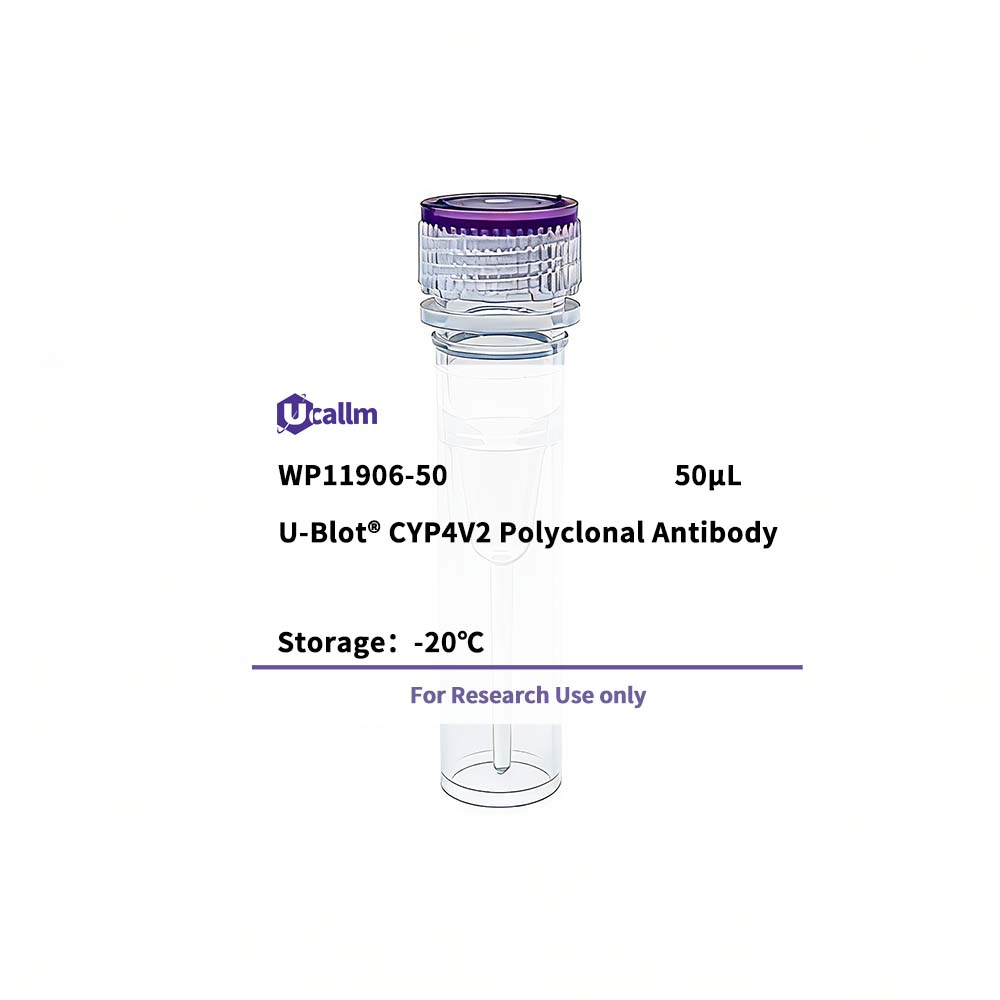
SKU: WP11906 Categories: ,

CYP4V2 Polyclonal Antibody

Price range: $268.00 through $328.00

SKU: WP11906-100
Enter the quantity you would like, or drag the panel to find the quantity and price that best for you
Bulk QuoteAuthorize OEM & ODM

Product details

Background:

This gene encodes a member of the cytochrome P450 hemethiolate protein superfamily which are involved in oxidizing various substrates in the metabolic pathway. It is implicated in the metabolism of fatty acid precursors into n-3 polyunsaturated fatty acids. Mutations in this gene result in Bietti crystalline corneoretinal dystrophy. [provided by RefSeq, Jul 2008],


Specifications

Size50μL/100μL
TargetCYP4V2
ReactivityHuman, Mouse, Rat
ApplicationsWB, IHC, IF, ELISA
MW(Calculated)
MW(Observed)60kD
Host SpeciesRabbit
IsotypeIgG
Conjugate/ModificationUnmodified
Recommended Dilution RatioWB 1:500-1:2000; IHC 1:100-1:300; ELISA 1:20000; IF 1:50-200 / Note: For IHC, we suggest antigen retrieval with TE buffer pH 9.0 (Cat#WT1004)
FormulationLiquid in PBS containing 50% glycerol, 0.5% BSA and 0.02% sodium azide.
PurificationThe antibody was affinity-purified from rabbit antiserum by affinity-chromatography using epitope-specific immunogen.
Storage-15°C to -25°C/1 year(Do not lower than -25°C)
Concentration1 mg/ml
ClonalityPolyclonal
Clone Number
ImmunogenSynthesized peptide derived from the Internal region of human CYP4V2.
SpecificityCYP4V2 Polyclonal Antibody detects endogenous levels of CYP4V2 protein.
Gene NameCYP4V2
Protein NameCytochrome P450 4V2
Other NameCYP4V2; / Cytochrome P450 4V2
SpeciesHuman
Gene ID285440
UniprotQ6ZWL3,
Species.1Mouse
Gene ID.1
Uniprot.1Q9DBW0
Species.2
Gene ID.2
Uniprot.2
Cellular LocalizationEndoplasmic reticulum membrane; Single-pass membrane protein .
Tissue ExpressionBroadly expressed. Detected in heart, brain, placenta, lung, liver, skeletal muscle, kidney, pancreas, retina, retinal pigment epithelium (RPE) and lymphocytes.
Signaling_pathway
Research Areas
Functioncofactor:Heme group.,Disease:Defects in CYP4V2 are a cause of Bietti crystalline corneoretinal dystrophy (BCD) [MIM:210370]. BCD is an autosomal recessive retinal dystrophy characterized by multiple glistening intraretinal crystals scattered over the fundus, a characteristic degeneration of the retina, and sclerosis of the choroidal vessels, ultimately resulting in progressive night blindness and constriction of the visual field. Most cases have similar crystals at the corneoscleral limbus. Clinically, BCD is progressive. Patients develop decreased vision, nyctalopia, and paracentral scotomata between the 2nd and 4th decade of life. Later, patients develop peripheral visual field loss and marked visual impairment, usually progressing to legal blindness by the 5th or 6th decade of life.,Function:Unknown. May have a role in fatty acid and steroid metabolism.,similarity:Belongs to the cytochrome P450 family.,tissue specificity:Broadly expressed. Detected in heart, brain, placenta, lung, liver, skeletal muscle, kidney, pancreas, retina, retinal pigment epithelium (RPE) and lymphocytes.,
Please login to post questions
Back to Top
Product has been added to your cart

