

Product details
Background:
This gene belongs to the forkhead family of transcription factors which is characterized by a distinct forkhead domain. Mutations in this gene cause autoimmune susceptibility 1. [provided by RefSeq, Nov 2008],
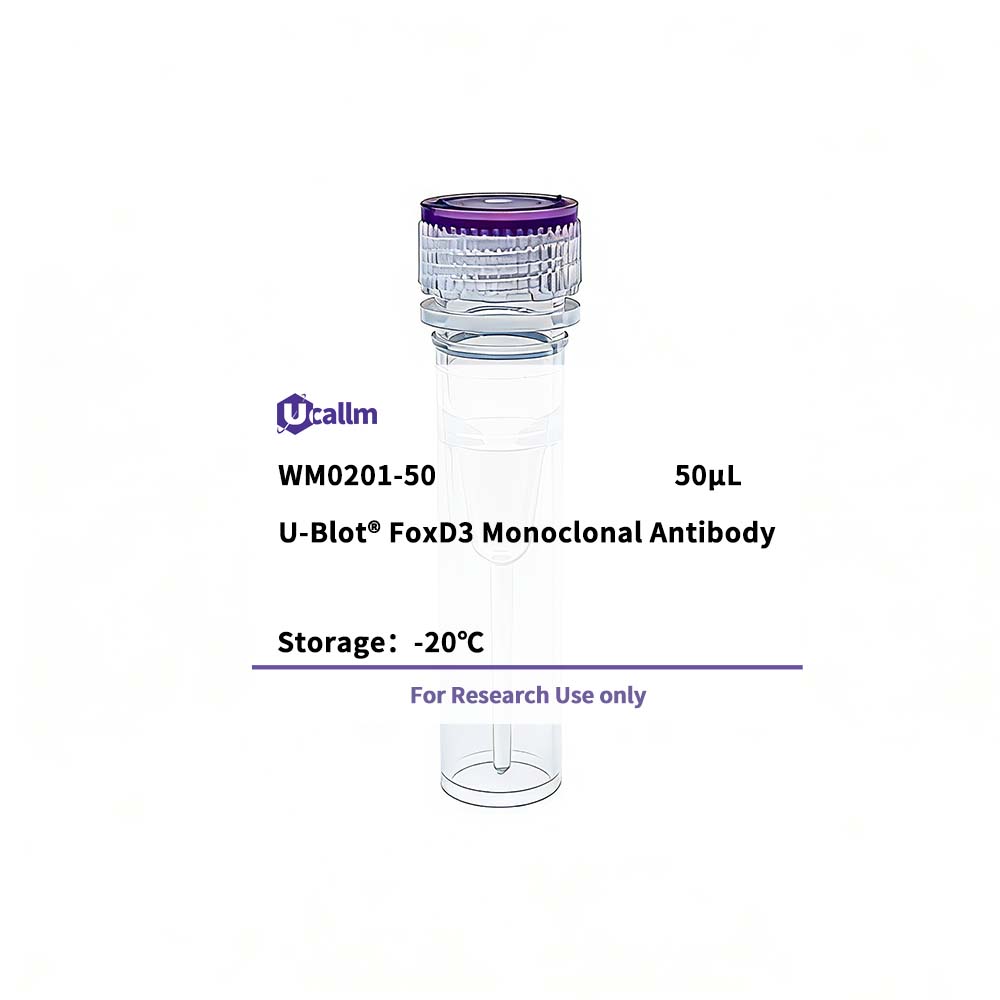
Price range: $268.00 through $328.00
Background:
This gene belongs to the forkhead family of transcription factors which is characterized by a distinct forkhead domain. Mutations in this gene cause autoimmune susceptibility 1. [provided by RefSeq, Nov 2008],
| Size | 50μL/100μL |
| Target | FoxD3 |
| Reactivity | Human, Mouse, Monkey |
| Applications | WB, IHC, IF, ELISA |
| MW(Calculated) | 48kD |
| MW(Observed) | |
| Host Species | Mouse |
| Isotype | |
| Conjugate/Modification | Unmodified |
| Recommended Dilution Ratio | WB 1:500-1:2000; IHC 1:200-1:1000; ELISA 1:10000; IF 1:50-200 / Note: For IHC, we suggest antigen retrieval with TE buffer pH 9.0 (Cat#WT1004) |
| Formulation | Liquid in PBS containing 50% glycerol, 0.5% BSA and 0.02% sodium azide. |
| Purification | Affinity purification |
| Storage | -15°C to -25°C/1 year(Do not lower than -25°C) |
| Concentration | |
| Clonality | Monoclonal |
| Clone Number | 9G4 |
| Immunogen | Purified recombinant fragment of human FoxD3 expressed in E. Coli. |
| Specificity | FoxD3 Monoclonal Antibody detects endogenous levels of FoxD3 protein. |
| Gene Name | FOXD3 |
| Protein Name | Forkhead box protein D3 |
| Other Name | FOXD3; / HFH2; / Forkhead box protein D3; / HNF3/FH transcription factor genesis |
| Species | Human |
| Gene ID | 27022 |
| Uniprot | Q9UJU5, |
| Species.1 | Mouse |
| Gene ID.1 | 15221 |
| Uniprot.1 | Q61060 |
| Species.2 | |
| Gene ID.2 | |
| Uniprot.2 | |
| Cellular Localization | Nucleus . |
| Tissue Expression | Expressed in chronic myeloid leukemia, Jurkat T-cell leukemia and teratocarcinoma cell lines, but not in any other cell lines or normal tissues examined. |
| Signaling_pathway | |
| Research Areas | |
| Function | Disease:Defects in FOXD3 are associated with susceptibility to autoimmune disease type 1 (AIS1) [MIM:607836]; also called vitiligo-associated multiple autoimmune disease susceptibility type 2 (VAMAS2). Generalized vitiligo is an acquired disorder in which white patches of skin and hair result from autoimmune loss of melanocytes, often associated with other autoimmune disorders. Most cases occur in a sporadic family pattern suggesting polygenic, multifactorial inheritance. However, a striking family in which a somewhat unusual vitiligo phenotype has been described, characterized by progressively coalescent diffuse depigmentation and relatively early disease onset, segregated as an apparent autosomal dominant with incomplete penetrance.,Function:Binds to the consensus sequence 5'-A[AT]T[AG]TTTGTTT-3' and acts as a transcriptional repressor. Also acts as a transcriptional activator. Promotes development of neural crest cells from neural tube progenitors. Restricts neural progenitor cells to the neural crest lineage while suppressing interneuron differentiation. Required for maintenance of pluripotent cells in the pre-implantation and peri-implantation stages of embryogenesis.,similarity:Contains 1 fork-head DNA-binding domain.,tissue specificity:Expressed in chronic myeloid leukemia, Jurkat T-cell leukemia and teratocarcinoma cell lines, but not in any other cell lines or normal tissues examined., |





