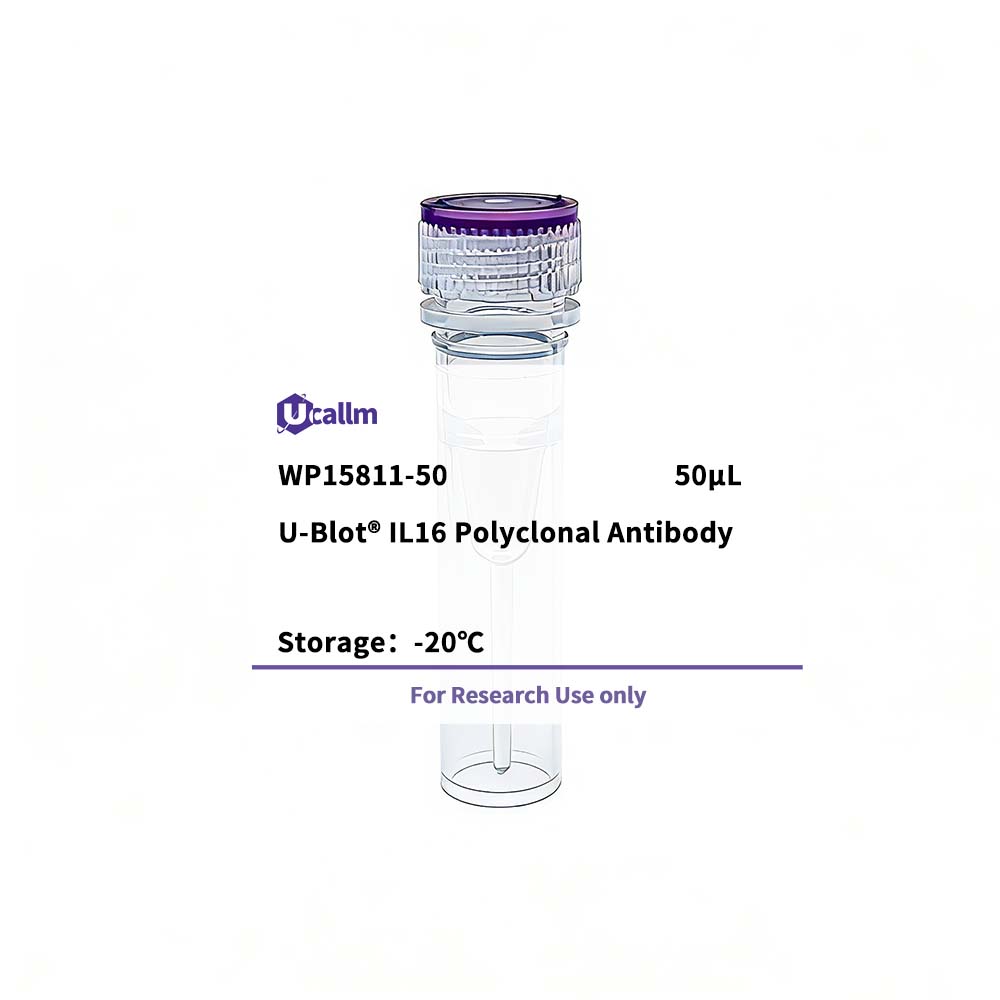
SKU: WP15811 Categories: ,

IL16 Polyclonal Antibody

Price range: $268.00 through $328.00

SKU: WP15811-100
Enter the quantity you would like, or drag the panel to find the quantity and price that best for you
Bulk QuoteAuthorize OEM & ODM

Product details

Background:

The protein encoded by this gene is a pleiotropic cytokine that functions as a chemoattractant, a modulator of T cell activation, and an inhibitor of HIV replication. The signaling process of this cytokine is mediated by CD4. The product of this gene undergoes proteolytic processing, which is found to yield two functional proteins. The cytokine function is exclusively attributed to the secreted C-terminal peptide, while the N-terminal product may play a role in cell cycle control. Caspase 3 is reported to be involved in the proteolytic processing of this protein. Alternate splicing results in multiple transcript variants. [provided by RefSeq, Feb 2010],

Specifications

Size50μL/100μL
TargetIL16
ReactivityHuman, Mouse
ApplicationsWB, ELISA
MW(Calculated)
MW(Observed)67kD
Host SpeciesRabbit
IsotypeIgG
Conjugate/ModificationUnmodified
Recommended Dilution RatioWB 1:500-2000; ELISA 1:10000-20000
FormulationLiquid in PBS containing 50% glycerol, 0.5% BSA and 0.02% sodium azide.
PurificationThe antibody was affinity-purified from rabbit antiserum by affinity-chromatography using epitope-specific immunogen.
Storage-15°C to -25°C/1 year(Do not lower than -25°C)
Concentration1 mg/ml
ClonalityPolyclonal
Clone Number
ImmunogenSynthetic peptide from human protein at AA range: 900-960
SpecificityThe antibody detects endogenous IL16
Gene NameIL16
Protein NamePro-interleukin-16 [Cleaved into: Interleukin-16 (IL-16) (Lymphocyte chemoattractant factor) (LCF)]
Other NamePro-interleukin-16 [Cleaved into: Interleukin-16; / IL-16; / Lymphocyte chemoattractant factor; / LCF; / ]
SpeciesHuman
Gene ID3603
UniprotQ14005,
Species.1Mouse
Gene ID.116170
Uniprot.1O54824
Species.2
Gene ID.2
Uniprot.2
Cellular Localization[Interleukin-16]: Secreted.; [Isoform 1]: Cytoplasm .; [Isoform 3]: Cytoplasm. Nucleus.
Tissue Expression[Isoform 3]: Expressed in hemopoietic tissues, such as resting T-cells, but undetectable during active T-cell proliferation.
Signaling_pathwayEnvironmental Information Processing >> Signaling molecules and interaction >> Cytokine-cytokine receptor interaction
Research Areas>>Cytokine-cytokine receptor interaction
FunctionFunction:Interleukin-16 stimulates a migratory response in CD4+ lymphocytes, monocytes, and eosinophils. Primes CD4+ T-cells for IL-2 and IL-15 responsiveness. Also induces T-lymphocyte expression of interleukin 2 receptor. Ligand for CD4.,Function:Isoform 1 may act as a scaffolding protein that anchors ion channels in the membrane.,Function:Isoform 3 is involved in cell cycle progression in T-cells. Appears to be involved in transcriptional regulation of SKP2 and is probably part of a transcriptional repression complex on the core promoter of the SKP2 gene. May act as a scaffold for GABPB1 (the DNA-binding subunit the GABP transcription factor complex) and HDAC3 thus maintaining transcriptional repression and blocking cell cycle progression in resting T-cells.,induction:Isoform 3 is down-regulated in T-cells after TCR activation.,PTM:Isoform 3 is synthesized as a chemo-attractant inactive precursor in hemopoietic tissues and is proteolytically cleaved by caspase-3 to yield IL-16.,similarity:Contains 1 PDZ (DHR) domain.,similarity:Contains 2 PDZ (DHR) domains.,similarity:Contains 4 PDZ (DHR) domains.,subunit:Homotetramer (Probable); according (PubMed:9699630) the formation of a homotetrameric protein complex is not required for the chemo-attractant function. Isoform 3 interacts (via PDZ 3 domain) with PPP1R12A, PPP1R12B and PPP1R12C. Isoform 1 interacts with PPP1R12B. Isoform 3 interacts with GRIN2A. Isoform 3 interacts with GABPB1. Isoform 3 interacts (via PDZ 3 domain) with HDAC3. Isoform 1 interacts with GRIN2D, KCNJ10, KCNJ15 and CACNA1C (By similarity). Isoform 3 interacts with HTLV-1 tax.,tissue specificity:Isoform 3 is expressed in hemopoietic tissues, such as resting T-cells, but is undetectable during active T cell proliferation.,
Please login to post questions
Back to Top
Product has been added to your cart
