


IRK14 Polyclonal Antibody
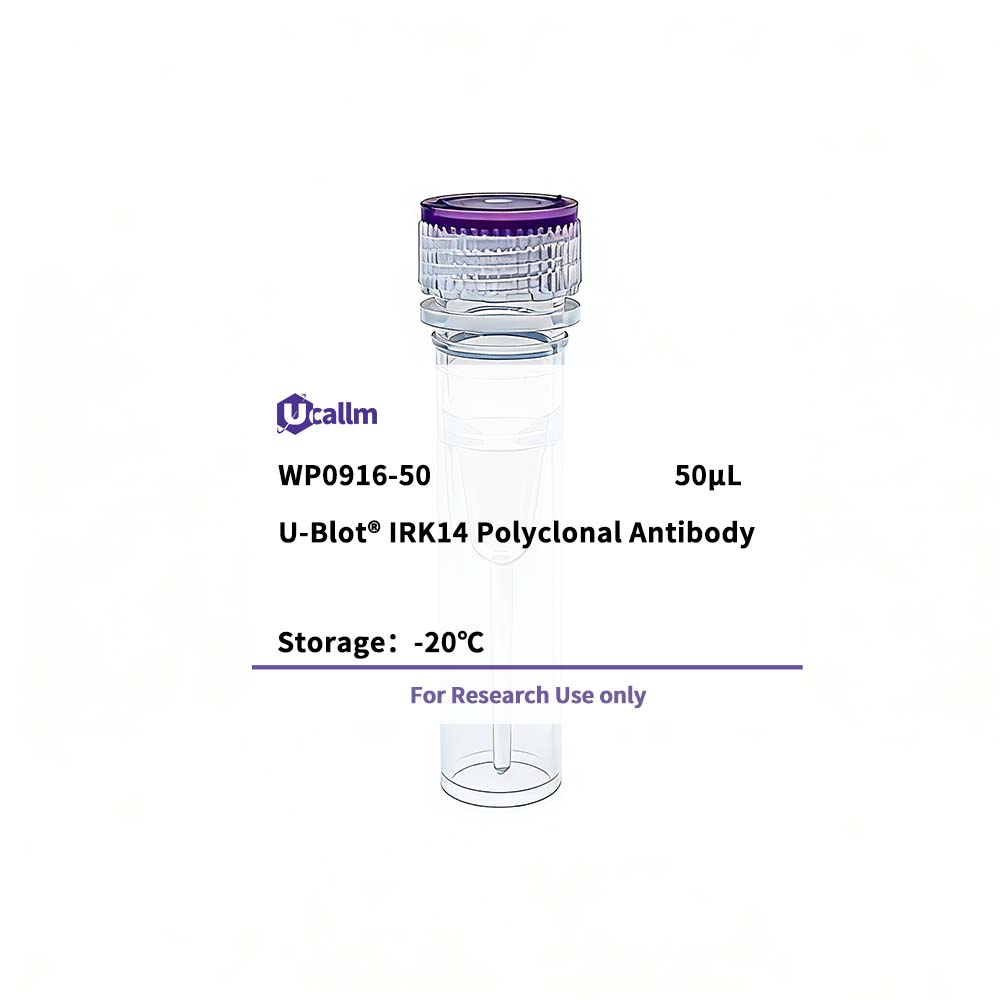
Ucallm_WP0916-50
Price range: $268.00 through $328.00
Product details
Background:
Potassium channels are present in most mammalian cells, where they participate in a wide range of physiologic responses. The protein encoded by this gene is an integral membrane protein and inward-rectifier type potassium channel, and probably has a role in controlling the excitability of motor neurons. [provided by RefSeq, Feb 2013],
Specifications
| Size | 50μL/100μL |
| Target | IRK14 |
| Reactivity | Human, Mouse, Rat |
| Applications | WB, ELISA |
| MW(Calculated) | |
| MW(Observed) | 47kD |
| Host Species | Rabbit |
| Isotype | IgG |
| Conjugate/Modification | Unmodified |
| Recommended Dilution Ratio | WB 1:500-2000; ELISA 1:5000-20000 |
| Formulation | Liquid in PBS containing 50% glycerol,0.5% BSA and 0.02% sodium azide. |
| Purification | The antibody was affinity-purified from rabbit antiserum by affinity-chromatography using epitope-specific immunogen. |
| Storage | -15°C to -25°C/1 year(Do not lower than -25°C) |
| Concentration | 1 mg/ml |
| Clonality | Polyclonal |
| Clone Number | |
| Immunogen | Synthesized peptide derived from human protein . at AA range: 350-430 |
| Specificity | IRK14 Polyclonal Antibody detects endogenous levels of protein. |
| Gene Name | KCNJ14 IRK4 |
| Protein Name | ATP-sensitive inward rectifier potassium channel 14 (Inward rectifier K(+) channel Kir2.4) (IRK-4) (Potassium channel, inwardly rectifying subfamily J member 14) |
| Other Name | |
| Species | Human |
| Gene ID | 3770 |
| Uniprot | Q9UNX9, |
| Species.1 | Mouse |
| Gene ID.1 | |
| Uniprot.1 | Q8JZN3, |
| Species.2 | Rat |
| Gene ID.2 | |
| Uniprot.2 | O70596 |
| Cellular Localization | Membrane; Multi-pass membrane protein. |
| Tissue Expression | Expressed preferentially in retina. |
| Signaling_pathway | Organismal Systems >> Endocrine system >> Oxytocin signaling pathway;Organismal Systems >> Nervous system >> Cholinergic synapse |
| Research Areas | >>Cholinergic synapse; / >>Oxytocin signaling pathway |
| Function | Function:Inward rectifier potassium channels are characterized by a greater tendency to allow potassium to flow into the cell rather than out of it. Their voltage dependence is regulated by the concentration of extracellular potassium; as external potassium is raised, the voltage range of the channel opening shifts to more positive voltages. The inward rectification is mainly due to the blockage of outward current by internal magnesium. KCNJ14 gives rise to low-conductance channels with a low affinity to the channel blockers Barium and Cesium.,similarity:Belongs to the inward rectifier-type potassium channel family.,tissue specificity:Expressed preferentially in retina., |
Please login to post questions
Related products





