

JNK3 Monoclonal Antibody
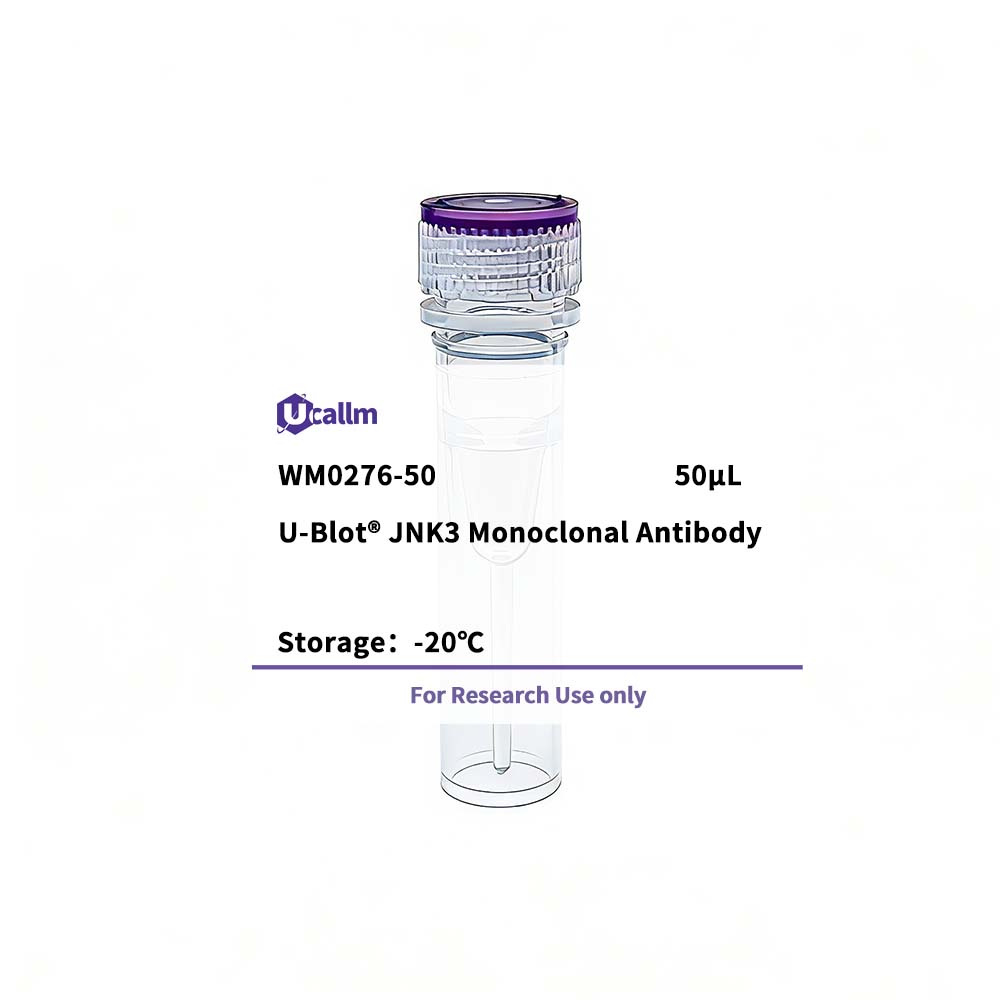
Ucallm_WM0276-50
Price range: $268.00 through $328.00
Product details
Background:
The protein encoded by this gene is a member of the MAP kinase family. MAP kinases act as integration points for multiple biochemical signals and are involved in a wide variety of cellular processes, such as proliferation, differentiation, transcription regulation and development. This kinase is specifically expressed in a subset of neurons in the nervous system and is activated by threonine and tyrosine phosphorylation. Targeted deletion of this gene in mice suggests that it may have a role in stress-induced neuronal apoptosis. Alternatively spliced transcript variants encoding different isoforms have been described for this gene. A recent study provided evidence for translational readthrough in this gene and expression of an additional C-terminally extended isoform via the use of an alternative in-frame translation termination codon. [provided by RefSeq, Dec 2015],
Specifications
| Size | 50μL/100μL |
| Target | JNK3 |
| Reactivity | Human, Mouse |
| Applications | WB, IF, ELISA |
| MW(Calculated) | 53kD |
| MW(Observed) | |
| Host Species | Mouse |
| Isotype | |
| Conjugate/Modification | Unmodified |
| Recommended Dilution Ratio | WB 1:500-1:2000; IF 1:200-1:1000; ELISA 1:10000; Not yet tested in other applications. |
| Formulation | Liquid in PBS containing 50% glycerol, 0.5% BSA and 0.02% sodium azide. |
| Purification | Affinity purification |
| Storage | -15°C to -25°C/1 year(Do not lower than -25°C) |
| Concentration | |
| Clonality | Monoclonal |
| Clone Number | 5H2 |
| Immunogen | Purified recombinant fragment of human JNK3 (aa28-233) expressed in E. Coli. |
| Specificity | JNK3 Monoclonal Antibody detects endogenous levels of JNK3 protein. |
| Gene Name | MAPK10 |
| Protein Name | Mitogen-activated protein kinase 10 |
| Other Name | MAPK10; / JNK3; / JNK3A; / PRKM10; / SAPK1B; / Mitogen-activated protein kinase 10; / MAP kinase 10; / MAPK 10; / MAP kinase p49 3F12; / Stress-activated protein kinase 1b; / SAPK1b; / Stress-activated protein kinase JNK3; / c-Jun N-terminal kinase 3 |
| Species | Human |
| Gene ID | 5602 |
| Uniprot | P53779, |
| Species.1 | Mouse |
| Gene ID.1 | |
| Uniprot.1 | Q61831 |
| Species.2 | |
| Gene ID.2 | |
| Uniprot.2 | |
| Cellular Localization | Cytoplasm . Membrane; Lipid-anchor . Nucleus . Mitochondrion . Palmitoylation regulates MAPK10 trafficking to cytoskeleton. Recruited to the mitochondria in the presence of SARM1 (By similarity). . |
| Tissue Expression | Specific to a subset of neurons in the nervous system. Present in the hippocampus and areas, cerebellum, striatum, brain stem, and weakly in the spinal cord. Very weak expression in testis and kidney. |
| Signaling_pathway | Cellular Processes >> Transport and catabolism >> Autophagy - animal;Cellular Processes >> Transport and catabolism >> Mitophagy - animal;Cellular Processes >> Cell growth and death >> Apoptosis;Cellular Processes >> Cell growth and death >> Apoptosis - multiple species;Cellular Processes >> Cell growth and death >> Necroptosis;Cellular Processes >> Cellular community - eukaryotes >> Focal adhesion;Cellular Processes >> Cellular community - eukaryotes >> Tight junction;Organismal Systems >> Immune system >> Toll-like receptor signaling pathway;Organismal Systems >> Immune system >> NOD-like receptor signaling pathway;Organismal Systems >> Immune system >> RIG-I-like receptor signaling pathway;Organismal Systems >> Immune system >> T cell receptor signaling pathway;Organismal Systems >> Immune system >> Th1 and Th2 cell differentiation;Organismal Systems >> Immune system >> Th17 cell differentiation;Organismal Systems >> Immune system >> IL-17 signaling pathway;Organismal Systems >> Immune system >> Fc epsilon RI signaling pathway;Organismal Systems >> Endocrine system >> Insulin signaling pathway;Organismal Systems >> Endocrine system >> Adipocytokine signaling pathway;Organismal Systems >> Endocrine system >> GnRH signaling pathway;Organismal Systems >> Endocrine system >> Prolactin signaling pathway;Organismal Systems >> Endocrine system >> Relaxin signaling pathway;Organismal Systems >> Endocrine system >> Growth hormone synthesis, secretion and action;Organismal Systems >> Nervous system >> Dopaminergic synapse;Organismal Systems >> Nervous system >> Neurotrophin signaling pathway;Organismal Systems >> Sensory system >> Inflammatory mediator regulation of TRP channels;Organismal Systems >> Development and regeneration >> Osteoclast differentiation;Human Diseases >> Cancer: overview >> Pathways in cancer;Human Diseases >> Cancer: specific types >> Colorectal cancer;Human Diseases >> Cancer: specific types >> Pancreatic cancer;Human Diseases >> Neurodegenerative disease >> Alzheimer disease;Human Diseases >> Neurodegenerative disease >> Parkinson disease;Human Diseases >> Neurodegenerative disease >> Huntington disease;Human Diseases >> Neurodegenerative disease >> Spinocerebellar ataxia;Human Diseases >> Neurodegenerative disease >> Prion disease;Human Diseases >> Neurodegenerative disease >> Pathways of neurodegeneration - multiple diseases;Environmental Information Processing >> Signal transduction >> MAPK signaling pathway;Environmental Information Processing >> Signal transduction >> ErbB signaling pathway;Environmental Information Processing >> Signal transduction >> Ras signaling pathway;Environmental Information Processing >> Signal transduction >> Wnt signaling pathway;Environmental Information Processing >> Signal transduction >> TNF signaling pathway;Environmental Information Processing >> Signal transduction >> FoxO signaling pathway;Environmental Information Processing >> Signal transduction >> Sphingolipid signaling pathway;Environmental Information Processing >> Signal transduction >> cAMP signaling pathway |
| Research Areas | >>Endocrine resistance; / >>MAPK signaling pathway; / >>ErbB signaling pathway; / >>Ras signaling pathway; / >>cAMP signaling pathway; / >>FoxO signaling pathway; / >>Sphingolipid signaling pathway; / >>Mitophagy - animal; / >>Autophagy - animal; / >>Protein processing in endoplasmic reticulum; / >>Apoptosis; / >>Apoptosis - multiple species; / >>Necroptosis; / >>Wnt signaling pathway; / >>Osteoclast differentiation; / >>Focal adhesion; / >>Tight junction; / >>Toll-like receptor signaling pathway; / >>NOD-like receptor signaling pathway; / >>RIG-I-like receptor signaling pathway; / >>C-type lectin receptor signaling pathway; / >>IL-17 signaling pathway; / >>Th1 and Th2 cell differentiation; / >>Th17 cell differentiation; / >>T cell receptor signaling pathway; / >>Fc epsilon RI signaling pathway; / >>TNF signaling pathway; / >>Neurotrophin signaling pathway; / >>Retrograde endocannabinoid signaling; / >>Dopaminergic synapse; / >>Inflammatory mediator regulation of TRP channels; / >>Insulin signaling pathway; / >>GnRH signaling pathway; / >>Progesterone-mediated oocyte maturation; / >>Prolactin signaling pathway; / >>Adipocytokine signaling pathway; / >>Relaxin signaling pathway; / >>Type II diabetes mellitus; / >>Insulin resistance; / >>Non-alcoholic fatty liver disease; / >>AGE-RAGE signaling pathway in diabetic complications; / >>Growth hormone synthesis, secretion and action; / >>Alcoholic liver disease; / >>Alzheimer disease; / >>Parkinson disease; / >>Huntington disease; / >>Spinocerebellar ataxia; / >>Prion disease; / >>Pathways of neurodegeneration - multiple diseases; / >>Epithelial cell signaling in Helicobacter pylori infection; / >>Pathogenic Escherichia coli infection; / >>Shigellosis; / >>Salmonella infection; / >>Pertussis; / >>Yersinia infection; / >>Chagas disease; / >>Toxoplasmosis; / >>Tuberculosis; / >>Hepatitis B; / >>Measles; / >>Human T-cell leukemia virus 1 infection; / >>Kaposi sarcoma-associated herpesvirus infection; / >>Epstein-Barr virus infection; / >>Human immunodeficiency virus 1 infection; / >>Coronavirus disease - COVID-19; / >>Pathways in cancer; / >>Chemical carcinogenesis - reactive oxygen species; / >>Colorectal cancer; / >>Pancreatic cancer; / >>Choline metabolism in cancer; / >>Diabetic cardiomyopathy; / >>Lipid and atherosclerosis; / >>Fluid shear stress and atherosclerosis |
| Function | Alternative products:A similar low level of binding to substrates is observed for isoform alpha-1 and isoform alpha-2. However, there is no correlation between binding and phosphorylation, which is achieved about at the same efficiency by all isoforms,Catalytic activity:ATP + a protein = ADP + a phosphoprotein.,Caution:The sequence shown here is derived from an Ensembl automatic analysis pipeline and should be considered as preliminary data.,cofactor:Magnesium.,Disease:A chromosomal rearrangement involving MAPK10 is a cause of epileptic encephalopathy Lennox-Gastaut type [MIM:606369]. Translocation t(Y; 4)(q11.2; q21) which causes MAPK10 truncation. Epileptic encephalopathies of the Lennox-Gastaut group are childhood epileptic disorders characterized by severe psychomotor delay and seizures.,Domain:The TXY motif contains the threonine and tyrosine residues whose phosphorylation activates the MAP kinases.,enzyme regulation:Activated by threonine and tyrosine phosphorylation by two dual specificity kinases, MAP2K4 and MAP2K7. MAP2K7 phosphorylates MAPK10 on Thr-221 causing a conformational change and a large increase in Vmax. MAP2K4 then phosphorylates Tyr-223 resulting in a further increase in Vmax. Inhibited by dual specificity phosphatases, such as DUSP1. Inhibited by HDAC9.,Function:Responds to activation by environmental stress and pro-inflammatory cytokines by phosphorylating a number of transcription factors, primarily components of AP-1 such as c-Jun and ATF2 and thus regulates AP-1 transcriptional activity. Required for stress-induced neuronal apoptosis and the pathogenesis of glutamate excitotoxicity.,mass spectrometry: PubMed:10715136,PTM:Dually phosphorylated on Thr-221 and Tyr-223, which activates the enzyme. Weakly autophosphorylated on threonine and tyrosine residues in vitro.,similarity:Belongs to the protein kinase superfamily. CMGC Ser/Thr protein kinase family. MAP kinase subfamily.,similarity:Contains 1 protein kinase domain.,subunit:Interacts with MAPKBP1 (By similarity). Binds to at least four scaffolding proteins, MAPK8IP1/JIP-1, MAPK8IP2/JIP-2, MAPK8IP3/JIP-3/JSAP1 and SPAG9/MAPK8IP4/JIP-4. These proteins also bind other components of the JNK signaling pathway. Interacts with HDAC9.,tissue specificity:Specific to a subset of neurons in the nervous system. Present in the hippocampus and areas, cerebellum, striatum, brain stem, and weakly in the spinal cord. Very weak expression in testis and kidney., |
Please login to post questions
Related products



