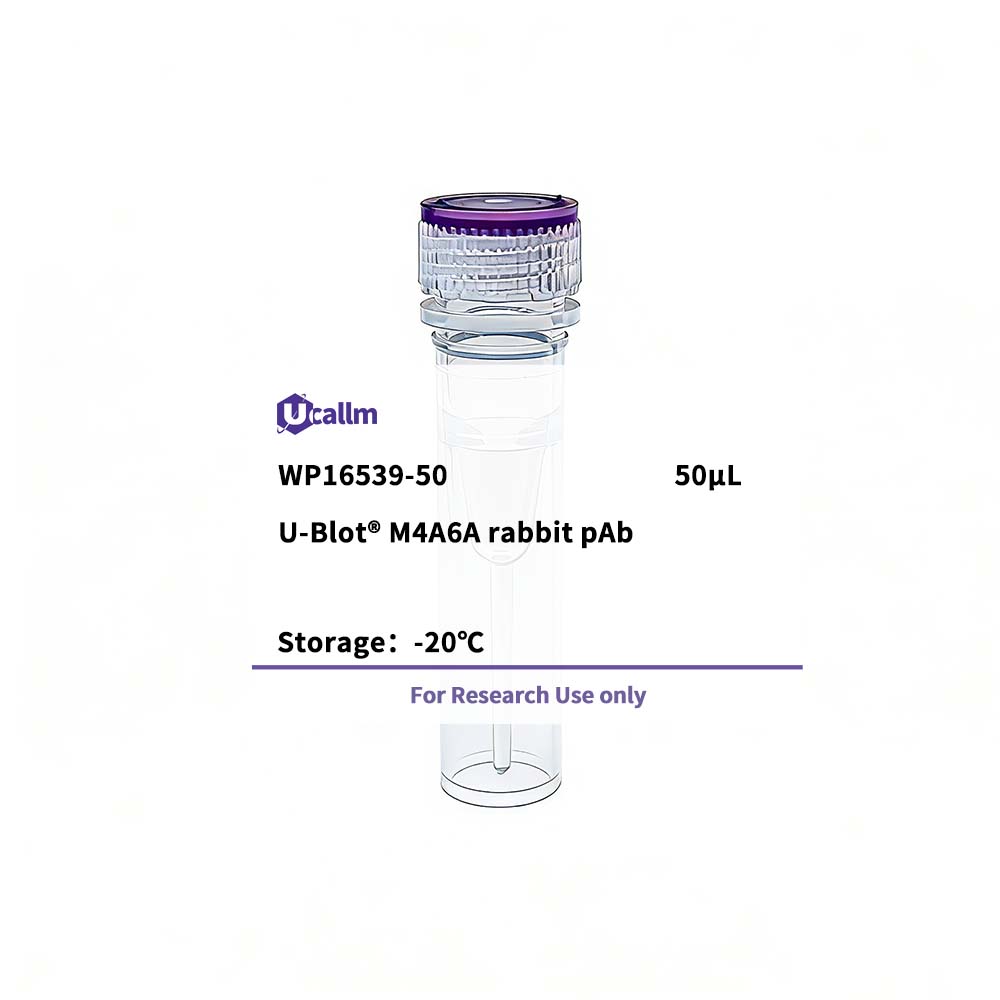
SKU: WP16539 Categories: ,

M4A6A rabbit pAb

Price range: $268.00 through $328.00

SKU: WP16539-100
Enter the quantity you would like, or drag the panel to find the quantity and price that best for you
Bulk QuoteAuthorize OEM & ODM

Product details

Background:

This gene encodes a member of the membrane-spanning 4A gene family. Members of this nascent protein family are characterized by common structural features and similar intron/exon splice boundaries and display unique expression patterns among hematopoietic cells and nonlymphoid tissues. The gene encoding this protein is localized to 11q12.1, among a cluster of family members. Alternative splicing of this gene results in several transcript variants that encode different protein isoforms. [provided by RefSeq, Oct 2011],


Specifications

Size50μL/100μL
TargetM4A6A
ReactivityHuman
ApplicationsWB
MW(Calculated)27kD
MW(Observed)
Host SpeciesRabbit
IsotypeIgG
Conjugate/ModificationUnmodified
Recommended Dilution RatioWB 1:500-2000
FormulationLiquid in PBS containing 50% glycerol, 0.5% BSA and 0.02% sodium azide.
PurificationThe antibody was affinity-purified from rabbit antiserum by affinity-chromatography using epitope-specific immunogen.
Storage-15°C to -25°C/1 year(Do not lower than -25°C)
Concentration1 mg/ml
ClonalityPolyclonal
Clone Number
ImmunogenSynthesized peptide derived from human M4A6A AA range: 8-58
SpecificityThis antibody detects endogenous levels of M4A6A at Human
Gene NameMS4A6A 4SPAN3 CD20L3 MS4A6 CDA01 MSTP090
Protein NameM4A6A
Other Name
SpeciesHuman
Gene ID64231
UniprotQ9H2W1
Species.1
Gene ID.1
Uniprot.1
Species.2
Gene ID.2
Uniprot.2
Cellular LocalizationMembrane; Multi-pass membrane protein.
Tissue ExpressionVariable expression in some B-cell, myelomonocytic, and erythroleukemia cell lines.
Signaling_pathway
Research Areas
FunctionFunction:May be involved in signal transduction as a component of a multimeric receptor complex.,similarity:Belongs to the MS4A family.,tissue specificity:Variable expression in some B-cell, myelomonocytic, and erythroleukemia cell lines.,
Please login to post questions
Back to Top
Product has been added to your cart
