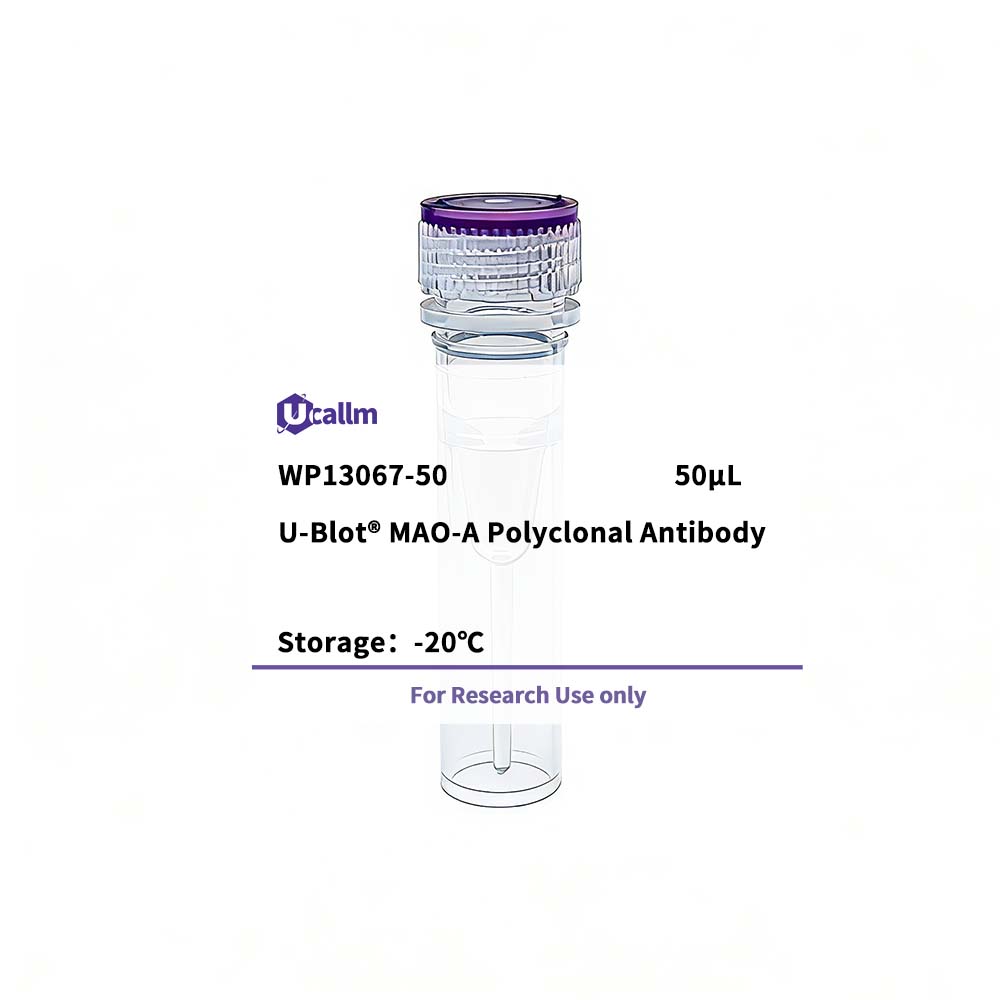
SKU: WP13067 Categories: ,

MAO-A Polyclonal Antibody

Price range: $268.00 through $328.00

SKU: WP13067-100
Enter the quantity you would like, or drag the panel to find the quantity and price that best for you
Bulk QuoteAuthorize OEM & ODM

Product details

Background:

This gene is one of two neighboring gene family members that encode mitochondrial enzymes which catalyze the oxidative deamination of amines, such as dopamine, norepinephrine, and serotonin. Mutation of this gene results in Brunner syndrome. This gene has also been associated with a variety of other psychiatric disorders, including antisocial behavior. Alternatively spliced transcript variants encoding multiple isoforms have been observed. [provided by RefSeq, Jul 2012],

Specifications

Size50μL/100μL
TargetMAO-A
ReactivityHuman, Mouse, Rat
ApplicationsWB, IHC, IF, ELISA
MW(Calculated)
MW(Observed)61kD
Host SpeciesRabbit
IsotypeIgG
Conjugate/ModificationUnmodified
Recommended Dilution RatioWB 1:500-1:2000; IHC 1:100-1:300; ELISA 1:20000; IF 1:50-200 / Note: For IHC, we suggest antigen retrieval with TE buffer pH 9.0 (Cat#WT1004)
FormulationLiquid in PBS containing 50% glycerol, 0.5% BSA and 0.02% sodium azide.
PurificationThe antibody was affinity-purified from rabbit antiserum by affinity-chromatography using epitope-specific immunogen.
Storage-15°C to -25°C/1 year(Do not lower than -25°C)
Concentration1 mg/ml
ClonalityPolyclonal
Clone Number
ImmunogenThe antiserum was produced against synthesized peptide derived from human MAO-A. AA range:298-347
SpecificityMAO-A Polyclonal Antibody detects endogenous levels of MAO-A protein.
Gene NameMAOA
Protein NameAmine oxidase [flavin-containing] A
Other NameMAOA; / Amine oxidase [flavin-containing] A; / Monoamine oxidase type A; / MAO-A
SpeciesHuman
Gene ID4128
UniprotP21397,
Species.1Mouse
Gene ID.117161
Uniprot.1Q64133,
Species.2Rat
Gene ID.2
Uniprot.2P21396
Cellular LocalizationMitochondrion outer membrane; Single-pass type IV membrane protein; Cytoplasmic side .
Tissue ExpressionHeart, liver, duodenum, blood vessels and kidney.
Signaling_pathwayOrganismal Systems >> Nervous system >> Dopaminergic synapse;Human Diseases >> Neurodegenerative disease >> Parkinson disease
Research Areas>>Glycine, serine and threonine metabolism; / >>Arginine and proline metabolism; / >>Histidine metabolism; / >>Tyrosine metabolism; / >>Phenylalanine metabolism; / >>Tryptophan metabolism; / >>Drug metabolism - cytochrome P450; / >>Metabolic pathways; / >>Serotonergic synapse; / >>Dopaminergic synapse; / >>Parkinson disease; / >>Cocaine addiction; / >>Amphetamine addiction; / >>Alcoholism
FunctionCatalytic activity:RCH(2)NHR' + H(2)O + O(2) = RCHO + R'NH(2) + H(2)O(2).,cofactor:FAD.,Disease:Defects in MAOA are the cause of Brunner syndrome (BRUNS) [MIM:300615]. Brunner syndrome is a form of X-linked non-dysmorphic mild mental retardation. Male patients are affected by a syndrome of borderline mental retardation and exhibit abnormal behavior, including disturbed regulation of impulsive aggression. Obligate female carriers have normal intelligence and behavior.,Function:Catalyzes the oxidative deamination of biogenic and xenobiotic amines and has important functions in the metabolism of neuroactive and vasoactive amines in the central nervous system and peripheral tissues. MAOA preferentially oxidizes biogenic amines such as 5-hydroxytryptamine (5-HT), norepinephrine and epinephrine.,mass spectrometry: PubMed:11812236,online information:Monoamine oxidase entry,similarity:Belongs to the flavin monoamine oxidase family.,subunit:Monomer, homo- or heterodimer (containing two subunits of similar size). Each subunit contains a covalently bound flavin. Enzymatically active as monomer.,tissue specificity:Heart, liver, duodenum, blood vessels and kidney.,
Please login to post questions
Back to Top
Product has been added to your cart