

U-Blot® Neurofilament (NF-L) Rabbit mAb
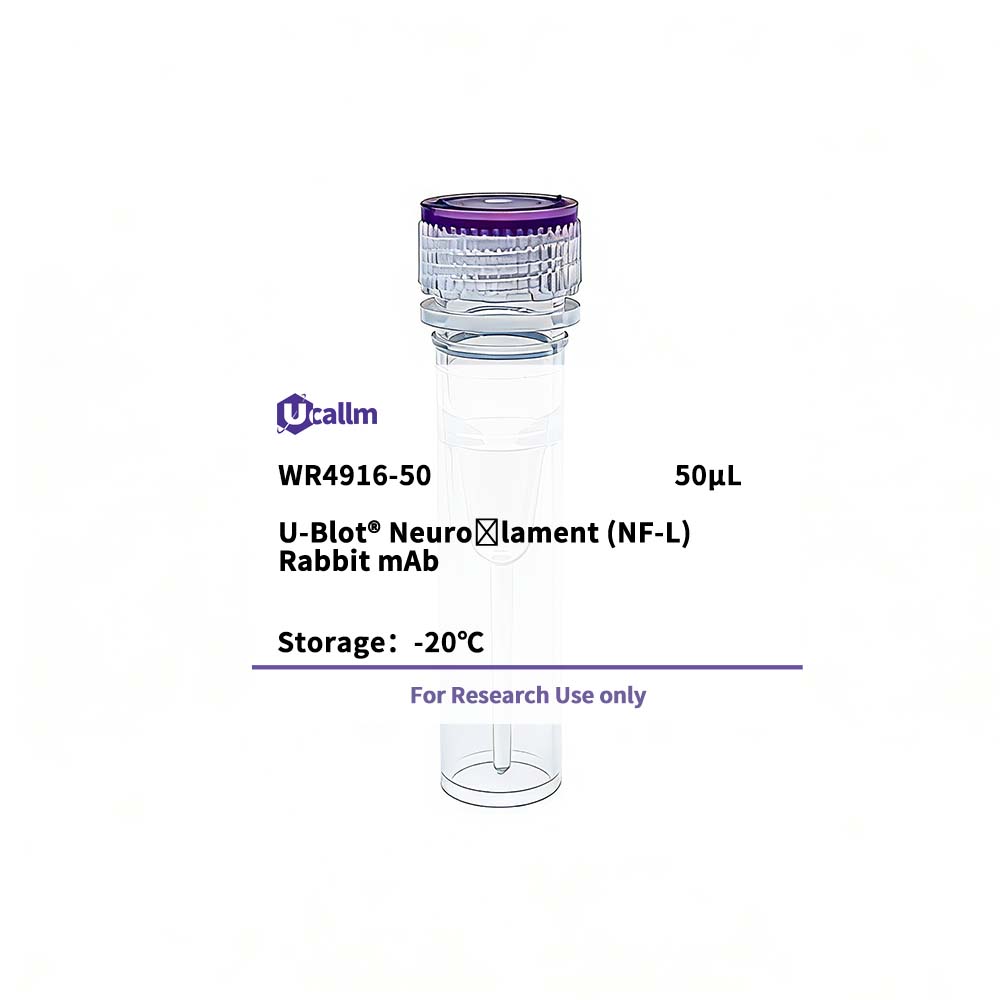
Ucallm_WR4916-50
Price range: $268.00 through $328.00
Product details
Background:Neurofilaments are type IV intermediate filament heteropolymers composed of light, medium, and heavy chains. Neurofilaments comprise the axoskeleton and they functionally maintain the neuronal caliber. They may also play a role in intracellular transport to axons and dendrites. This gene encodes the light chain neurofilament protein. Mutations in this gene cause Charcot-Marie-Tooth disease types 1F (CMT1F) and 2E (CMT2E), disorders of the peripheral nervous system that are characterized by distinct neuropathies. A pseudogene has been identified on chromosome Y. [provided by RefSeq, Oct 2008],
Specifications
| Size | 50μL/100μL |
| Target | NF-L |
| Reactivity | Human, Mouse, Rat |
| Applications | WB, IHC, IF, IP, ELISA |
| MW(Calculated) | 62kD |
| MW(Observed) | 68kD |
| Host Species | Rabbit |
| Isotype | IgG,Kappa |
| Conjugate/Modification | Unmodified |
| Recommended Dilution Ratio | IHC 1:2000-1:10000; WB 1:2000-1:10000; IF 1:200-1:1000; ELISA 1:5000-1:20000; IP 1:50-1:200; / Note: For IHC, we suggest antigen retrieval with TE buffer pH 9.0 (Cat#WT1004) |
| Formulation | PBS, 50% glycerol, 0.05% Proclin 300, 0.05%BSA |
| Purification | Recombinant Antibody expressed in animal component-free (ACF) media, purified via Protein A affinity chromatography. |
| Storage | -15°C to -25°C/1 year(Do not lower than -25°C) |
| Concentration | |
| Clonality | Monoclonal |
| Clone Number | RM1146R |
| Immunogen | The specific immunogen used to produce this antibody is proprietary information. |
| Specificity | Endogenous |
| Gene Name | NEFL NF68 NFL |
| Protein Name | Neurofilament light polypeptide; NF-L; Neurofilament triplet L protein; 68 kDa neurofilament protein |
| Other Name | Neurofilament light polypeptide; / NF-L; / 68 kDa neurofilament protein; / Neurofilament triplet L protein |
| Species | Human |
| Gene ID | 4747 |
| Uniprot | P07196, |
| Species.1 | Mouse |
| Gene ID.1 | 18039 |
| Uniprot.1 | P08551, |
| Species.2 | Rat |
| Gene ID.2 | 83613 |
| Uniprot.2 | P19527 |
| Cellular Localization | Cytoplasmic |
| Tissue Expression | brain, retina,Expressed in dorsal root ganglion and 159 other cell types or tissues, |
| Signaling_pathway | Human Diseases >> Neurodegenerative disease >> Amyotrophic lateral sclerosis;Human Diseases >> Neurodegenerative disease >> Pathways of neurodegeneration - multiple diseases |
| Research Areas | >>Amyotrophic lateral sclerosis; / >>Pathways of neurodegeneration - multiple diseases |
| Function | Caution:The sequence shown here is derived from an Ensembl automatic analysis pipeline and should be considered as preliminary data.,Disease:Defects in NEFL are the cause of Charcot-Marie-Tooth disease type 1F (CMT1F) [MIM:607734]. CMT1F is a form of Charcot-Marie-Tooth disease, the most common inherited disorder of the peripheral nervous system. Charcot-Marie-Tooth disease is classified in two main groups on the basis of electrophysiologic properties and histopathology: primary peripheral demyelinating neuropathy or CMT1, and primary peripheral axonal neuropathy or CMT2. Neuropathies of the CMT1 group are characterized by severely reduced nerve conduction velocities (less than 38 m/sec), segmental demyelination and remyelination with onion bulb formations on nerve biopsy, slowly progressive distal muscle atrophy and weakness, absent deep tendon reflexes, and hollow feet. CMT1F is characterized by onset in infancy or childhood (range 1 to 13 years).,Disease:Defects in NEFL are the cause of Charcot-Marie-Tooth disease type 2E (CMT2E) [MIM:607684]. CMT2E is an autosomal dominant form of Charcot-Marie-Tooth disease type 2. Neuropathies of the CMT2 group are characterized by signs of axonal regeneration in the absence of obvious myelin alterations, normal or slightly reduced nerve conduction velocities, and progressive distal muscle weakness and atrophy.,Domain:The extra mass and high charge density that distinguish the neurofilament proteins from all other intermediate filament proteins are due to the tailpiece extensions. This region may form a charged scaffolding structure suitable for interaction with other neuronal components or ions.,Function:Neurofilaments usually contain three intermediate filament proteins: L, M, and H which are involved in the maintenance of neuronal caliber.,miscellaneous:NF-L is the most abundant of the three neurofilament proteins and, as the other nonepithelial intermediate filament proteins, it can form homopolymeric 10-nm filaments.,PTM:O-glycosylated.,similarity:Belongs to the intermediate filament family.,subunit:Interacts with RGNEF., |
Please login to post questions
Related products





