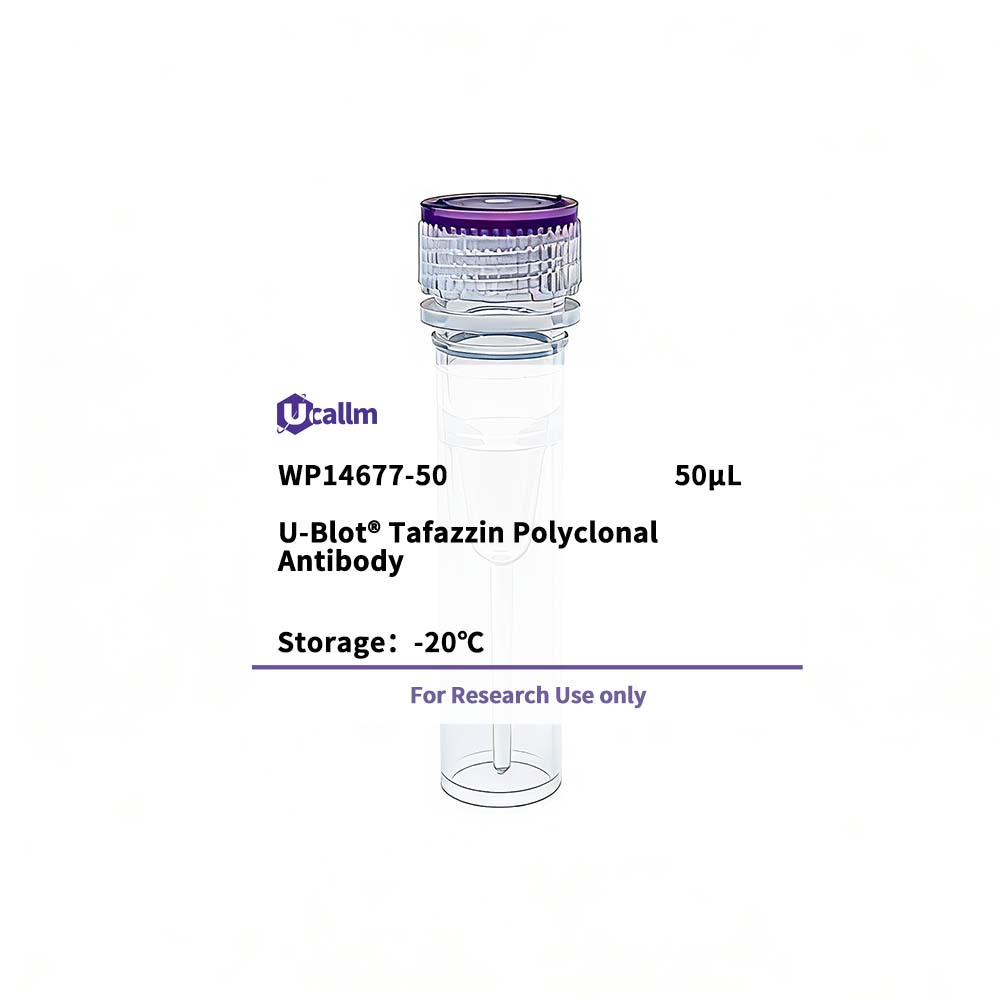
SKU: WP14677 Categories: ,

Tafazzin Polyclonal Antibody

Price range: $268.00 through $328.00

SKU: WP14677-100
Enter the quantity you would like, or drag the panel to find the quantity and price that best for you
Bulk QuoteAuthorize OEM & ODM

Product details

Background:

This gene encodes a protein that is expressed at high levels in cardiac and skeletal muscle. Mutations in this gene have been associated with a number of clinical disorders including Barth syndrome, dilated cardiomyopathy (DCM), hypertrophic DCM, endocardial fibroelastosis, and left ventricular noncompaction (LVNC). Multiple transcript variants encoding different isoforms have been described. A long form and a short form of each of these isoforms is produced; the short form lacks a hydrophobic leader sequence and may exist as a cytoplasmic protein rather than being membrane-bound. Other alternatively spliced transcripts have been described but the full-length nature of all these transcripts is not known. [provided by RefSeq, Jul 2008],

Specifications

Size50μL/100μL
TargetTafazzin
ReactivityHuman, Mouse
ApplicationsWB, ELISA
MW(Calculated)
MW(Observed)33kD
Host SpeciesRabbit
IsotypeIgG
Conjugate/ModificationUnmodified
Recommended Dilution RatioWB 1:500-1:2000; ELISA 1:5000; Not yet tested in other applications.
FormulationLiquid in PBS containing 50% glycerol, 0.5% BSA and 0.02% sodium azide.
PurificationThe antibody was affinity-purified from rabbit antiserum by affinity-chromatography using epitope-specific immunogen.
Storage-15°C to -25°C/1 year(Do not lower than -25°C)
Concentration1 mg/ml
ClonalityPolyclonal
Clone Number
ImmunogenSynthesized peptide derived from the Internal region of human Tafazzin.
SpecificityTafazzin Polyclonal Antibody detects endogenous levels of Tafazzin protein.
Gene NameTAZ
Protein NameTafazzin
Other NameTAZ; / EFE2; / G4.5; / Tafazzin; / Protein G4.5
SpeciesHuman
Gene ID6901
UniprotQ16635
Species.1
Gene ID.1
Uniprot.1
Species.2
Gene ID.2
Uniprot.2
Cellular LocalizationMitochondrion outer membrane; Peripheral membrane protein; Intermembrane side . Mitochondrion inner membrane; Peripheral membrane protein; Intermembrane side .; [Isoform 1]: Mitochondrion membrane .; [Isoform 2]: Cytoplasm .; [Isoform 3]: Mitochondrion membrane .; [Isoform 5]: Mitochondrion membrane .; [Isoform 6]: Cytoplasm .; [Isoform 7]: Mitochondrion membrane .; [Isoform 8]: Cytoplasm .; [Isoform 9]: Cytoplasm .
Tissue ExpressionHigh levels in cardiac and skeletal muscle. Up to 10 isoforms can be present in different amounts in different tissues. Most isoforms are ubiquitous. Isoforms that lack the N-terminus are found in leukocytes and fibroblasts, but not in heart and skeletal muscle. Some forms appear restricted to cardiac and skeletal muscle or to leukocytes.
Signaling_pathway
Research Areas>>Glycerophospholipid metabolism
FunctionDisease:Defects in TAZ are the cause of 3-methylglutaconic aciduria type 2 (MGA2) [MIM:302060]. MGA2 is a severe metabolic disorder, often fatal in childhood, characterized by dilated cardiomyopathy, skeletal myopathy, short stature, neutropenia and 3-methylglutaconicaciduria.,Disease:Defects in TAZ are the cause of non-compaction of left ventricular myocardium isolated X-linked (LVNCX) [MIM:300183]. LVNC is due to an arrest of myocardial morphogenesis. The disorder is characterized by a hypertrophic left ventricular with deep trabeculations and with poor systolic function, with or without associated left ventricular dilation. In some cases, the right ventricle is also affected.,Domain:The hydrophilic domain may serve as an exposed loop interacting with other proteins.,Function:Some isoforms may be involved in cardiolipin metabolism.,online information:TAZ mutation db,similarity:Belongs to the taffazin family.,tissue specificity:High levels in cardiac and skeletal muscle. Up to 10 isoforms can be present in different amounts in different tissues. Most isoforms are ubiquitous. Isoforms that lack the N-terminus are found in leukocytes and fibroblasts, but not in heart and skeletal muscle. Some forms appear restricted to cardiac and skeletal muscle or to leukocytes.,
Please login to post questions
Back to Top
Product has been added to your cart

