SKU: WR4896 Categories: ,

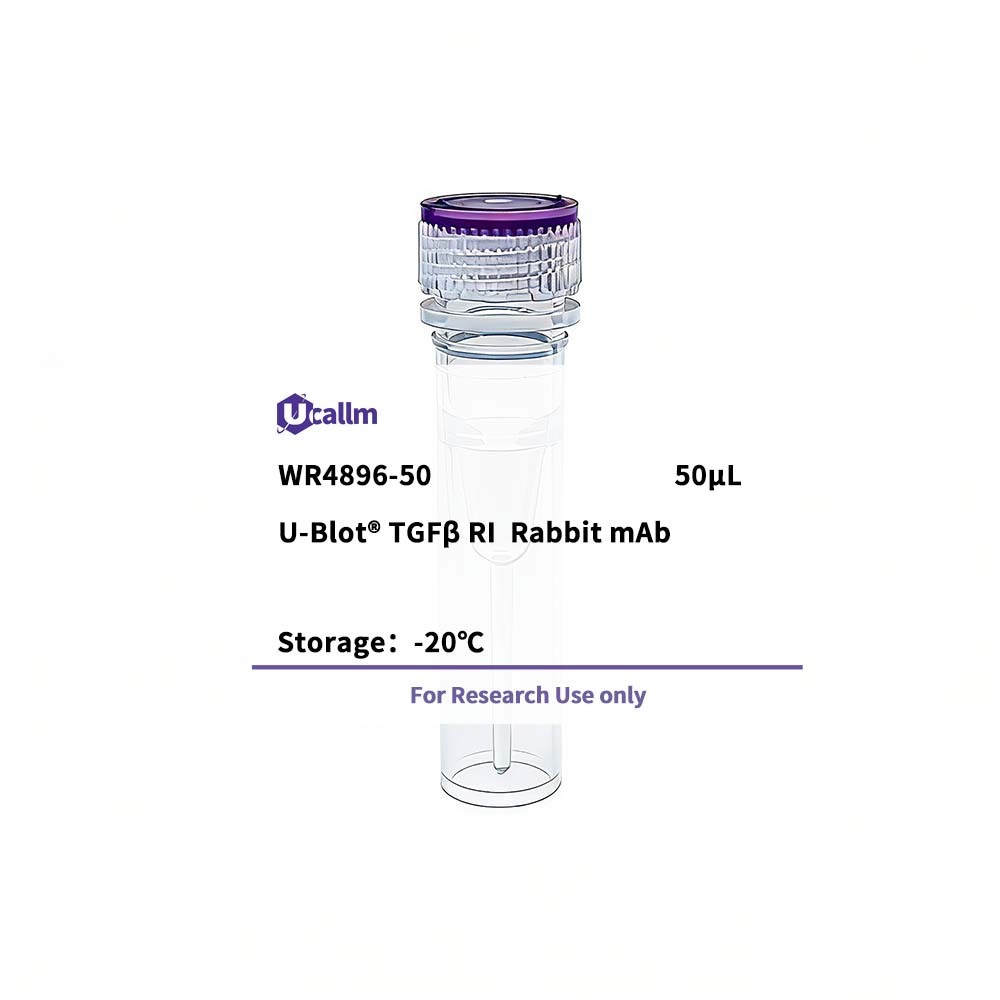
U-Blot® TGFβ RI Rabbit mAb

Price range: $268.00 through $328.00

SKU: WR4896-50
Enter the quantity you would like, or drag the panel to find the quantity and price that best for you
Bulk QuoteAuthorize OEM & ODM

Product details

Background:The protein encoded by this gene forms a heteromeric complex with type II TGF-beta receptors when bound to TGF-beta, transducing the TGF-beta signal from the cell surface to the cytoplasm. The encoded protein is a serine/threonine protein kinase. Mutations in this gene have been associated with Loeys-Dietz aortic aneurysm syndrome (LDAS). Multiple transcript variants encoding different isoforms have been found for this gene. [provided by RefSeq, Aug 2008],

Specifications

Size50μL/100μL
TargetTGF β Receptor I
ReactivityHuman, Mouse, Rat
ApplicationsWB, IF, IP, ELISA
MW(Calculated)56kD
MW(Observed)55kD
Host SpeciesRabbit
IsotypeIgG,Kappa
Conjugate/ModificationUnmodified
Recommended Dilution RatioWB 1:2000-1:10000; IF 1:200-1:1000; ELISA 1:5000-1:20000; IP 1:50-1:200;
FormulationPBS, 50% glycerol, 0.05% Proclin 300, 0.05%BSA
PurificationRecombinant Antibody expressed in animal component-free (ACF) media, purified via Protein A affinity chromatography.
Storage-15°C to -25°C/1 year(Do not lower than -25°C)
Concentration
ClonalityMonoclonal
Clone NumberRM1069R
ImmunogenThe specific immunogen used to produce this antibody is proprietary information.
SpecificityEndogenous
Gene NameTGFBR1 ALK5 SKR4
Protein NameTGF-beta receptor type-1
Other NameTGFBR1; / ALK5; / SKR4; / TGF-beta receptor type-1; / TGFR-1; / Activin A receptor type II-like protein kinase of 53kD; / Activin receptor-like kinase 5; / ALK-5; / ALK5; / Serine/threonine-protein kinase receptor R4; / SKR4; / TGF-beta type I receptor; / Transfor
SpeciesHuman
Gene ID7046
UniprotP36897,
Species.1Mouse
Gene ID.121812
Uniprot.1Q64729,
Species.2Rat
Gene ID.2
Uniprot.2P80204
Cellular LocalizationCell membrane; Single-pass type I membrane protein . Cell junction, tight junction . Cell surface . Membrane raft .
Tissue ExpressionFound in all tissues examined, most abundant in placenta and least abundant in brain and heart. Expressed in a variety of cancer cell lines (PubMed:25893292).
Signaling_pathwayCellular Processes >> Cell growth and death >> Cellular senescence;Cellular Processes >> Cellular community - eukaryotes >> Adherens junction;Organismal Systems >> Immune system >> Th17 cell differentiation;Organismal Systems >> Endocrine system >> Relaxin signaling pathway;Organismal Systems >> Development and regeneration >> Osteoclast differentiation;Human Diseases >> Cancer: overview >> Pathways in cancer;Human Diseases >> Cancer: specific types >> Colorectal cancer;Human Diseases >> Cancer: specific types >> Pancreatic cancer;Human Diseases >> Cancer: specific types >> Hepatocellular carcinoma;Human Diseases >> Cancer: specific types >> Gastric cancer;Human Diseases >> Cancer: specific types >> Chronic myeloid leukemia;Environmental Information Processing >> Signal transduction >> MAPK signaling pathway;Environmental Information Processing >> Signal transduction >> TGF-beta signaling pathway;Environmental Information Processing >> Signal transduction >> Hippo signaling pathway;Environmental Information Processing >> Signal transduction >> Apelin signaling pathway;Environmental Information Processing >> Signal transduction >> FoxO signaling pathway;Environmental Information Processing >> Signaling molecules and interaction >> Cytokine-cytokine receptor interaction
Research Areas>>MAPK signaling pathway; / >>Cytokine-cytokine receptor interaction; / >>FoxO signaling pathway; / >>Endocytosis; / >>Cellular senescence; / >>TGF-beta signaling pathway; / >>Apelin signaling pathway; / >>Osteoclast differentiation; / >>Hippo signaling pathway; / >>Adherens junction; / >>Th17 cell differentiation; / >>Relaxin signaling pathway; / >>AGE-RAGE signaling pathway in diabetic complications; / >>Chagas disease; / >>Hepatitis B; / >>Human T-cell leukemia virus 1 infection; / >>Pathways in cancer; / >>Colorectal cancer; / >>Pancreatic cancer; / >>Chronic myeloid leukemia; / >>Hepatocellular carcinoma; / >>Gastric cancer; / >>Diabetic cardiomyopathy
FunctionCatalytic activity:ATP + [receptor-protein] = ADP + [receptor-protein] phosphate.,cofactor:Magnesium or manganese.,Disease:Defects in TGFBR1 are the cause of aortic aneurysm familial thoracic type 5 (AAT5) [MIM:608967]. Aneurysms and dissections of the aorta usually result from degenerative changes in the aortic wall. Thoracic aortic aneurysms and dissections are primarily associated with a characteristic histologic appearance known as 'medial necrosis' in which there is degeneration and fragmentation of elastic fibers, loss of smooth muscle cells, and an accumulation of basophilic ground substance.,Disease:Defects in TGFBR1 are the cause of Loeys-Dietz syndrome type 1A (LDS1A) [MIM:609192]; also known as Furlong syndrome or Loeys-Dietz aortic aneurysm syndrome (LDAS). LDS1 is an aortic aneurysm syndrome with widespread systemic involvement. The disorder is characterized by arterial tortuosity and aneurysms, craniosynostosis, hypertelorism, and bifid uvula or cleft palate. Other findings include exotropy, micrognathia and retrognathia, structural brain abnormalities, intellectual deficit, congenital heart disease, translucent skin, joint hyperlaxity and aneurysm with dissection throughout the arterial tree.,Disease:Defects in TGFBR1 are the cause of Loeys-Dietz syndrome type 2A (LDS2A) [MIM:608967]. LDS2 is an aortic aneurysm syndrome with widespread systemic involvement. Physical findings include prominent joint laxity, easy bruising, wide and atrophic scars, velvety and translucent skin with easily visible veins, spontaneous rupture of the spleen or bowel, diffuse arterial aneurysms and dissections, and catastrophic complications of pregnancy, including rupture of the gravid uterus and the arteries, either during pregnancy or in the immediate postpartum period. LDS2 is characterized by the absence of craniofacial abnormalities with the exception of bifid uvula that can be present in some patients.,Function:On ligand binding, forms a receptor complex consisting of two type II and two type I transmembrane serine/threonine kinases. Type II receptors phosphorylate and activate type I receptors which autophosphorylate, then bind and activate SMAD transcriptional regulators. Receptor for TGF-beta.,PTM:Phosphorylated at basal levels in the absence of ligand binding. Activated by multiple phosphorylation, mainly in the GS region.,similarity:Belongs to the protein kinase superfamily.,similarity:Belongs to the protein kinase superfamily. TKL Ser/Thr protein kinase family. TGFB receptor subfamily.,similarity:Contains 1 GS domain.,similarity:Contains 1 protein kinase domain.,subunit:Interacts with CD109. The unphosphorylated protein interacts with FKBP1A and is stabilized the inactive conformation. Phosphorylation of the GS region abrogates FKBP1A binding. Interacts with SMAD2 when phosphorylated on several residues in the GS region.,tissue specificity:Found in all tissues examined, most abundant in placenta and least abundant in brain and heart.,
Please login to post questions
Back to Top
Product has been added to your cart