

U-Blot® Trk B Rabbit mAb
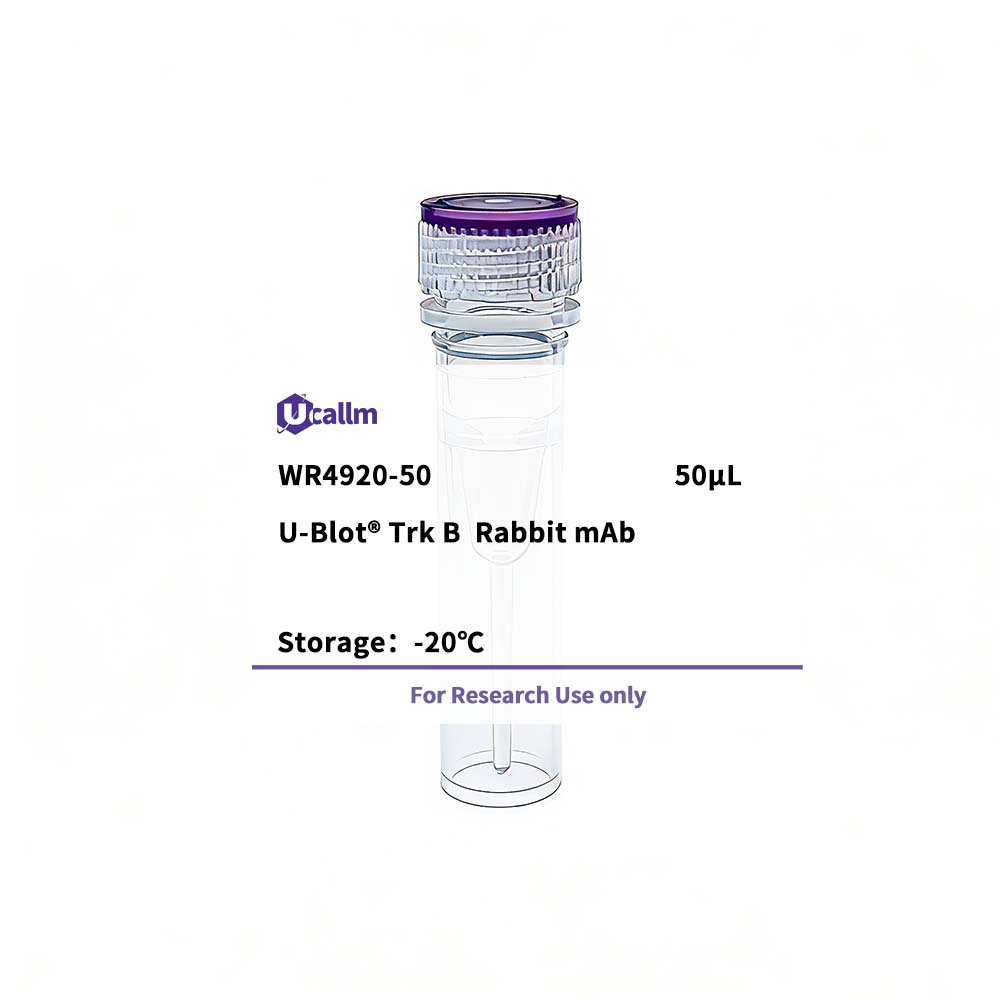
Ucallm_WR4920-50
Price range: $268.00 through $328.00
Product details
Background:This gene encodes a member of the neurotrophic tyrosine receptor kinase (NTRK) family. This kinase is a membrane-bound receptor that, upon neurotrophin binding, phosphorylates itself and members of the MAPK pathway. Signalling through this kinase leads to cell differentiation. Mutations in this gene have been associated with obesity and mood disorders. Alternative splicing results in multiple transcript variants. [provided by RefSeq, May 2014],
Specifications
| Size | 50μL/100μL |
| Target | Trk B |
| Reactivity | Human, Mouse, Rat |
| Applications | WB, IHC, IF, ELISA |
| MW(Calculated) | 92kD |
| MW(Observed) | 130kD |
| Host Species | Rabbit |
| Isotype | IgG,Kappa |
| Conjugate/Modification | Unmodified |
| Recommended Dilution Ratio | IHC 1:100-1:500; WB 1:2000-1:10000; IF 1:200-1:1000; ELISA 1:5000-1:20000; / Note: For IHC, we suggest antigen retrieval with TE buffer pH 9.0 (Cat#WT1004) |
| Formulation | PBS, 50% glycerol, 0.05% Proclin 300, 0.05%BSA |
| Purification | Recombinant Antibody expressed in animal component-free (ACF) media, purified via Protein A affinity chromatography. |
| Storage | -15°C to -25°C/1 year(Do not lower than -25°C) |
| Concentration | |
| Clonality | Monoclonal |
| Clone Number | RM1150R |
| Immunogen | The specific immunogen used to produce this antibody is proprietary information. |
| Specificity | Endogenous |
| Gene Name | NTRK2 |
| Protein Name | BDNF/NT-3 growth factors receptor |
| Other Name | NTRK2; / TRKB; / BDNF/NT-3 growth factors receptor; / GP145-TrkB; / Trk-B; / Neurotrophic tyrosine kinase receptor type 2; / TrkB tyrosine kinase; / Tropomyosin-related kinase B |
| Species | Human |
| Gene ID | 4915 |
| Uniprot | Q16620, |
| Species.1 | Mouse |
| Gene ID.1 | 18212 |
| Uniprot.1 | P15209, |
| Species.2 | Rat |
| Gene ID.2 | 25054 |
| Uniprot.2 | Q63604 |
| Cellular Localization | Cell membrane; Single-pass type I membrane protein . Endosome membrane; Single-pass type I membrane protein . Early endosome membrane . Cell projection, axon . Cell projection, dendrite . Cytoplasm, perinuclear region . Cell junction, synapse, postsynaptic density . Internalized to endosomes upon ligand-binding. . |
| Tissue Expression | Isoform TrkB is expressed in the central and peripheral nervous system. In the central nervous system (CNS), expression is observed in the cerebral cortex, hippocampus, thalamus, choroid plexus, granular layer of the cerebellum, brain stem, and spinal cord. In the peripheral nervous system, it is expressed in many cranial ganglia, the ophthalmic nerve, the vestibular system, multiple facial structures, the submaxillary glands, and dorsal root ganglia. Isoform TrkB-T1 is mainly expressed in the brain but also detected in other tissues including pancreas, kidney and heart. Isoform TrkB-T-Shc is predominantly expressed in the brain. |
| Signaling_pathway | Organismal Systems >> Nervous system >> Neurotrophin signaling pathway;Environmental Information Processing >> Signal transduction >> MAPK signaling pathway;Environmental Information Processing >> Signal transduction >> Ras signaling pathway;Environmental Information Processing >> Signal transduction >> Calcium signaling pathway;Environmental Information Processing >> Signal transduction >> PI3K-Akt signaling pathway |
| Research Areas | >>MAPK signaling pathway; / >>Ras signaling pathway; / >>Calcium signaling pathway; / >>PI3K-Akt signaling pathway; / >>Neurotrophin signaling pathway; / >>Alcoholism |
| Function | Alternative products:Additional isoforms seem to exist,Catalytic activity:ATP + a [protein]-L-tyrosine = ADP + a [protein]-L-tyrosine phosphate.,Function:Receptor for brain-derived neurotrophic factor (BDNF), neurotrophin-3 and neurotrophin-4/5 but not nerve growth factor (NGF). Involved in the development and/or maintenance of the nervous system. This is a tyrosine-protein kinase receptor. Known substrates for the TRK receptors are SHC1, PI-3 kinase, and PLC-gamma-1.,PTM:Ligand-mediated auto-phosphorylation.,similarity:Belongs to the protein kinase superfamily. Tyr protein kinase family.,similarity:Belongs to the protein kinase superfamily. Tyr protein kinase family. Insulin receptor subfamily.,similarity:Contains 1 protein kinase domain.,similarity:Contains 2 Ig-like C2-type (immunoglobulin-like) domains.,similarity:Contains 2 LRR (leucine-rich) repeats.,subunit:Exists in a dynamic equilibrium between monomeric (low affinity) and dimeric (high affinity) structures. Binds SH2B2. Interacts with SQSTM1 and KIDINS220.,tissue specificity:Isoform TrkB is widely expressed, mainly in the nervous tissue. In the CNS, expression is observed in the cerebral cortex, hippocampus, thalamus, choroid plexus, granular layer of the cerebellum, brain stem, and spinal cord. In the peripheral nervous system, it is expressed in many cranial ganglia, the ophtalmic nerve, the vestibular system, multiple facial structures, the submaxillary glands, and dorsal root ganglia. Isoform TrkB-T1 is expressed in multiple tissues, mainly in brain, pancreas, kidney and heart. Isoform TrkB-T-Shc is predominantly expressed in brain., |
Please login to post questions
Related products





