SKU: WR5309 Categories: ,

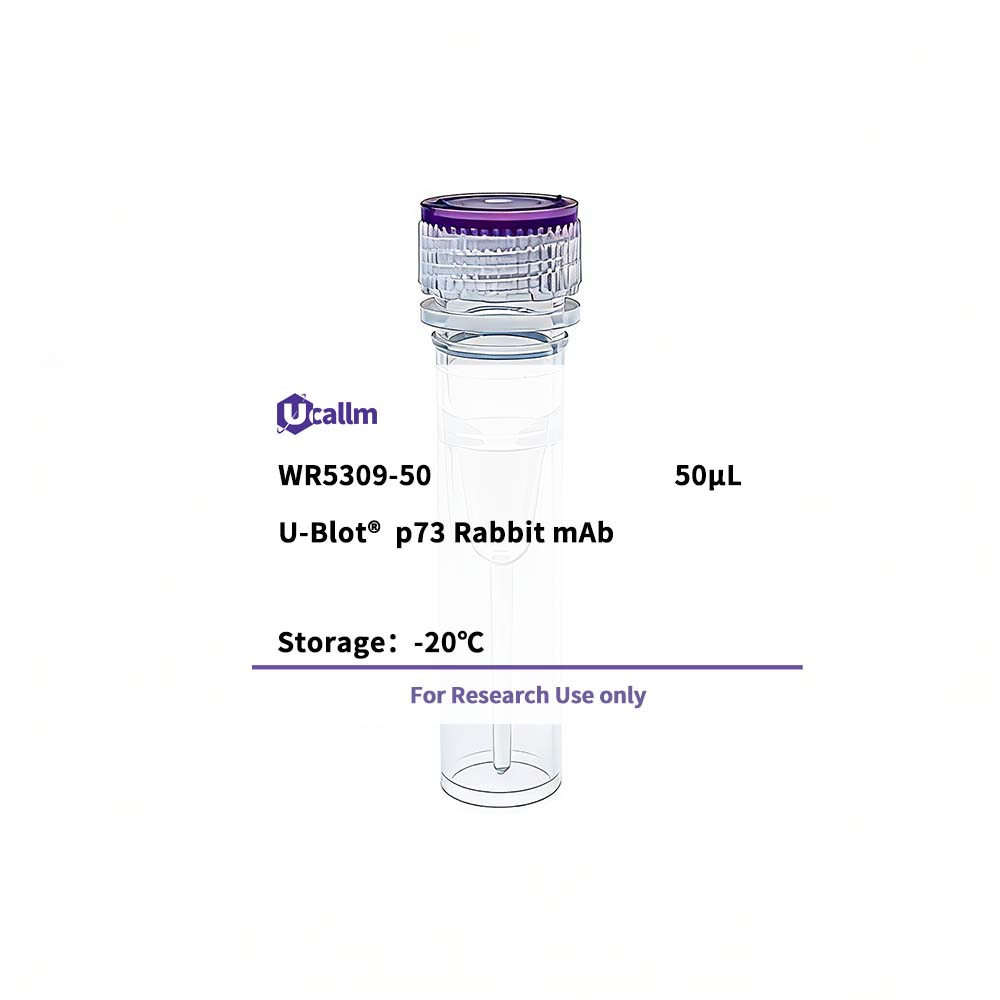
U-Blot® p73 Rabbit mAb

Price range: $268.00 through $328.00

SKU: WR5309-50
Enter the quantity you would like, or drag the panel to find the quantity and price that best for you
Bulk QuoteAuthorize OEM & ODM

Product details

Background:tumor protein p73(TP73) Homo sapiens This gene encodes a member of the p53 family of transcription factors involved in cellular responses to stress and development. It maps to a region on chromosome 1p36 that is frequently deleted in neuroblastoma and other tumors, and thought to contain multiple tumor suppressor genes. The demonstration that this gene is monoallelically expressed (likely from the maternal allele), supports the notion that it is a candidate gene for neuroblastoma. Many transcript variants resulting from alternative splicing and/or use of alternate promoters have been found for this gene, but the biological validity and the full-length nature of some variants have not been determined. [provided by RefSeq, Feb 2011],

Specifications

Targetp73
ReactivityHuman, Mouse
ApplicationsWB, IHC, IF, ELISA
MW(Calculated)70kD
MW(Observed)70kD
Host SpeciesRabbit
IsotypeIgG,Kappa
Conjugate/ModificationUnmodified
Modification
Recommended Dilution RatioIHC 1:200-1:1000; WB 1:1000-1:5000; IF 1:200-1:1000; ELISA 1:5000-1:20000; / Note: For IHC, we suggest antigen retrieval with TE buffer pH 9.0 (Cat#YS0004)
FormulationPBS, 50% glycerol, 0.05% Proclin 300, 0.05%BSA
Source
PurificationRecombinant Antibody expressed in animal component-free (ACF) media, purified via Protein A affinity chromatography.
Purity
Storage-15°C to -25°C/1 year(Do not lower than -25°C)
Concentration
ClonalityMonoclonal
Clone NumberPT1535R
ImmunogenThe specific immunogen used to produce this antibody is proprietary information.
Sequence
SpecificityEndogenous
Gene NameTP73
Protein NameTumor protein p73
Other NameTP73; / P73; / Tumor protein p73; / p53-like transcription factor; / p53-related protein
SpeciesHuman
Gene ID-17161
UniprotO15350,
Species.1Mouse
Gene ID-2
Uniprot.1Q9JJP2
Species.2
Gene ID-3
Uniprot.2
Organism-4
Gene ID-4
SwissProt-4
Backgroundtumor protein p73(TP73) Homo sapiens This gene encodes a member of the p53 family of transcription factors involved in cellular responses to stress and development. It maps to a region on chromosome 1p36 that is frequently deleted in neuroblastoma and other tumors, and thought to contain multiple tumor suppressor genes. The demonstration that this gene is monoallelically expressed (likely from the maternal allele), supports the notion that it is a candidate gene for neuroblastoma. Many transcript variants resulting from alternative splicing and/or use of alternate promoters have been found for this gene, but the biological validity and the full-length nature of some variants have not been determined. [provided by RefSeq, Feb 2011],
Cellular LocalizationNucleus . Cytoplasm. Accumulates in the nucleus in response to DNA damage.
Tissue ExpressionExpressed in striatal neurons of patients with Huntington disease (at protein level). Brain, kidney, placenta, colon, heart, liver, spleen, skeletal muscle, prostate, thymus and pancreas. Highly expressed in fetal tissue. Expressed in the respiratory epithelium (PubMed:34077761).
Signaling_pathwayCellular Processes >> Cell growth and death >> p53 signaling pathway;Organismal Systems >> Nervous system >> Neurotrophin signaling pathway;Environmental Information Processing >> Signal transduction >> Hippo signaling pathway
Research Areas
Functioncofactor:Binds 1 zinc ion per subunit.,Disease:Maps to a chromosome region frequently mutated in diverse cell lines of human cancer. Appears not to be frequently mutated in human cancers, in contrast to p53. Hemizygosity is observed in neuroblastoma and oligodendroglioma.,Domain:Possesses an acidic transactivation domain, a central DNA binding domain and a C-terminal oligomerization domain that binds to the ABL tyrosine kinase SH3 domain.,Domain:The WW-binding motif mediates interaction with WWOX.,Function:Participates in the apoptotic response to DNA damage. Isoforms containing the transactivation domain are pro-apoptotic, isoforms lacking the domain are anti-apoptotic and block the function of p53 and transactivating p73 isoforms. May be a tumor suppressor protein.,induction:Not induced by DNA damage. Isoforms lacking the transactivation domain block gene induction.,miscellaneous:Activated and stabilized by interaction with RANBP9.,PTM:Isoform alpha (but not isoform beta) is sumoylated on Lys-627, which potentiates proteasomal degradation but does not affect transcriptional activity.,similarity:Belongs to the p53 family.,similarity:Contains 1 SAM (sterile alpha motif) domain.,subcellular location:Accumulates in the nucleus in response to DNA damage.,subunit:Found in a complex with p53/TP53 and CABLES1. The C-terminal oligomerization domain binds to the ABL tyrosine kinase SH3 domain. Interacts with HECW2. Isoform Beta interacts homotypically and with p53/TP53, whereas isoform Alpha does not. Isoform Gamma interacts homotypically and with all p73 isoforms. Isoform Delta interacts with isoform Gamma, isoform Alpha, and homotypically. Isoforms Alpha and Beta interact with HIPK2. Isoform Alpha interacts with RANBP9. Isoform Beta interacts with WWOX.,tissue specificity:Brain, kidney, placenta, colon, heart, liver, spleen, skeletal muscle, prostate, thymus and pancreas. Highly expressed in fetal tissue.,
RRID
Please login to post questions
Back to Top
Product has been added to your cart