SKU: WR5284 Categories: ,

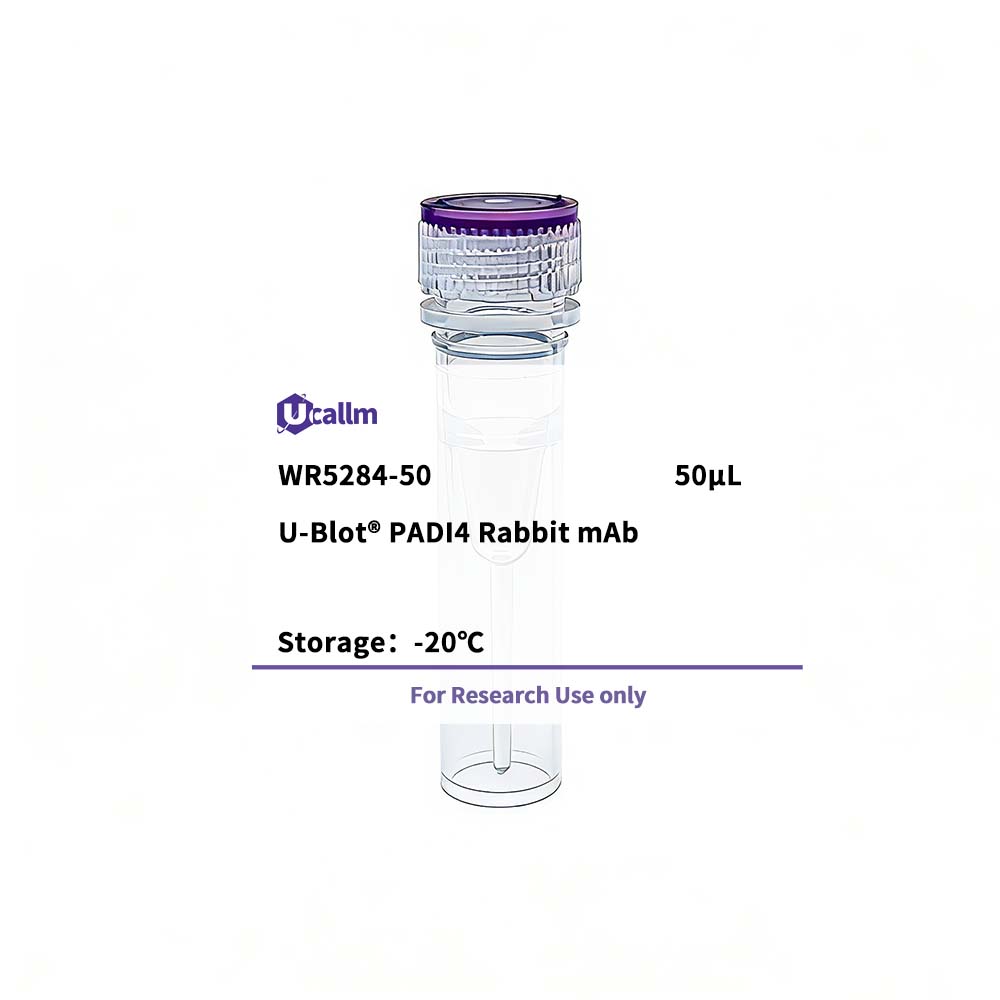
U-Blot® PADI4 Rabbit mAb

Price range: $268.00 through $328.00

SKU: WR5284-100
Enter the quantity you would like, or drag the panel to find the quantity and price that best for you
Bulk QuoteAuthorize OEM & ODM

Product details

Background:This gene is a member of a gene family which encodes enzymes responsible for the conversion of arginine residues to citrulline residues. This gene may play a role in granulocyte and macrophage development leading to inflammation and immune response. [provided by RefSeq, Jul 2008]

Specifications

Size50μL/100μL
TargetPADI4
ReactivityHuman, Mouse, Rat
ApplicationsWB, IHC, IF, ELISA
MW(Calculated)74kD
MW(Observed)80kD
Host SpeciesRabbit
IsotypeIgG,Kappa
Conjugate/ModificationUnmodified
Recommended Dilution RatioIHC 1:200-1:1000; WB 1:2000-1:10000; IF 1:200-1:1000; ELISA 1:5000-1:20000; / Note: For IHC, we suggest antigen retrieval with TE buffer pH 9.0 (Cat#WT1004)
FormulationPBS, 50% glycerol, 0.05% Proclin 300, 0.05%BSA
PurificationRecombinant Antibody expressed in animal component-free (ACF) media, purified via Protein A affinity chromatography.
Storage-15°C to -25°C/1 year(Do not lower than -25°C)
Concentration
ClonalityMonoclonal
Clone NumberRM1538R
ImmunogenThe specific immunogen used to produce this antibody is proprietary information.
SpecificityEndogenous
Gene NamePAD4 PADI5 PDI5
Protein NameProtein-arginine deiminase type-4
Other NamePADI4; / PAD4; / PADI5; / PDI5; / HL-60 PAD; / Peptidylarginine deiminase IV; / Protein-arginine deiminase type IV
SpeciesHuman
Gene ID23569
UniprotQ9UM07,
Species.1Mouse
Gene ID.118602
Uniprot.1Q9Z183,
Species.2Rat
Gene ID.229512
Uniprot.2O88807
Cellular LocalizationCytoplasm . Nucleus . Cytoplasmic granule . Cytoplasmic granules of eosinophils and neutrophils. .
Tissue ExpressionExpressed in eosinophils and neutrophils, not expressed in peripheral monocytes or lymphocytes.
Signaling_pathwayOrganismal Systems >> Immune system >> Neutrophil extracellular trap formation
Research Areas
FunctionCatalyzes the citrullination/deimination of arginine residues of proteins such as histones, thereby playing a key role in histone code and regulation of stem cell maintenance (PubMed:15339660, PubMed:15345777, PubMed:16567635, PubMed:21245532). Citrullinates histone H1 at 'Arg-54' (to form H1R54ci), histone H3 at 'Arg-2', 'Arg-8', 'Arg-17' and/or 'Arg-26' (to form H3R2ci, H3R8ci, H3R17ci, H3R26ci, respectively) and histone H4 at 'Arg-3' (to form H4R3ci) (PubMed:15339660, PubMed:15345777, PubMed:16567635, PubMed:21245532). Acts as a key regulator of stem cell maintenance by mediating citrullination of histone H1: citrullination of 'Arg-54' of histone H1 (H1R54ci) results in H1 displacement from chromatin and global chromatin decondensation, thereby promoting pluripotency and stem cell maintenance (PubMed:15339660, PubMed:15345777, PubMed:16567635, PubMed:21245532). Promotes profound chromatin decondensation during the innate immune response to infection in neutrophils by mediating formation of H1R54ci (PubMed:18209087). Required for the formation of neutrophil extracellular traps (NETs); NETs are mainly composed of DNA fibers and are released by neutrophils to bind pathogens during inflammation (By similarity). Citrullination of histone H3 prevents their methylation by CARM1 and HRMT1L2/PRMT1 and represses transcription (PubMed:15345777). Citrullinates EP300/P300 at 'Arg-2142', which favors its interaction with NCOA2/GRIP1 (PubMed:15731352).
Please login to post questions
Back to Top
Product has been added to your cart
