


U-Blot® PTGER2 Rabbit mAb
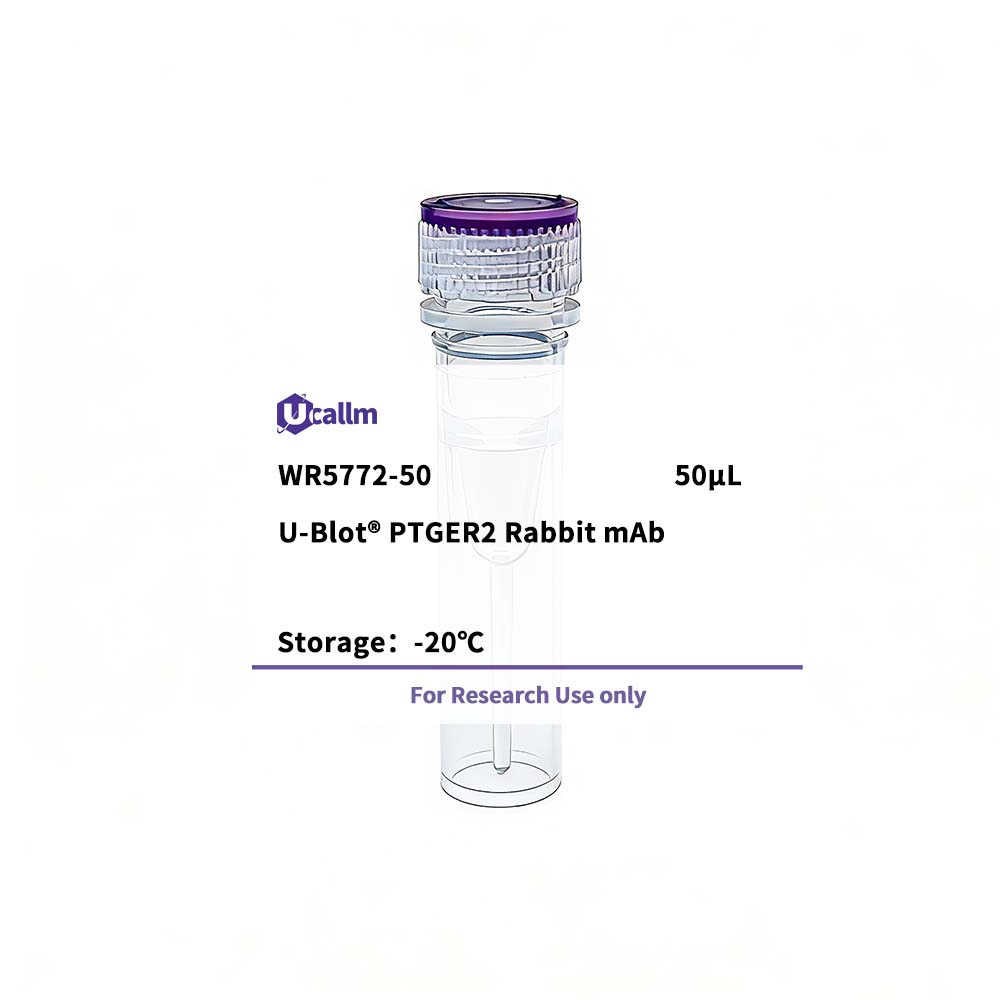
Ucallm_WR5772-50
Price range: $268.00 through $328.00
Specifications
| Size | 50μL/100μL |
| Target | PTGER2 |
| Reactivity | Human, Mouse, Rat |
| Applications | WB, IHC, IF, ELISA |
| MW(Calculated) | 40kD |
| MW(Observed) | 60kD |
| Host Species | Rabbit |
| Isotype | IgG,Kappa |
| Conjugate/Modification | Unmodified |
| Recommended Dilution Ratio | IHC 1:200-1:1000; WB 1:2000-1:10000; IF 1:200-1:1000; ELISA 1:5000-1:20000; / Note: For IHC, we suggest antigen retrieval with TE buffer pH 9.0 (Cat#WT1004) |
| Formulation | PBS, 50% glycerol, 0.05% Proclin 300, 0.05%BSA |
| Purification | Recombinant Antibody expressed in animal component-free (ACF) media, purified via Protein A affinity chromatography. |
| Storage | -15°C to -25°C/1 year(Do not lower than -25°C) |
| Concentration | |
| Clonality | Monoclonal |
| Clone Number | RM1735R |
| Immunogen | The specific immunogen used to produce this antibody is proprietary information. |
| Specificity | Endogenous |
| Gene Name | PTGER2 |
| Protein Name | Prostaglandin E2 receptor EP2 subtype |
| Other Name | PTGER2; / Prostaglandin E2 receptor EP2 subtype; / PGE receptor EP2 subtype; / PGE2 receptor EP2 subtype; / Prostanoid EP2 receptor |
| Species | Human |
| Gene ID | 5732 |
| Uniprot | P43116, |
| Species.1 | Mouse |
| Gene ID.1 | 19217 |
| Uniprot.1 | Q62053, |
| Species.2 | Rat |
| Gene ID.2 | 81752 |
| Uniprot.2 | Q62928 |
| Cellular Localization | Cell membrane; Multi-pass membrane protein. |
| Tissue Expression | Placenta and lung. |
| Signaling_pathway | Organismal Systems >> Sensory system >> Inflammatory mediator regulation of TRP channels;Human Diseases >> Cancer: overview >> Pathways in cancer;Environmental Information Processing >> Signal transduction >> cAMP signaling pathway |
| Research Areas | >>cAMP signaling pathway; / >>Neuroactive ligand-receptor interaction; / >>Inflammatory mediator regulation of TRP channels; / >>Renin secretion; / >>Human cytomegalovirus infection; / >>Pathways in cancer |
| Function | Function:Receptor for prostaglandin E2 (PGE2). The activity of this receptor is mediated by G(s) proteins that stimulate adenylate cyclase. The subsequent raise in intracellular cAMP is responsible for the relaxing effect of this receptor on smooth muscle.,similarity:Belongs to the G-protein coupled receptor 1 family.,tissue specificity:Placenta and lung., |
Please login to post questions
Related products





