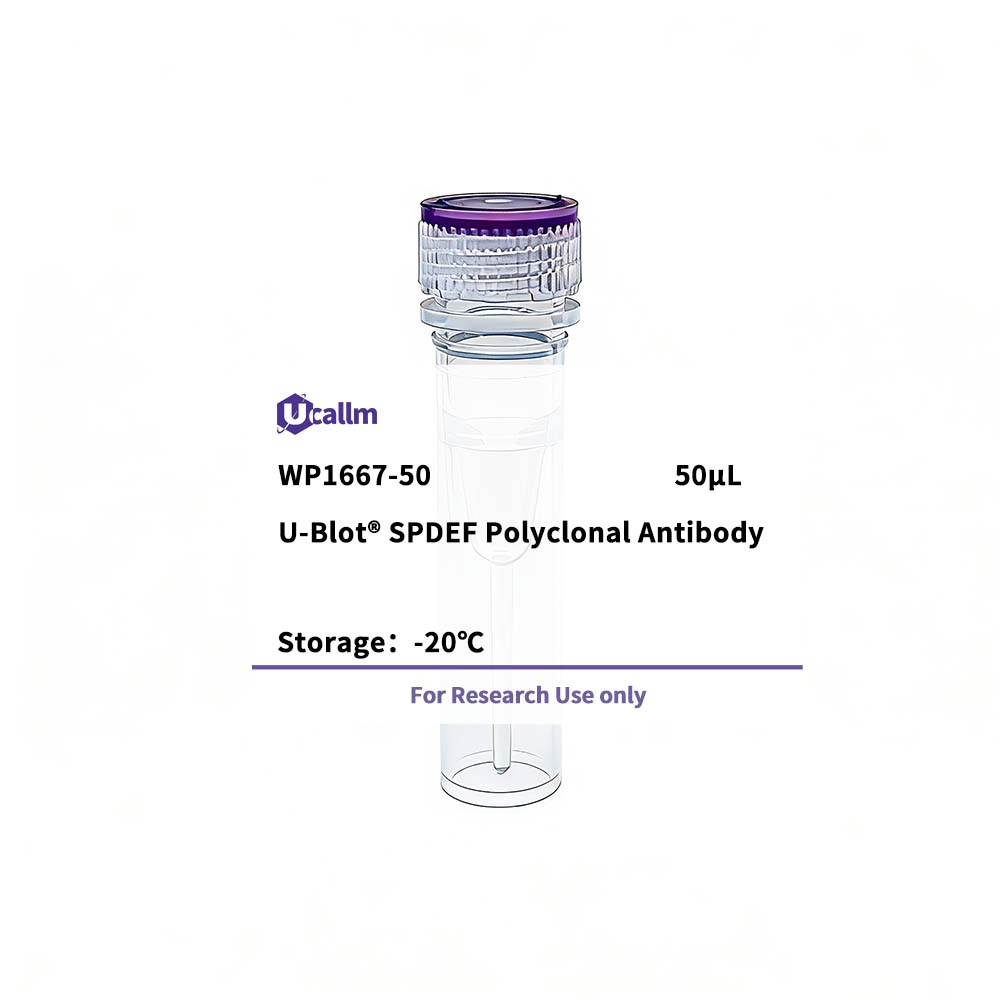
SKU: WP1667 Categories: ,

SPDEF Polyclonal Antibody

Price range: $268.00 through $328.00

SKU: WP1667-100
Enter the quantity you would like, or drag the panel to find the quantity and price that best for you
Bulk QuoteAuthorize OEM & ODM

Product details

Background:

The protein encoded by this gene belongs to the ETS family of transcription factors. It is highly expressed in the prostate epithelial cells, and functions as an androgen-independent transactivator of prostate-specific antigen (PSA) promoter. Higher expression of this protein has also been reported in brain, breast, lung and ovarian tumors, compared to the corresponding normal tissues, and it shows better tumor-association than other cancer-associated molecules, making it a more suitable target for developing specific cancer therapies. Alternatively spliced transcript variants encoding different isoforms have been found for this gene. [provided by RefSeq, Nov 2011],

Specifications

Size50μL/100μL
TargetSPDEF
ReactivityHuman, Mouse
ApplicationsWB, ELISA
MW(Calculated)
MW(Observed)36kD
Host SpeciesRabbit
IsotypeIgG
Conjugate/ModificationUnmodified
Recommended Dilution RatioWB 1:500-2000; ELISA 1:5000-20000
FormulationLiquid in PBS containing 50% glycerol,0.5% BSA and 0.02% sodium azide.
PurificationThe antibody was affinity-purified from rabbit antiserum by affinity-chromatography using epitope-specific immunogen.
Storage-15°C to -25°C/1 year(Do not lower than -25°C)
Concentration1 mg/ml
ClonalityPolyclonal
Clone Number
ImmunogenSynthesized peptide derived from human protein . at AA range: 140-220
SpecificitySPDEF Polyclonal Antibody detects endogenous levels of protein.
Gene NameSPDEF PDEF PSE
Protein NameSAM pointed domain-containing Ets transcription factor (Prostate epithelium-specific Ets transcription factor) (Prostate-specific Ets) (Prostate-derived Ets factor)
Other Name
SpeciesHuman
Gene ID25803
UniprotO95238,
Species.1Mouse
Gene ID.1
Uniprot.1Q9WTP3
Species.2
Gene ID.2
Uniprot.2
Cellular LocalizationNucleus .
Tissue ExpressionExpressed in a very restricted set of primarily hormone-regulated epithelial tissues with particularly high expression in the prostate gland. Significantly lower expression is seen in other hormone regulated tissues such as mammary gland, salivary gland, and ovary. Expressed in prostate carcinoma cells.
Signaling_pathway
Research Areas
FunctionFunction:May function as an androgen-independent transactivator of the prostate-specific antigen (PSA) promoter. Binds to 5'-GGAT-3' DNA sequences. May play a role in the regulation of the prostate gland and/or prostate cancer development. Acts as a transcriptional activator for SERPINB5 promoter.,similarity:Belongs to the ETS family.,similarity:Contains 1 ETS DNA-binding domain.,similarity:Contains 1 PNT (pointed) domain.,subunit:Interacts with the DNA-binding domain of the androgen receptor. Interacts with NKX3-1.,tissue specificity:Expressed in a very restricted set of primarily hormone-regulated epithelial tissues with particularly high expression in the prostate gland. Significantly lower expression is seen in other hormone regulated tissues such as mammary gland, salivary gland, and ovary. Expressed in prostate carcinoma cells.,
Please login to post questions
Back to Top
Product has been added to your cart