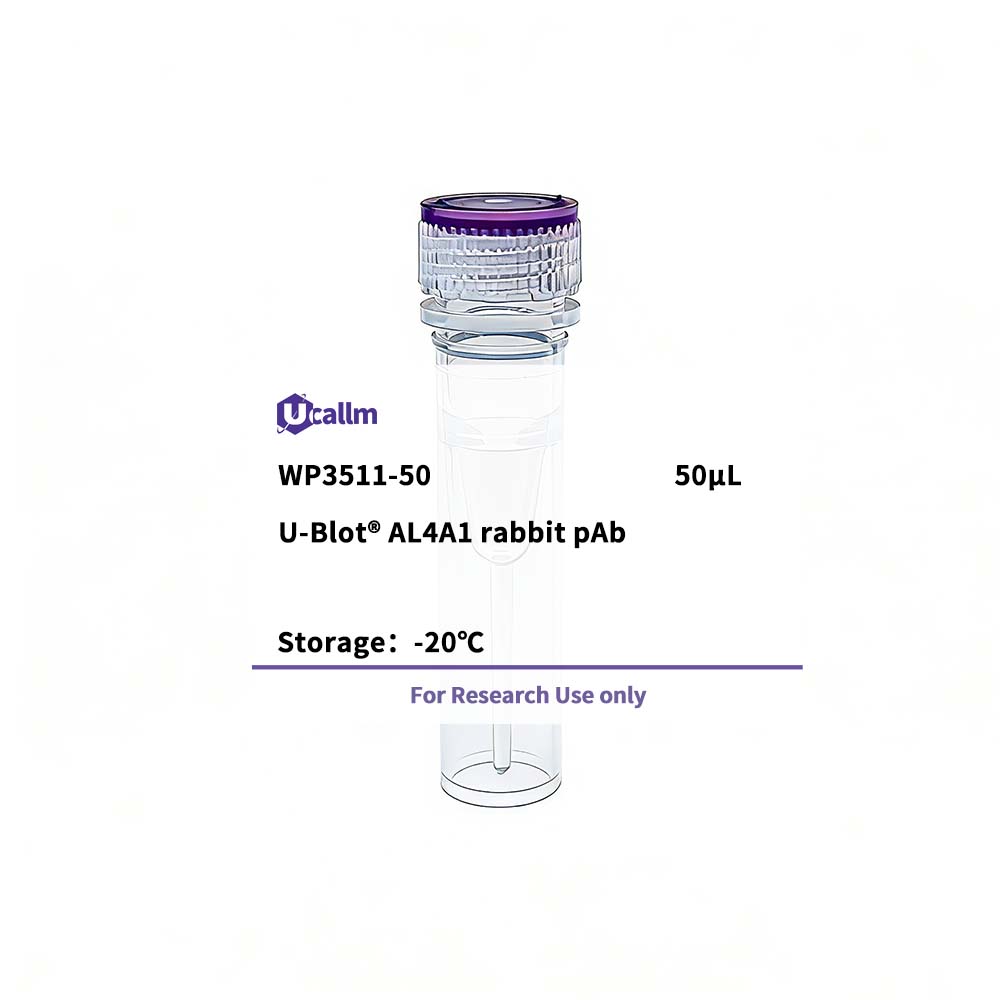
SKU: WP3511 Categories: ,

AL4A1 rabbit pAb

Price range: $268.00 through $328.00

SKU: WP3511-100
Enter the quantity you would like, or drag the panel to find the quantity and price that best for you
Bulk QuoteAuthorize OEM & ODM

Product details

Background:

This protein belongs to the aldehyde dehydrogenase family of proteins. This enzyme is a mitochondrial matrix NAD-dependent dehydrogenase which catalyzes the second step of the proline degradation pathway, converting pyrroline-5-carboxylate to glutamate. Deficiency of this enzyme is associated with type II hyperprolinemia, an autosomal recessive disorder characterized by accumulation of delta-1-pyrroline-5-carboxylate (P5C) and proline. Alternatively spliced transcript variants encoding different isoforms have been identified for this gene. [provided by RefSeq, Jun 2009],

Specifications

Size50μL/100μL
TargetAL4A1
ReactivityHuman, Mouse, Rat
ApplicationsWB
MW(Calculated)
MW(Observed)60kD
Host SpeciesRabbit
IsotypeIgG
Conjugate/ModificationUnmodified
Recommended Dilution RatioWB 1:500-2000
FormulationLiquid in PBS containing 50% glycerol, 0.5% BSA and 0.02% sodium azide.
PurificationThe antibody was affinity-purified from rabbit antiserum by affinity-chromatography using epitope-specific immunogen.
Storage-15°C to -25°C/1 year(Do not lower than -25°C)
Concentration1 mg/ml
ClonalityPolyclonal
Clone Number
ImmunogenSynthesized peptide derived from human AL4A1 AA range: 39-89
SpecificityThis antibody detects endogenous levels of AL4A1 at Human/Mouse/Rat
Gene NameALDH4A1 ALDH4 P5CDH
Protein NameAL4A1
Other NameDelta-1-pyrroline-5-carboxylate dehydrogenase, mitochondrial; / P5C dehydrogenase; / Aldehyde dehydrogenase family 4 member A1
SpeciesHuman
Gene ID8659
UniprotP30038,
Species.1Mouse
Gene ID.1212647
Uniprot.1Q8CHT0,
Species.2Rat
Gene ID.2
Uniprot.2P0C2X9
Cellular LocalizationMitochondrion matrix.
Tissue ExpressionHighest expression is found in liver followed by skeletal muscle, kidney, heart, brain, placenta, lung and pancreas.
Signaling_pathway
Research Areas>>Alanine, aspartate and glutamate metabolism; / >>Arginine and proline metabolism; / >>Metabolic pathways
FunctionCatalytic activity:(S)-1-pyrroline-5-carboxylate + NAD(P)(+) + 2 H(2)O = L-glutamate + NAD(P)H.,Disease:Defects in ALDH4A1 are the cause of hyperprolinemia type II (HPII) [MIM:239510]. HPII is characterized by the accumulation of delta-1-pyrroline-5-carboxylate (P5C) and proline. The disorder may be causally related to neurologic manifestations, including seizures and mental retardation.,Function:Irreversible conversion of delta-1-pyrroline-5-carboxylate (P5C), derived either from proline or ornithine, to glutamate. This is a necessary step in the pathway interconnecting the urea and tricarboxylic acid cycles. The preferred substrate is glutamic gamma-semialdehyde, other substrates include succinic, glutaric and adipic semialdehydes.,pathway:Amino-acid degradation; L-proline degradation into L-glutamate; L-glutamate from L-proline: step 2/2.,similarity:Belongs to the aldehyde dehydrogenase family.,subunit:Homodimer.,tissue specificity:Highest expression is found in liver followed by skeletal muscle, kidney, heart, brain, placenta, lung and pancreas.,
Please login to post questions
Back to Top
Product has been added to your cart
