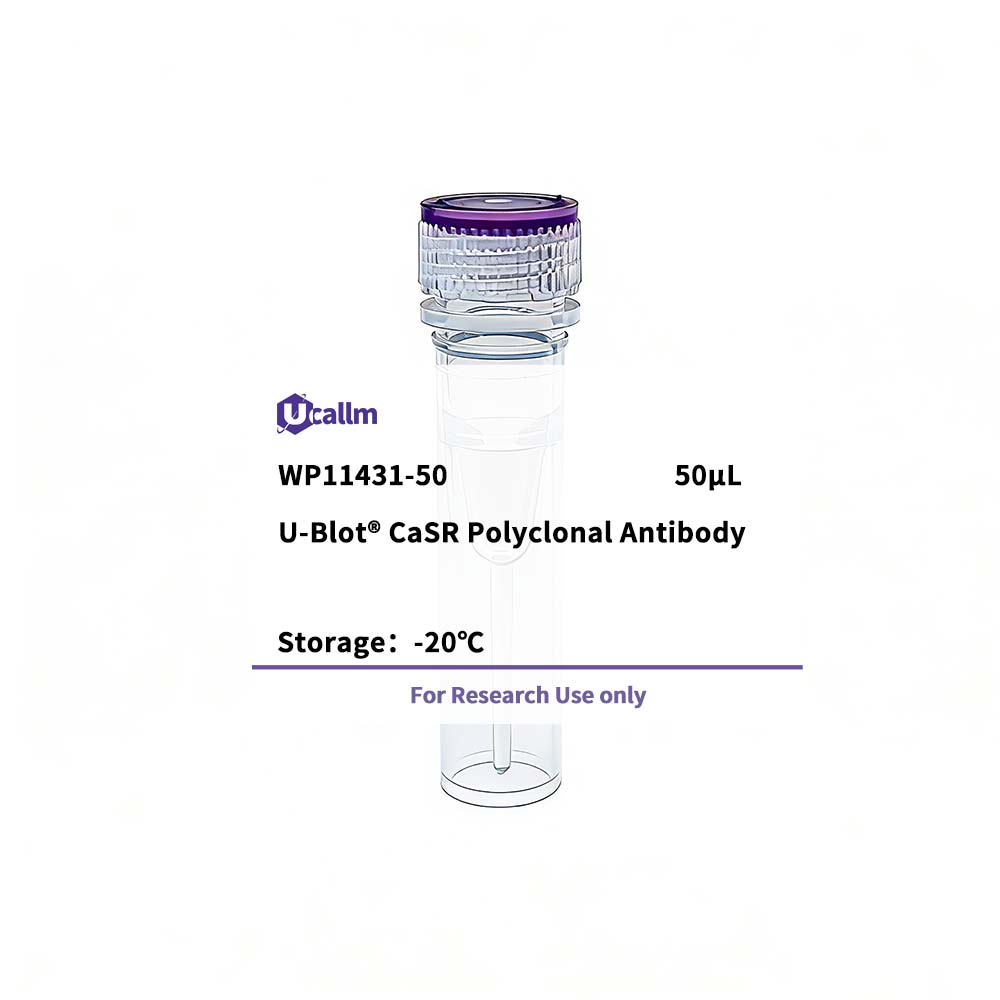
SKU: WP11431 Categories: ,

CaSR Polyclonal Antibody

Price range: $268.00 through $328.00

SKU: WP11431-100
Enter the quantity you would like, or drag the panel to find the quantity and price that best for you
Bulk QuoteAuthorize OEM & ODM

Product details

Background:

The protein encoded by this gene is a G protein-coupled receptor that is expressed in the parathyroid hormone (PTH)-producing chief cells of the parathyroid gland, and the cells lining the kidney tubule. It senses small changes in circulating calcium concentration and couples this information to intracellular signaling pathways that modify PTH secretion or renal cation handling, thus this protein plays an essential role in maintaining mineral ion homeostasis. Mutations in this gene cause familial hypocalciuric hypercalcemia, familial, isolated hypoparathyroidism, and neonatal severe primary hyperparathyroidism. [provided by RefSeq, Jul 2008],


Specifications

Size50μL/100μL
TargetCaSR
ReactivityHuman, Mouse, Rat
ApplicationsWB, IHC, IF, ELISA
MW(Calculated)
MW(Observed)140kD
Host SpeciesRabbit
IsotypeIgG
Conjugate/ModificationUnmodified
Recommended Dilution RatioWB 1:500-1:2000; IHC 1:100-1:300; ELISA 1:5000; IF 1:50-200 / Note: For IHC, we suggest antigen retrieval with TE buffer pH 9.0 (Cat#WT1004)
FormulationLiquid in PBS containing 50% glycerol, 0.5% BSA and 0.02% sodium azide.
PurificationThe antibody was affinity-purified from rabbit antiserum by affinity-chromatography using epitope-specific immunogen.
Storage-15°C to -25°C/1 year(Do not lower than -25°C)
Concentration1 mg/ml
ClonalityPolyclonal
Clone Number
ImmunogenThe antiserum was produced against synthesized peptide derived from human Calcium Sensing Receptor. AA range:854-903
SpecificityCaSR Polyclonal Antibody detects endogenous levels of CaSR protein.
Gene NameCASR
Protein NameExtracellular calcium-sensing receptor
Other NameCASR; / GPRC2A; / PCAR1; / Extracellular calcium-sensing receptor; / CaSR; / Parathyroid cell calcium-sensing receptor; / PCaR1
SpeciesHuman
Gene ID846
UniprotP41180,
Species.1Mouse
Gene ID.112374
Uniprot.1Q9QY96,
Species.2Rat
Gene ID.224247
Uniprot.2P48442
Cellular LocalizationCell membrane; Multi-pass membrane protein .
Tissue ExpressionExpressed in the temporal lobe, frontal lobe, parietal lobe, hippocampus, and cerebellum. Also found in kidney, lung, liver, heart, skeletal muscle, placenta.
Signaling_pathwayOrganismal Systems >> Immune system >> NOD-like receptor signaling pathway
Research Areas>>NOD-like receptor signaling pathway; / >>Parathyroid hormone synthesis, secretion and action
FunctionDisease:Defects in CASR are the cause of autosomal dominant hypoparathyroidism (FIH) [MIM:146200]. FIH is characterized by hypocalcemia and hyperphosphatemia due to inadequate secretion of parathyroid hormone. Symptoms are seizures, tetany and cramps.,Disease:Defects in CASR are the cause of familial hypocalciuric hypercalcemia type 1 (FHH) [MIM:145980]; in which the receptor has reduced activity. FHH is characterized by altered calcium homeostasis. Affected individuals exhibit mild or modest hypercalcemia, relative hypocalciuria, and inappropriately normal PTH levels.,Disease:Defects in CASR are the cause of neonatal severe primary hyperparathyroidism (NSHPT) [MIM:239200]; in which the receptor has reduced activity. NSHPT is a rare autosomal recessive life-threatening disorder characterized by very high serum calcium concentrations, skeletal demineralization, and parathyroid hyperplasia. In some instances NSHPT has been demonstrated to be the homozygous form of FHH.,Function:Senses changes in the extracellular concentration of calcium ions. The activity of this receptor is mediated by a G-protein that activates a phosphatidylinositol-calcium second messenger system.,PTM:N-glycosylated.,PTM:Ubiquitinated by RNF19A; which induces proteasomal degradation.,similarity:Belongs to the G-protein coupled receptor 3 family.,subunit:Interacts with VCP and RNF19A.,tissue specificity:Found in kidney, but not in brain, lung, liver, heart, skeletal muscle, or placenta.,
Please login to post questions
Back to Top
Product has been added to your cart