SKU: WP12365 Categories: ,

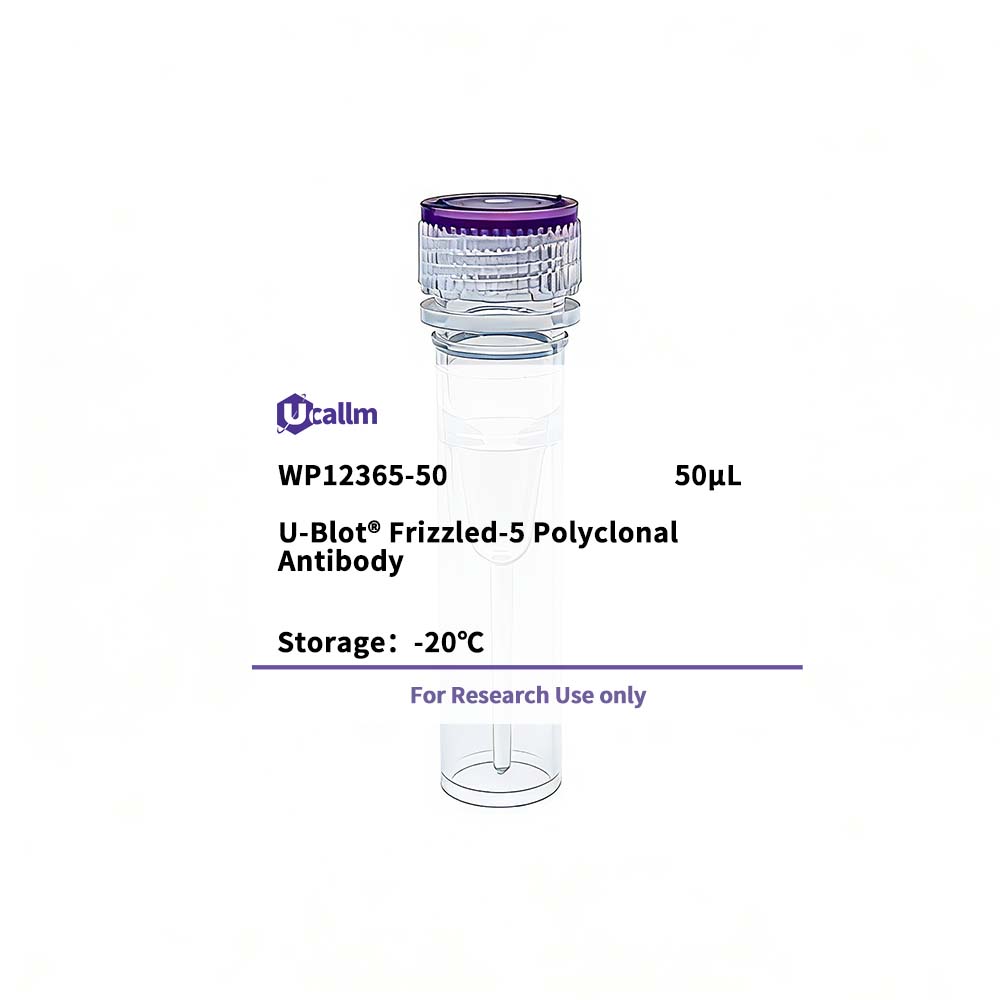
Frizzled-5 Polyclonal Antibody

Price range: $268.00 through $328.00

SKU: WP12365-100
Enter the quantity you would like, or drag the panel to find the quantity and price that best for you
Bulk QuoteAuthorize OEM & ODM

Product details

Background:

frizzled class receptor 5(FZD5) Homo sapiens Members of the 'frizzled' gene family encode 7-transmembrane domain proteins that are receptors for Wnt signaling proteins. The FZD5 protein is believed to be the receptor for the Wnt5A ligand. [provided by RefSeq, Jul 2008],


Specifications

Size50μL/100μL
TargetFrizzled-5
ReactivityHuman, Mouse, Rat
ApplicationsWB, IHC, IF, ELISA
MW(Calculated)
MW(Observed)65kD
Host SpeciesRabbit
IsotypeIgG
Conjugate/ModificationUnmodified
Recommended Dilution RatioWB 1:500-1:2000; IHC 1:100-1:300; IF 1:200-1:1000; ELISA 1:20000; Not yet tested in other applications. / Note: For IHC, we suggest antigen retrieval with TE buffer pH 9.0 (Cat#WT1004)
FormulationLiquid in PBS containing 50% glycerol, 0.5% BSA and 0.02% sodium azide.
PurificationThe antibody was affinity-purified from rabbit antiserum by affinity-chromatography using epitope-specific immunogen.
Storage-15°C to -25°C/1 year(Do not lower than -25°C)
Concentration1 mg/ml
ClonalityPolyclonal
Clone Number
ImmunogenThe antiserum was produced against synthesized peptide derived from human FZD5. AA range:461-510
SpecificityFrizzled-5 Polyclonal Antibody detects endogenous levels of Frizzled-5 protein.
Gene NameFZD5
Protein NameFrizzled-5
Other NameFZD5; / C2orf31; / Frizzled-5; / Fz-5; / hFz5; / FzE5
SpeciesHuman
Gene ID7855
UniprotQ13467,
Species.1Mouse
Gene ID.114367
Uniprot.1Q9EQD0,
Species.2Rat
Gene ID.2317674
Uniprot.2Q8CHL0
Cellular LocalizationCell membrane; Multi-pass membrane protein . Golgi apparatus membrane; Multi-pass membrane protein . Cell junction, synapse . Perikaryon . Cell projection, dendrite . Cell projection, axon . Localized at the plasma membrane and also found at the Golgi. .
Tissue ExpressionOesophageal carcinoma,Retina,
Signaling_pathwayCellular Processes >> Cellular community - eukaryotes >> Signaling pathways regulating pluripotency of stem cells;Human Diseases >> Cancer: overview >> Pathways in cancer;Human Diseases >> Cancer: specific types >> Hepatocellular carcinoma;Human Diseases >> Cancer: specific types >> Gastric cancer;Human Diseases >> Cancer: specific types >> Basal cell carcinoma;Human Diseases >> Cancer: specific types >> Breast cancer;Human Diseases >> Neurodegenerative disease >> Alzheimer disease;Human Diseases >> Neurodegenerative disease >> Pathways of neurodegeneration - multiple diseases;Environmental Information Processing >> Signal transduction >> Wnt signaling pathway;Environmental Information Processing >> Signal transduction >> Hippo signaling pathway;Environmental Information Processing >> Signal transduction >> mTOR signaling pathway
Research Areas>>mTOR signaling pathway; / >>Wnt signaling pathway; / >>Hippo signaling pathway; / >>Signaling pathways regulating pluripotency of stem cells; / >>Melanogenesis; / >>Cushing syndrome; / >>Alzheimer disease; / >>Pathways of neurodegeneration - multiple diseases; / >>Human papillomavirus infection; / >>Pathways in cancer; / >>Proteoglycans in cancer; / >>Basal cell carcinoma; / >>Breast cancer; / >>Hepatocellular carcinoma; / >>Gastric cancer
FunctionDomain:Lys-Thr-X-X-X-Trp motif is involved in the activation of the Wnt/beta-catenin signaling pathway.,Domain:The FZ domain is involved in binding with Wnt ligands.,Domain:The PDZ-binding motif mediates interaction with GOPC.,Function:Receptor for Wnt proteins. Most of frizzled receptors are coupled to the beta-catenin canonical signaling pathway, which leads to the activation of disheveled proteins, inhibition of GSK-3 kinase, nuclear accumulation of beta-catenin and activation of Wnt target genes. A second signaling pathway involving PKC and calcium fluxes has been seen for some family members, but it is not yet clear if it represents a distinct pathway or if it can be integrated in the canonical pathway, as PKC seems to be required for Wnt-mediated inactivation of GSK-3 kinase. Both pathways seem to involve interactions with G-proteins. May be involved in transduction and intercellular transmission of polarity information during tissue morphogenesis and/or in differentiated tissues. Interacts specifically with Wnt5A to induce the beta-catenin pathway.,similarity:Belongs to the G-protein coupled receptor Fz/Smo family.,similarity:Contains 1 FZ (frizzled) domain.,subcellular location:Localized at the plasma membrane and also found at the Golgi.,subunit:Interacts with GOPC.,
Please login to post questions
Back to Top
Product has been added to your cart
