

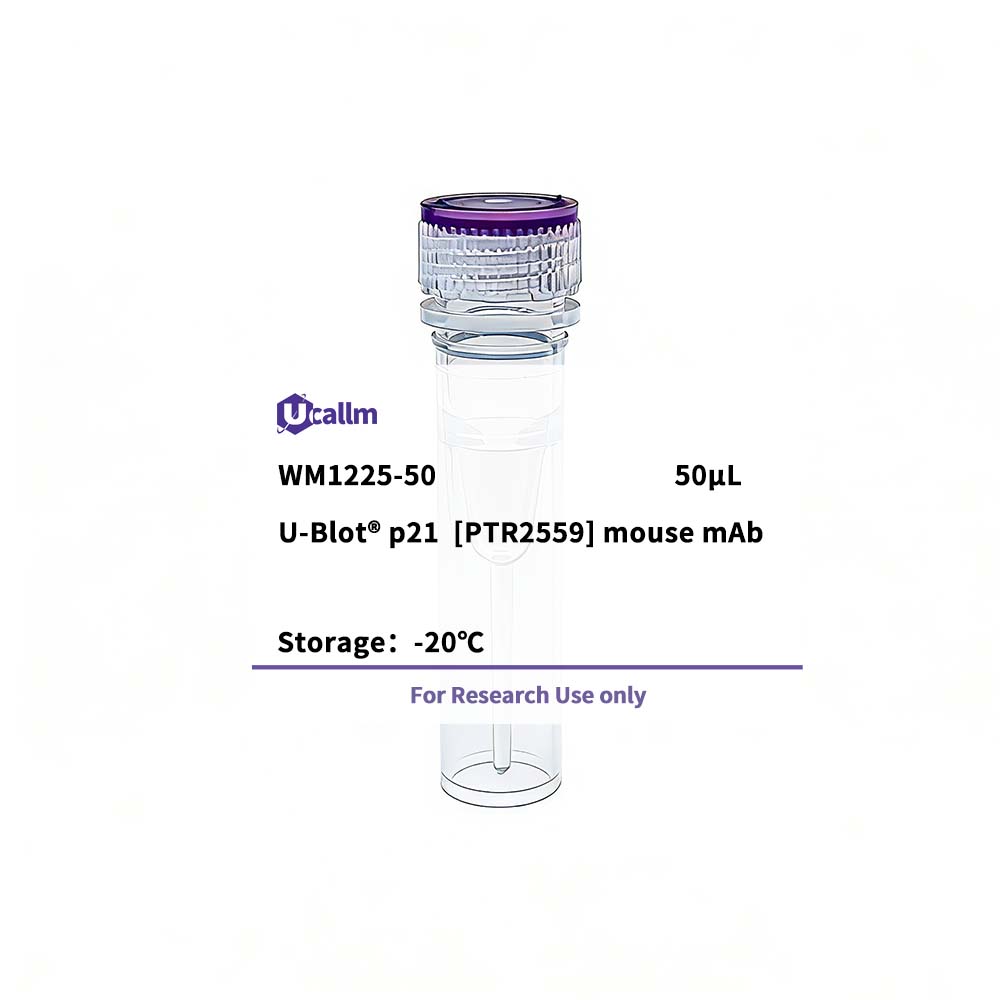
Specifications
| Size | 50μL/100μL |
| Target | p21 |
| Reactivity | Human, Mouse |
| Applications | IHC, WB, IF, ELISA |
| MW(Calculated) | 21kD |
| MW(Observed) | 21kD |
| Host Species | Mouse |
| Isotype | IgG1,Kappa |
| Conjugate/Modification | Unmodified |
| Recommended Dilution Ratio | IHC 1:200-1000; WB 1:500-2000; IF 1:100-500; ELISA 1:1000-5000 / Note: For IHC, we suggest antigen retrieval with TE buffer pH 9.0 (Cat#WT1004) |
| Formulation | PBS, 50% glycerol, 0.05% Proclin 300, 0.05%BSA |
| Purification | Recombinant Antibody expressed in animal component-free (ACF) media, purified via Protein G affinity chromatography. |
| Storage | -15°C to -25°C/1 year(Do not lower than -25°C) |
| Concentration | 1 mg/ml |
| Clonality | Monoclonal |
| Clone Number | RMMR2559 |
| Immunogen | Synthesized peptide derived from human p21 AA range: 1-100 |
| Specificity | This antibody detects endogenous levels of p21 protein. |
| Gene Name | CDKN1A CAP20 CDKN1 CIP1 MDA6 PIC1 SDI1 WAF1 |
| Protein Name | Cyclin-dependent kinase inhibitor 1 |
| Other Name | CDKN1A; / CAP20; / CDKN1; / CIP1; / MDA6; / PIC1; / SDI1; / WAF1; / Cyclin-dependent kinase inhibitor 1; / CDK-interacting protein 1; / Melanoma differentiation-associated protein 6; / MDA-6; / p21 |
| Species | Human |
| Gene ID | 1026 |
| Uniprot | P38936, |
| Species.1 | Mouse |
| Gene ID.1 | 12575 |
| Uniprot.1 | P39689 |
| Species.2 | |
| Gene ID.2 | |
| Uniprot.2 | |
| Cellular Localization | Cytoplasmic, Nuclear |
| Tissue Expression | Expressed in all adult tissues, with 5-fold lower levels observed in the brain. |
| Signaling_pathway | Cellular Processes >> Cell growth and death >> Cell cycle;Cellular Processes >> Cell growth and death >> p53 signaling pathway;Cellular Processes >> Cell growth and death >> Cellular senescence;Organismal Systems >> Endocrine system >> Oxytocin signaling pathway;Human Diseases >> Cancer: overview >> Pathways in cancer;Human Diseases >> Cancer: overview >> Transcriptional misregulation in cancer;Human Diseases >> Cancer: overview >> MicroRNAs in cancer;Human Diseases >> Cancer: specific types >> Colorectal cancer;Human Diseases >> Cancer: specific types >> Pancreatic cancer;Human Diseases >> Cancer: specific types >> Hepatocellular carcinoma;Human Diseases >> Cancer: specific types >> Gastric cancer;Human Diseases >> Cancer: specific types >> Glioma;Human Diseases >> Cancer: specific types >> Thyroid cancer;Human Diseases >> Cancer: specific types >> Chronic myeloid leukemia;Human Diseases >> Cancer: specific types >> Basal cell carcinoma;Human Diseases >> Cancer: specific types >> Melanoma;Human Diseases >> Cancer: specific types >> Renal cell carcinoma;Human Diseases >> Cancer: specific types >> Bladder cancer;Human Diseases >> Cancer: specific types >> Prostate cancer;Human Diseases >> Cancer: specific types >> Endometrial cancer;Human Diseases >> Cancer: specific types >> Breast cancer;Human Diseases >> Cancer: specific types >> Small cell lung cancer;Human Diseases >> Cancer: specific types >> Non-small cell lung cancer;Environmental Information Processing >> Signal transduction >> ErbB signaling pathway;Environmental Information Processing >> Signal transduction >> JAK-STAT signaling pathway;Environmental Information Processing >> Signal transduction >> HIF-1 signaling pathway;Environmental Information Processing >> Signal transduction >> FoxO signaling pathway;Environmental Information Processing >> Signal transduction >> PI3K-Akt signaling pathway |
| Research Areas | |
| Function | Function:May be the important intermediate by which p53 mediates its role as an inhibitor of cellular proliferation in response to DNA damage. Binds to and inhibits cyclin-dependent kinase activity, preventing phosphorylation of critical cyclin-dependent kinase substrates and blocking cell cycle progression.,induction:By p53, mezerein (antileukemic compound) and interferon beta.,PTM:Phosphorylation of Thr-145 by Akt or of Ser-146 by PKC impairs binding to PCNA.,similarity:Belongs to the CDI family.,tissue specificity:Expressed in all adult human tissues, with 5-fold lower levels observed in the brain., |




