SKU: WP4499 Categories: ,

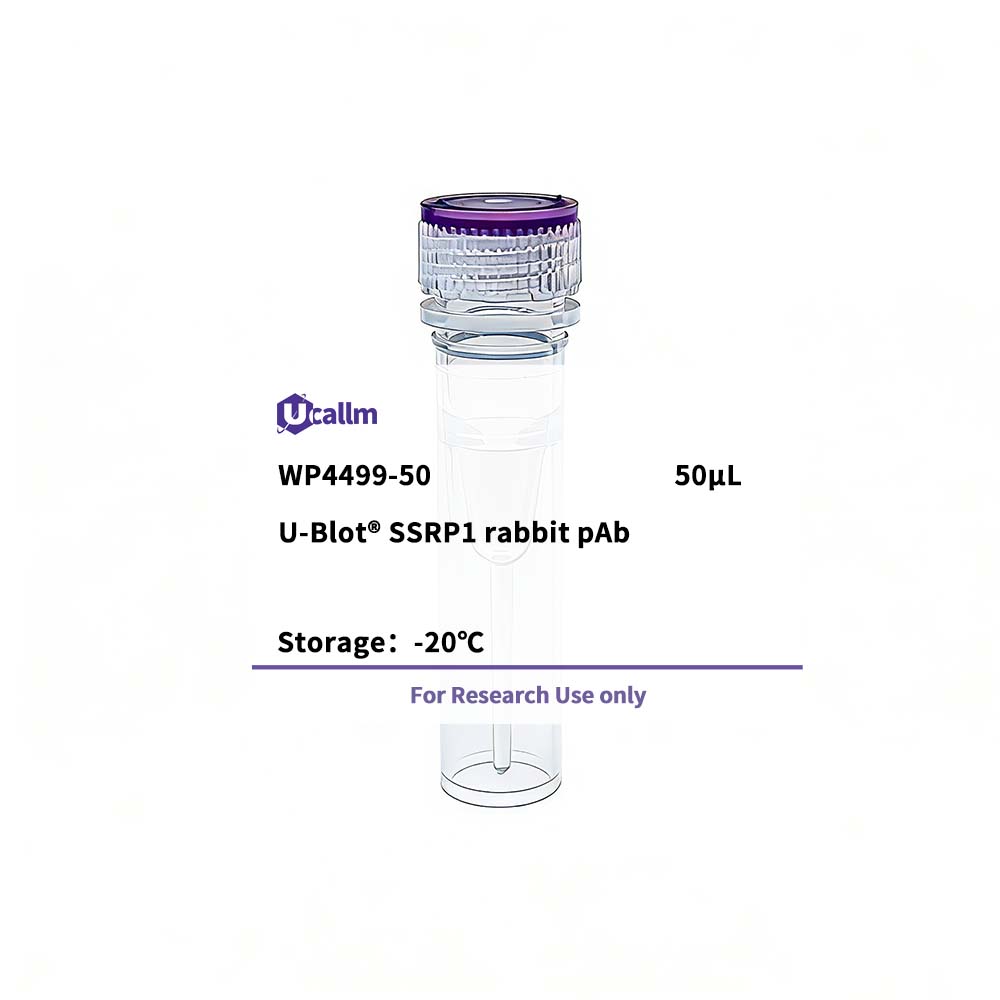
SSRP1 rabbit pAb

Price range: $268.00 through $328.00

SKU: WP4499-100
Enter the quantity you would like, or drag the panel to find the quantity and price that best for you
Bulk QuoteAuthorize OEM & ODM

Product details

Background:

The protein encoded by this gene is a subunit of a heterodimer that, along with SUPT16H, forms chromatin transcriptional elongation factor FACT. FACT interacts specifically with histones H2A/H2B to effect nucleosome disassembly and transcription elongation. FACT and cisplatin-damaged DNA may be crucial to the anticancer mechanism of cisplatin. This encoded protein contains a high mobility group box which most likely constitutes the structure recognition element for cisplatin-modified DNA. This protein also functions as a co-activator of the transcriptional activator p63. An alternatively spliced transcript variant of this gene has been described, but its full-length nature is not known. [provided by RefSeq, Jul 2008],

Specifications

Size50μL/100μL
TargetSSRP1
ReactivityHuman, Mouse, Rat
ApplicationsWB
MW(Calculated)78kD
MW(Observed)
Host SpeciesRabbit
IsotypeIgG
Conjugate/ModificationUnmodified
Recommended Dilution RatioWB 1:500-2000
FormulationLiquid in PBS containing 50% glycerol, 0.5% BSA and 0.02% sodium azide.
PurificationThe antibody was affinity-purified from rabbit antiserum by affinity-chromatography using epitope-specific immunogen.
Storage-15°C to -25°C/1 year(Do not lower than -25°C)
Concentration1 mg/ml
ClonalityPolyclonal
Clone Number
ImmunogenSynthesized peptide derived from human SSRP1 AA range: 209-259
SpecificityThis antibody detects endogenous levels of SSRP1 at Human/Mouse/Rat
Gene NameSSRP1 FACT80
Protein NameSSRP1
Other Name
SpeciesHuman
Gene ID6749
UniprotQ08945,
Species.1Mouse
Gene ID.120833
Uniprot.1Q08943,
Species.2Rat
Gene ID.281785
Uniprot.2Q04931
Cellular LocalizationNucleus . Nucleus, nucleolus . Chromosome . Colocalizes with RNA polymerase II on chromatin. Recruited to actively transcribed loci. .
Tissue Expression
Signaling_pathway
Research Areas
FunctionDomain:The HMG box DNA-binding domain mediates DNA-binding. It has both affinity and specificity for DNA damaged globally with cisplatin.,Function:Component of the FACT complex, a general chromatin factor that acts to reorganize nucleosomes. The FACT complex is involved in multiple processes that require DNA as a template such as mRNA elongation, DNA replication and DNA repair. During transcription elongation the FACT complex acts as a histone chaperone that both destabilizes and restores nucleosomal structure. It facilitates the passage of RNA polymerase II and transcription by promoting the dissociation of one histone H2A-H2B dimer from the nucleosome, then subsequently promotes the reestablishment of the nucleosome following the passage of RNA polymerase II. The FACT complex is probably also involved in phosphorylation of 'Ser-392' of p53/TP53 via its association with CK2 (casein kinase II). Binds specifically to double-stranded DNA and at low levels to DNA modified by the antitumor agent cisplatin. May potentiate cisplatin-induced cell death by blocking replication and repair of modified DNA. Also acts as a transcriptional coactivator for p63/TP63.,miscellaneous:Autoantibodies against SSRP1 are present in sera from patients with systemic lupus erythematosus, but not other rheumatic diseases.,PTM:Phosphorylated by CK2 following UV but not gamma irradiation. Phosphorylation inhibits its DNA-binding activity.,PTM:Sumoylated.,PTM:Ubiquitinated. Polyubiquitinated following caspase cleavage resulting in degradation of the N-terminal ubiquitinated part of the cleaved protein.,sequence Caution:Contaminating sequence. Potential poly-A sequence.,similarity:Belongs to the SSRP1 family.,similarity:Contains 1 HMG box DNA-binding domain.,subcellular location:Colocalizes with RNA polymerase II on chromatin. Recruited to actively transcribed loci.,subunit:Component of the FACT complex, a stable heterodimer of SSRP1 and SUPT16H. Also component of a CK2-SPT16-SSRP1 complex which forms following UV irradiation, composed of SSRP1, SUPT16H, CSNK2A1, CSNK2A2 and CSNK2B. Binds to histone H3-H4 tetramers, but not to intact nucleosomes. Interacts with isoform gamma of p63/TP63. Interacts with SRF and NEK9.,
Please login to post questions
Back to Top
Product has been added to your cart
