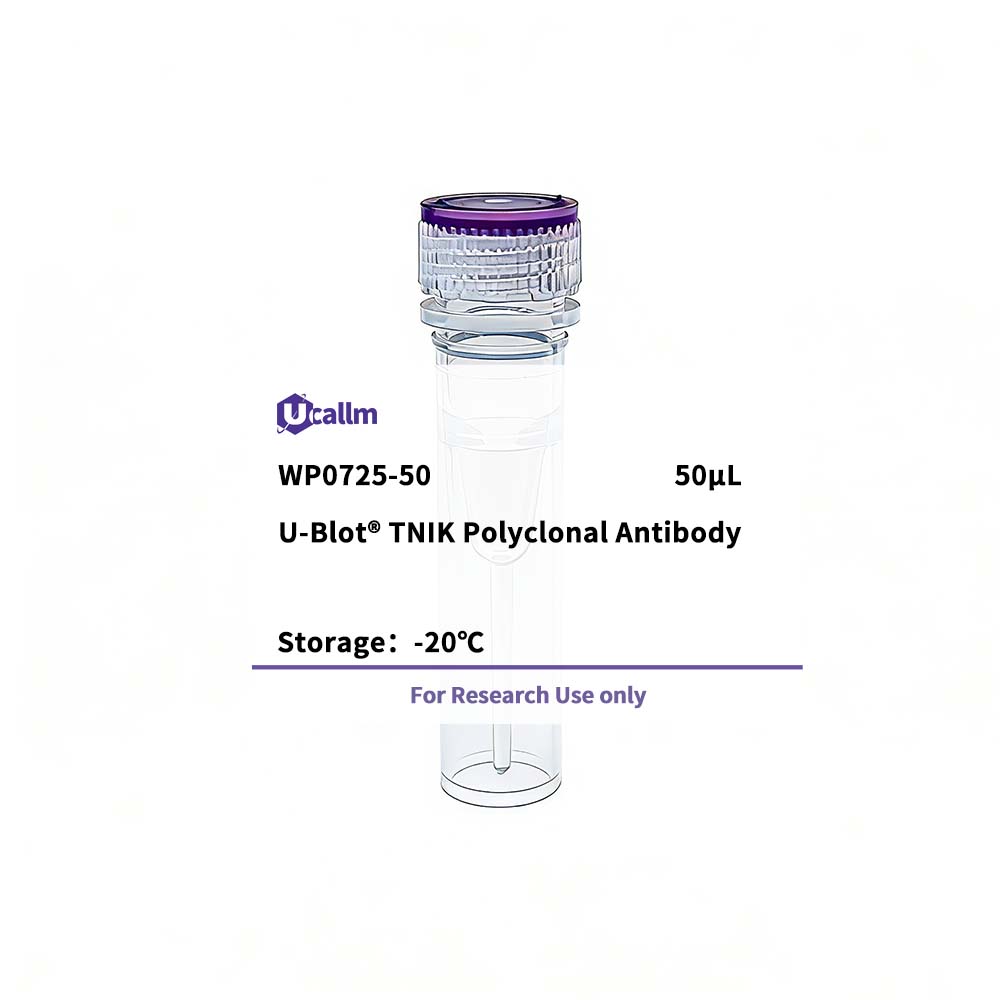
SKU: WP0725 Categories: ,

TNIK Polyclonal Antibody

Price range: $268.00 through $328.00

SKU: WP0725-100
Enter the quantity you would like, or drag the panel to find the quantity and price that best for you
Bulk QuoteAuthorize OEM & ODM

Product details

Background:

Germinal center kinases (GCKs), such as TNIK, are characterized by an N-terminal kinase domain and a C-terminal GCK domain that serves a regulatory function (Fu et al., 1999 [PubMed 10521462]).[supplied by OMIM, Mar 2008],


Specifications

Size50μL/100μL
TargetTNIK
ReactivityHuman, Mouse
ApplicationsWB, ELISA
MW(Calculated)
MW(Observed)149kD
Host SpeciesRabbit
IsotypeIgG
Conjugate/ModificationUnmodified
Recommended Dilution RatioWB 1:500-2000; ELISA 1:5000-20000
FormulationLiquid in PBS containing 50% glycerol,0.5% BSA and 0.02% sodium azide.
PurificationThe antibody was affinity-purified from rabbit antiserum by affinity-chromatography using epitope-specific immunogen.
Storage-15°C to -25°C/1 year(Do not lower than -25°C)
Concentration1 mg/ml
ClonalityPolyclonal
Clone Number
ImmunogenSynthesized peptide derived from human protein . at AA range: 350-430
SpecificityTNIK Polyclonal Antibody detects endogenous levels of protein.
Gene NameTNIK KIAA0551
Protein NameTRAF2 and NCK-interacting protein kinase (EC 2.7.11.1)
Other Name
SpeciesHuman
Gene ID23043
UniprotQ9UKE5,
Species.1Mouse
Gene ID.1
Uniprot.1P83510
Species.2
Gene ID.2
Uniprot.2
Cellular LocalizationNucleus. Cytoplasm. Recycling endosome. Cytoplasm, cytoskeleton. Associated with recycling endosomes and the cytoskeletal fraction upon RAP2A overexpression.
Tissue ExpressionExpressed ubiquitously. Highest levels observed in heart, brain and skeletal muscle. Expressed in normal colonic epithelia and colorectal cancer tissues.
Signaling_pathway
Research Areas
FunctionCatalytic activity:ATP + a protein = ADP + a phosphoprotein.,Function:Stress-activated serine/threonine kinase that may play a role in the response to environmental stress. Appears to act upstream of the JUN N-terminal pathway. May play a role in cytoskeletal regulation.,similarity:Belongs to the protein kinase superfamily. STE Ser/Thr protein kinase family. STE20 subfamily.,similarity:Contains 1 CNH domain.,similarity:Contains 1 protein kinase domain.,subunit:Interacts with TRAF2 and NCK.,tissue specificity:Expressed ubiquitously. Highest levels observed in heart, brain and skeletal muscle.,
Please login to post questions
Back to Top
Product has been added to your cart
