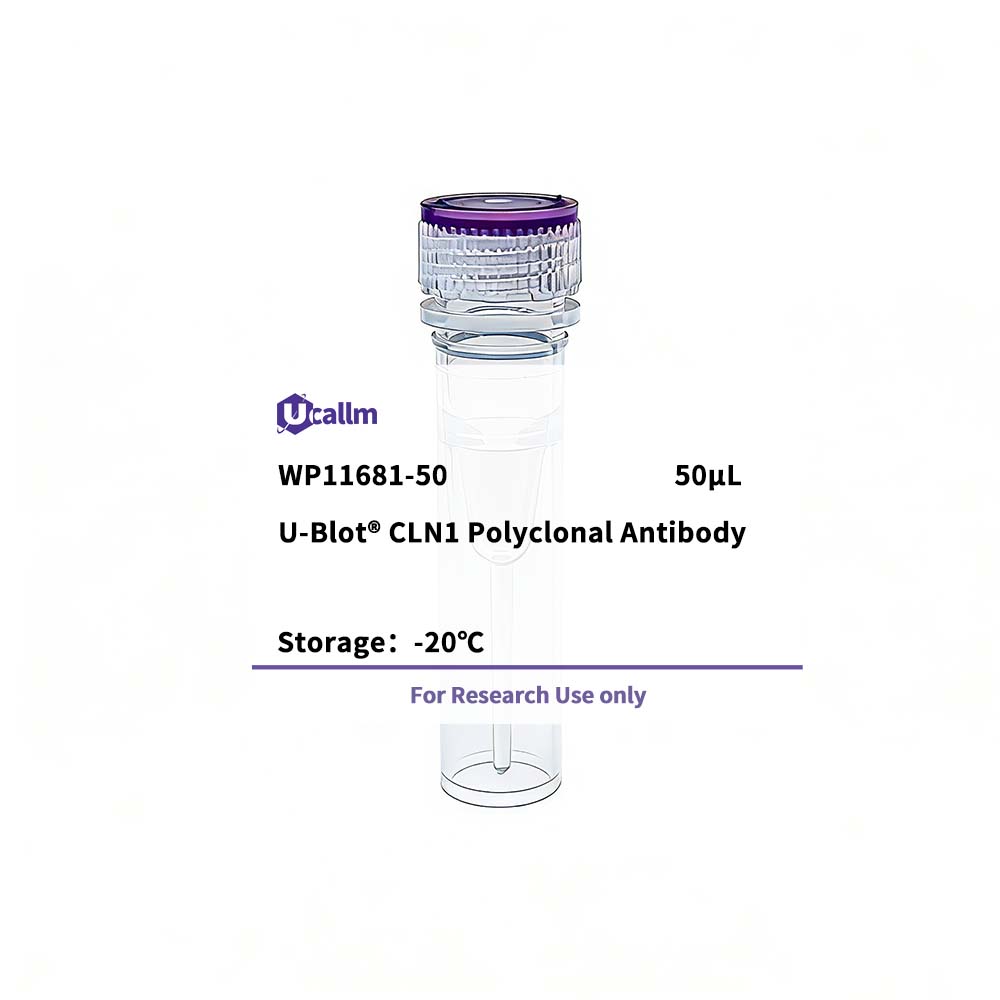
SKU: WP11681 Categories: ,

CLN1 Polyclonal Antibody

Price range: $268.00 through $328.00

SKU: WP11681-100
Enter the quantity you would like, or drag the panel to find the quantity and price that best for you
Bulk QuoteAuthorize OEM & ODM

Product details

Background:

The protein encoded by this gene is a small glycoprotein involved in the catabolism of lipid-modified proteins during lysosomal degradation. The encoded enzyme removes thioester-linked fatty acyl groups such as palmitate from cysteine residues. Defects in this gene are a cause of infantile neuronal ceroid lipofuscinosis 1 (CLN1, or INCL) and neuronal ceroid lipofuscinosis 4 (CLN4). Two transcript variants encoding different isoforms have been found for this gene.[provided by RefSeq, Dec 2008],


Specifications

Size50μL/100μL
TargetCLN1
ReactivityHuman, Mouse, Rat
ApplicationsIHC, IF, ELISA
MW(Calculated)
MW(Observed)37kD
Host SpeciesRabbit
IsotypeIgG
Conjugate/ModificationUnmodified
Recommended Dilution RatioIHC 1:100-1:300; ELISA 1:10000; IF 1:50-200 / Note: For IHC, we suggest antigen retrieval with TE buffer pH 9.0 (Cat#WT1004)
FormulationLiquid in PBS containing 50% glycerol, 0.5% BSA and 0.02% sodium azide.
PurificationThe antibody was affinity-purified from rabbit antiserum by affinity-chromatography using epitope-specific immunogen.
Storage-15°C to -25°C/1 year(Do not lower than -25°C)
Concentration1 mg/ml
ClonalityPolyclonal
Clone Number
ImmunogenThe antiserum was produced against synthesized peptide derived from human CLN1. AA range:16-65
SpecificityCLN1 Polyclonal Antibody detects endogenous levels of CLN1 protein.
Gene NamePPT1
Protein NamePalmitoyl-protein thioesterase 1
Other NamePPT1; / PPT; / Palmitoyl-protein thioesterase 1; / PPT-1; / Palmitoyl-protein hydrolase 1
SpeciesHuman
Gene ID5538
UniprotP50897,
Species.1Mouse
Gene ID.119063
Uniprot.1O88531,
Species.2Rat
Gene ID.229411
Uniprot.2P45479
Cellular LocalizationLysosome . Secreted .
Tissue ExpressionBrain,Cerebellum,Liver,Prostate,Testis,
Signaling_pathwayCellular Processes >> Transport and catabolism >> Lysosome
Research Areas>>Fatty acid elongation; / >>Metabolic pathways; / >>Fatty acid metabolism; / >>Lysosome
FunctionCatalytic activity:Palmitoyl-protein + H(2)O = palmitate + protein.,Disease:Defects in PPT1 are a cause of neuronal ceroid lipofuscinosis 4 (CLN4) [MIM:204300]; also known as adult type neuronal ceroid lipofuscinosis (NCL) or Kufs disease.,Disease:Defects in PPT1 are the cause of infantile neuronal ceroid lipofuscinosis 1 (CLN1) [MIM:256730]; also called infantile neuronal ceroid lipofuscinosis (INCL). The neuronal ceroid lipofuscinosis are a group of progressive neurodegenerative diseases characterized by the intracellular accumulation of autofluorescent lipopigment storage material in different patterns ultrastructurally. The lipopigment pattern seen most often in CLN1 is referred to as granular osmiophilic deposits (GROD). There is a core group of four major clinical forms, the infantile, the late-infantile, the juvenile, and the adult forms. The infantile forms are characterized by progressive visual impairment, seizure, motor disturbances, dementia and premature death (8-11 years of age).,Function:Removes thioester-linked fatty acyl groups such as palmitate from modified cysteine residues in proteins or peptides during lysosomal degradation. Prefers acyl chain lengths of 14 to 18 carbons.,online information:Neural Ceroid Lipofuscinoses mutation db,online information:Retina International's Scientific Newsletter,similarity:Belongs to the palmitoyl-protein thioesterase family.,
Please login to post questions
Back to Top
Product has been added to your cart

