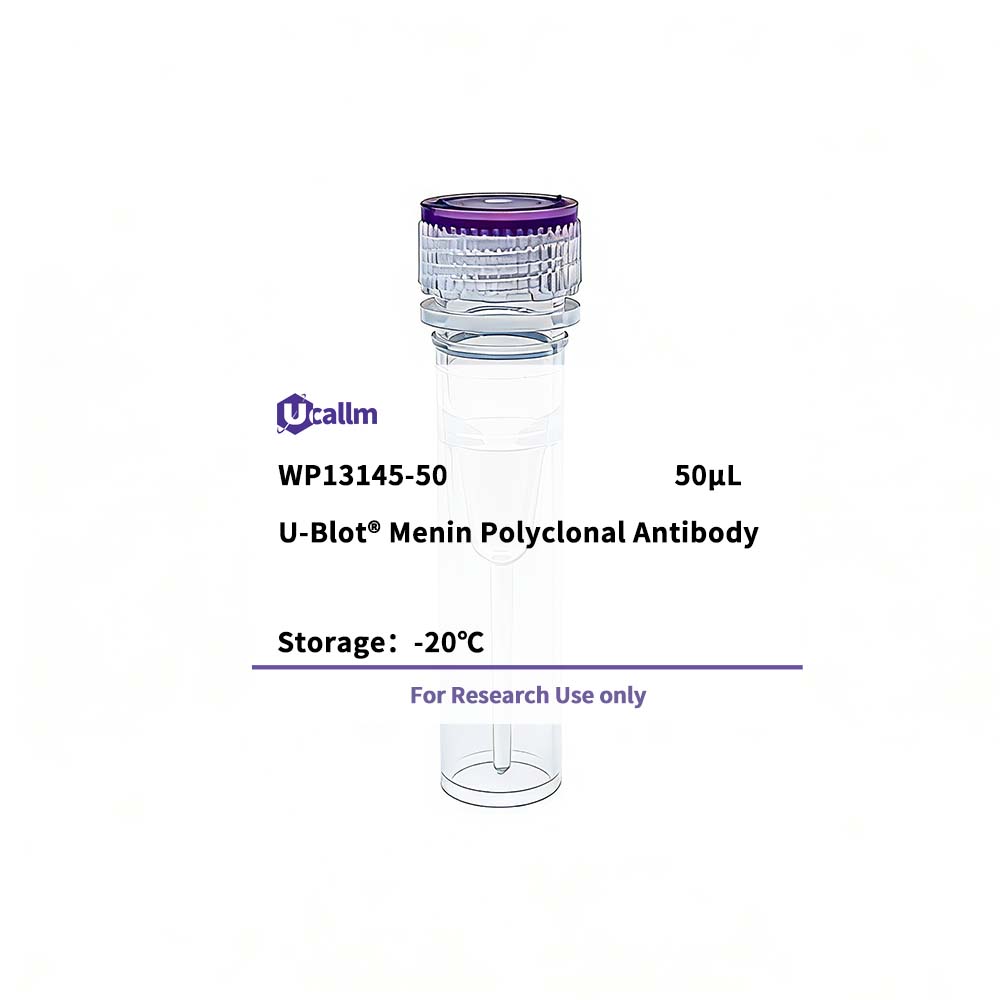
SKU: WP13145 Categories: ,

Menin Polyclonal Antibody

Price range: $268.00 through $328.00

SKU: WP13145-100
Enter the quantity you would like, or drag the panel to find the quantity and price that best for you
Bulk QuoteAuthorize OEM & ODM

Product details

Background:

This gene encodes menin, a putative tumor suppressor associated with a syndrome known as multiple endocrine neoplasia type 1. In vitro studies have shown menin is localized to the nucleus, possesses two functional nuclear localization signals, and inhibits transcriptional activation by JunD, however, the function of this protein is not known. Two messages have been detected on northern blots but the larger message has not been characterized. Alternative splicing results in multiple transcript variants. [provided by RefSeq, Oct 2008],


Specifications

Size50μL/100μL
TargetMenin
ReactivityHuman, Mouse, Rat
ApplicationsWB, IHC, IF, ELISA
MW(Calculated)
MW(Observed)67kD
Host SpeciesRabbit
IsotypeIgG
Conjugate/ModificationUnmodified
Recommended Dilution RatioWB 1:500-1:2000; IHC 1:100-1:300; ELISA 1:20000; IF 1:50-200 / Note: For IHC, we suggest antigen retrieval with TE buffer pH 9.0 (Cat#WT1004)
FormulationLiquid in PBS containing 50% glycerol, 0.5% BSA and 0.02% sodium azide.
PurificationThe antibody was affinity-purified from rabbit antiserum by affinity-chromatography using epitope-specific immunogen.
Storage-15°C to -25°C/1 year(Do not lower than -25°C)
Concentration1 mg/ml
ClonalityPolyclonal
Clone Number
ImmunogenThe antiserum was produced against synthesized peptide derived from human MEN1. AA range:181-230
SpecificityMenin Polyclonal Antibody detects endogenous levels of Menin protein.
Gene NameMEN1
Protein NameMenin
Other NameMEN1; / SCG2; / Menin
SpeciesHuman
Gene ID4221
UniprotO00255,
Species.1Mouse
Gene ID.117283
Uniprot.1O88559,
Species.2Rat
Gene ID.229417
Uniprot.2Q9WVR8
Cellular LocalizationNucleus . Concentrated in nuclear body-like structures. Relocates to the nuclear matrix upon gamma irradiation.
Tissue ExpressionUbiquitous.
Signaling_pathwayHuman Diseases >> Cancer: overview >> Transcriptional misregulation in cancer
Research Areas>>Cushing syndrome; / >>Transcriptional misregulation in cancer
FunctionDisease:Defects in MEN1 are the cause of familial isolated hyperparathyroidism (FIHP) [MIM:145000]; also known as hyperparathyroidism type 1 (HRPT1). FIHP is an autosomal dominant disorder characterized by hypercalcemia, elevated parathyroid hormone (PTH) levels, and uniglandular or multiglandular parathyroid tumors.,Disease:Defects in MEN1 are the cause of familial multiple endocrine neoplasia type I (MEN1) [MIM:131100]; an autosomal dominant disorder characterized by tumors of the parathyroid glands, gastro-intestinal endocrine tissue, the anterior pituitary and other tissues. Cutaneous lesions and nervous-tissue tumors can exist. Prognosis in MEN1 patients is related to hormonal hypersecretion by tumors, such as hypergastrinemia causing severe peptic ulcer disease (Zollinger-Ellison syndrome, ZES), primary hyperparathyroidism, and acute forms of hyperinsulinemia.,Function:May be involved in DNA repair.,PTM:Phosphorylated upon DNA damage, probably by ATM or ATR.,subcellular location:Concentrated in nuclear body-like structures. Relocates to the nuclear matrix upon gamma irradiation.,subunit:Interacts with FANCD2 and DBF4. Component of MLL-containing complexes (named MLL, ASCOM, MLL2/MLL3 or MLL3/MLL4 complex): at least composed ASH2L, RBBP5, DPY30, WDR5, one or several histone methyltransferases (MLL, MLL2, MLL3 and/or MLL4), and the facultative components MEN1, HCFC1, HCFC2, NCOA6, KDM6A, PAXIP1/PTIP and C16orf53/PA1.,tissue specificity:Ubiquitous.,
Please login to post questions
Back to Top
Product has been added to your cart


