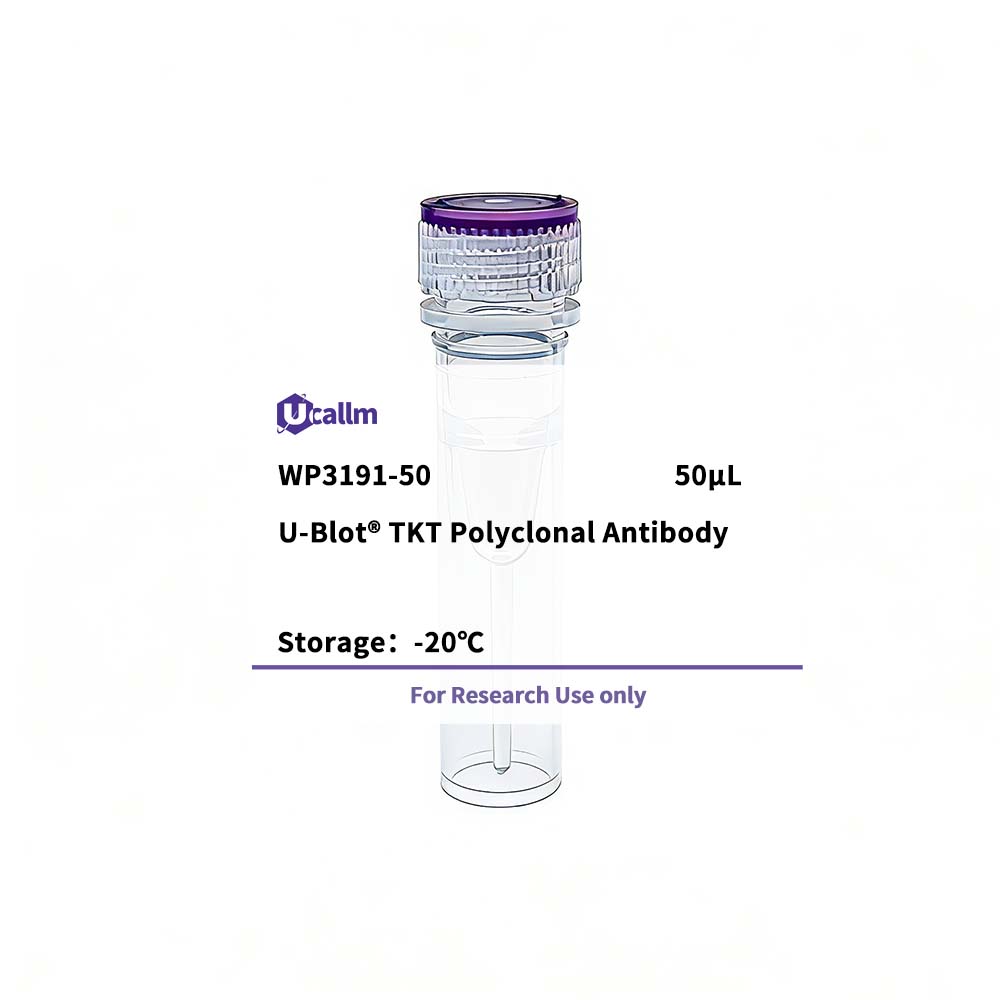
SKU: WP3191 Categories: ,

TKT Polyclonal Antibody

Price range: $268.00 through $328.00

SKU: WP3191-100
Enter the quantity you would like, or drag the panel to find the quantity and price that best for you
Bulk QuoteAuthorize OEM & ODM

Product details

Background:

This gene encodes a thiamine-dependent enzyme which plays a role in the channeling of excess sugar phosphates to glycolysis in the pentose phosphate pathway. Alternatively spliced transcript variants encoding multiple isoforms have been observed for this gene. [provided by RefSeq, Apr 2012],

Specifications

Size50μL/100μL
TargetTKT
ReactivityHuman, Mouse, Rat
ApplicationsWB, ELISA
MW(Calculated)
MW(Observed)68kD
Host SpeciesRabbit
IsotypeIgG
Conjugate/ModificationUnmodified
Recommended Dilution RatioWB 1:500-2000; ELISA 1:5000-20000
FormulationLiquid in PBS containing 50% glycerol,0.5% BSA and 0.02% sodium azide.
PurificationThe antibody was affinity-purified from rabbit antiserum by affinity-chromatography using epitope-specific immunogen.
Storage-15°C to -25°C/1 year(Do not lower than -25°C)
Concentration1 mg/ml
ClonalityPolyclonal
Clone Number
ImmunogenSynthesized peptide derived from part region of human protein AA range: 125-175
SpecificityTKT Polyclonal Antibody detects endogenous levels of protein.
Gene NameTKT
Protein NameTransketolase (TK) (EC 2.2.1.1)
Other Name
SpeciesHuman
Gene ID7086
UniprotP29401,
Species.1Mouse
Gene ID.1
Uniprot.1P40142,
Species.2Rat
Gene ID.2
Uniprot.2P50137
Cellular Localizationnucleus,nucleoplasm,peroxisome,cytosol,vesicle,myelin sheath,extracellular exosome,
Tissue ExpressionBrain,Epithelium,Human uterus,Kidney,Liver,Lymph,Platelet,Thymus,
Signaling_pathway
Research Areas>>Pentose phosphate pathway; / >>Metabolic pathways; / >>Carbon metabolism; / >>Biosynthesis of amino acids
FunctionCatalytic activity:Sedoheptulose 7-phosphate + D-glyceraldehyde 3-phosphate = D-ribose 5-phosphate + D-xylulose 5-phosphate.,cofactor:Binds 1 calcium ion per subunit.,cofactor:Binds 1 thiamine pyrophosphate per subunit.,Disease:Has been implicated in the latent genetic disease Wernicke-Korsakoff syndrome (WKS) [MIM:277730]. WKS causes specific brain damage.,online information:Transketolase entry,similarity:Belongs to the transketolase family.,subunit:Homodimer.,
Please login to post questions
Back to Top
Product has been added to your cart