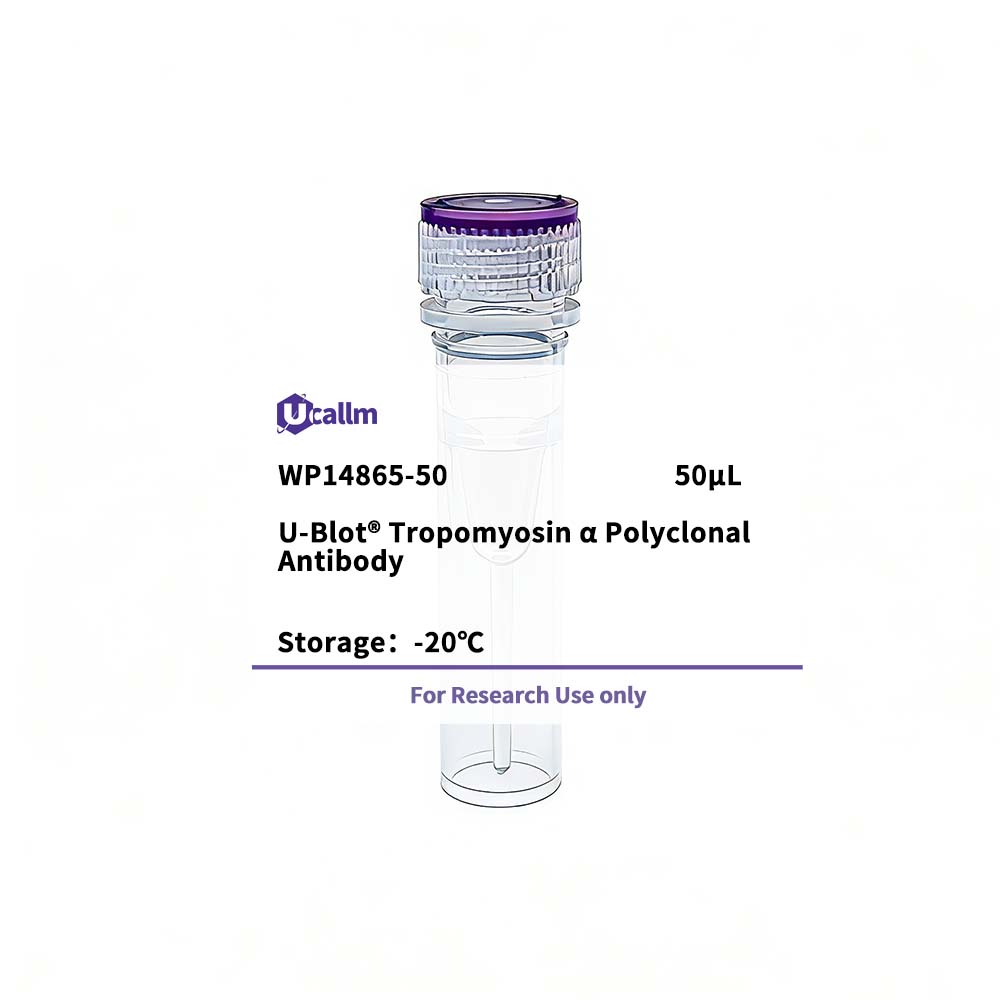
SKU: WP14865 Categories: ,

Tropomyosin α Polyclonal Antibody

Price range: $268.00 through $328.00

SKU: WP14865-100
Enter the quantity you would like, or drag the panel to find the quantity and price that best for you
Bulk QuoteAuthorize OEM & ODM

Product details

Background:

This gene is a member of the tropomyosin family of highly conserved, widely distributed actin-binding proteins involved in the contractile system of striated and smooth muscles and the cytoskeleton of non-muscle cells. Tropomyosin is composed of two alpha-helical chains arranged as a coiled-coil. It is polymerized end to end along the two grooves of actin filaments and provides stability to the filaments. The encoded protein is one type of alpha helical chain that forms the predominant tropomyosin of striated muscle, where it also functions in association with the troponin complex to regulate the calcium-dependent interaction of actin and myosin during muscle contraction. In smooth muscle and non-muscle cells, alternatively spliced transcript variants encoding a range of isoforms have been described. Mutations in this gene are associated with type 3 familial hypertrophic cardiomyopathy. [provided by

Specifications

Size50μL/100μL
TargetTropomyosin α
ReactivityHuman, Mouse, Rat
ApplicationsWB, ELISA
MW(Calculated)
MW(Observed)35kD
Host SpeciesRabbit
IsotypeIgG
Conjugate/ModificationUnmodified
Recommended Dilution RatioWB 1:500-1:2000; ELISA 1:10000; Not yet tested in other applications.
FormulationLiquid in PBS containing 50% glycerol, 0.5% BSA and 0.02% sodium azide.
PurificationThe antibody was affinity-purified from rabbit antiserum by affinity-chromatography using epitope-specific immunogen.
Storage-15°C to -25°C/1 year(Do not lower than -25°C)
Concentration1 mg/ml
ClonalityPolyclonal
Clone Number
ImmunogenThe antiserum was produced against synthesized peptide derived from human Tropomyosin alpha. AA range:40-89
SpecificityTropomyosin α Polyclonal Antibody detects endogenous levels of Tropomyosin α protein.
Gene NameTPM1
Protein NameTropomyosin alpha-1 chain
Other NameTPM1; / C15orf13; / TMSA; / Tropomyosin alpha-1 chain; / Alpha-tropomyosin; / Tropomyosin-1
SpeciesHuman
Gene ID7168
UniprotP09493,
Species.1Mouse
Gene ID.122003
Uniprot.1P58771,
Species.2Rat
Gene ID.224851
Uniprot.2P04692
Cellular LocalizationCytoplasm, cytoskeleton . Associates with F-actin stress fibers. .
Tissue ExpressionDetected in primary breast cancer tissues but undetectable in normal breast tissues in Sudanese patients. Isoform 1 is expressed in adult and fetal skeletal muscle and cardiac tissues, with higher expression levels in the cardiac tissues. Isoform 10 is expressed in adult and fetal cardiac tissues, but not in skeletal muscle.
Signaling_pathwayOrganismal Systems >> Circulatory system >> Cardiac muscle contraction;Organismal Systems >> Circulatory system >> Adrenergic signaling in cardiomyocytes;Human Diseases >> Cancer: overview >> MicroRNAs in cancer
Research Areas>>Cardiac muscle contraction; / >>Adrenergic signaling in cardiomyocytes; / >>MicroRNAs in cancer; / >>Hypertrophic cardiomyopathy; / >>Dilated cardiomyopathy
FunctionAlternative products:Additional isoforms seem to exist,Disease:Defects in TPM1 are the cause of cardiomyopathy dilated type 1Y (CMD1Y) [MIM:611878]. Dilated cardiomyopathy is a disorder characterized by ventricular dilation and impaired systolic function, resulting in congestive heart failure and arrhythmia. Patients are at risk of premature death.,Disease:Defects in TPM1 are the cause of cardiomyopathy familial hypertrophic type 3 (CMH3) [MIM:115196]. Familial hypertrophic cardiomyopathy is a hereditary heart disorder characterized by ventricular hypertrophy, which is usually asymmetric and often involves the interventricular septum. The symptoms include dyspnea, syncope, collapse, palpitations, and chest pain. They can be readily provoked by exercise. The disorder has inter- and intrafamilial variability ranging from benign to malignant forms with high risk of cardiac failure and sudden cardiac death.,Domain:The molecule is in a coiled coil structure that is formed by 2 polypeptide chains. The sequence exhibits a prominent seven-residues periodicity.,Function:Binds to actin filaments in muscle and non-muscle cells. Plays a central role, in association with the troponin complex, in the calcium dependent regulation of vertebrate striated muscle contraction. Smooth muscle contraction is regulated by interaction with caldesmon. In non-muscle cells is implicated in stabilizing cytoskeleton actin filaments.,mass spectrometry: PubMed:11840567,similarity:Belongs to the tropomyosin family.,subunit:Heterodimer of an alpha and a beta chain.,tissue specificity:Detected in primary breast cancer tissues but undetectable in normal breast tissues in Sudanese patients. Isoform 1 is expressed in adult and fetal skeletal muscle and cardiac tissues, with higher expression levels in the cardiac tissues. Isoform 10 is expressed in adult and fetal cardiac tissues, but not in skeletal muscle.,
Please login to post questions
Back to Top
Product has been added to your cart